
Attachment styles are ways people tend to think, feel, and behave in close relationships. You may have heard the term on social media, in therapy conversations, or when friends talk about relationship patterns. This guide explains what attachment styles mean, where they come from, and how the four commonly described styles differ, using clear language and practical examples. The goal is to give a friendly, evidence-aware introduction for readers new to the idea.

What Does Attachment Style Mean?
A simple explanation
An attachment style describes a reliable pattern in how someone connects with others emotionally. It is not a label of good or bad. Instead, it is a way to describe tendencies, such as whether a person is comfortable relying on others, worries about being abandoned, or prefers to keep emotional distance. The American Psychological Association provides definitions and background for psychological terms like this, which can help when you want a concise description of the concept and its use in psychology.
For a related next step, see this guide to the signs of anxious attachment.
In everyday terms, attachment style is a short way to say, “This is how I usually respond when someone I care about gets close, needs me, or seems distant.” Those responses develop over time and become familiar habits in relationships.
Why attachment style affects how people connect
Attachment patterns shape expectations about relationships. If someone expects others to be supportive and available, they tend to approach closeness differently than someone who expects inconsistency or rejection. These expectations influence emotional responses, behavior during conflict, and how comfortable a person feels asking for help or offering it.
Attachment-related expectations are often automatic. That means people may react before they have time to think, which can make relationship patterns feel hard to change. Recognizing the pattern is the first step to responding differently when it matters.
For a related next step, see this guide to understanding an attachment style test.
For a related next step, see this guide to the signs of avoidant attachment.
For a related next step, see this guide to the disorganized attachment style.
For a related next step, see this guide to the secure attachment style.
For a related next step, see this guide to the avoidant attachment style.
For a related next step, see this guide to the anxious attachment style.
Why it often shows up in close relationships
Close relationships activate strong emotions and needs. Because attachment styles are about how we handle needs for comfort, safety, and connection, those relationships act like a mirror. Small events that would be minor with acquaintances can feel intense with someone important, and those moments reveal attachment tendencies.
For example, an argument with a partner or a sudden delay in a message can trigger worry, withdrawal, or calm problem solving, depending on attachment tendencies. Over time, these repeated reactions shape the relationship itself, reinforcing certain patterns.
Where Do Attachment Styles Come From?
Early emotional bonds
Attachment ideas originally come from research on how infants respond to caregiving. Early emotional bonds with caregivers help children learn whether the world is a safe place to seek comfort. Those early experiences are influential because they are primary sources of social and emotional learning in childhood.
Descriptions of how close relationships form and how early bonds matter are included in psychology resources that summarize established ideas about development and relationships. These resources emphasize that early caregiving provides a template for later expectations about closeness and safety.
Caregiver consistency and emotional safety
Two factors that often shape early attachment are consistency and emotional safety. When a caregiver reliably meets a child’s needs and responds with calm, sensitive care, the child learns that support is available. When care is inconsistent, frightening, or emotionally distant, a child may develop patterns such as heightened worry or avoidance.
Consistency does not require perfection. It means predictable availability and responses that generally help a child feel soothed and understood. Emotional safety means the child learns their feelings matter and that seeking comfort is okay.
How early patterns can become adult habits
Early interaction patterns can become familiar habits because they guide expectations and emotion regulation. As children grow, these patterns influence how they manage stress, what they expect from friends and partners, and which coping styles feel natural. Without new experiences or reflection, those early templates can continue into adulthood.
That said, habits are not destiny. New relationships, learning, therapy, and intentional practice can shift how a person responds in relationships. Understanding the origin of a pattern helps explain why it feels automatic and how change can be built step by step.
The 4 Attachment Styles Explained Simply
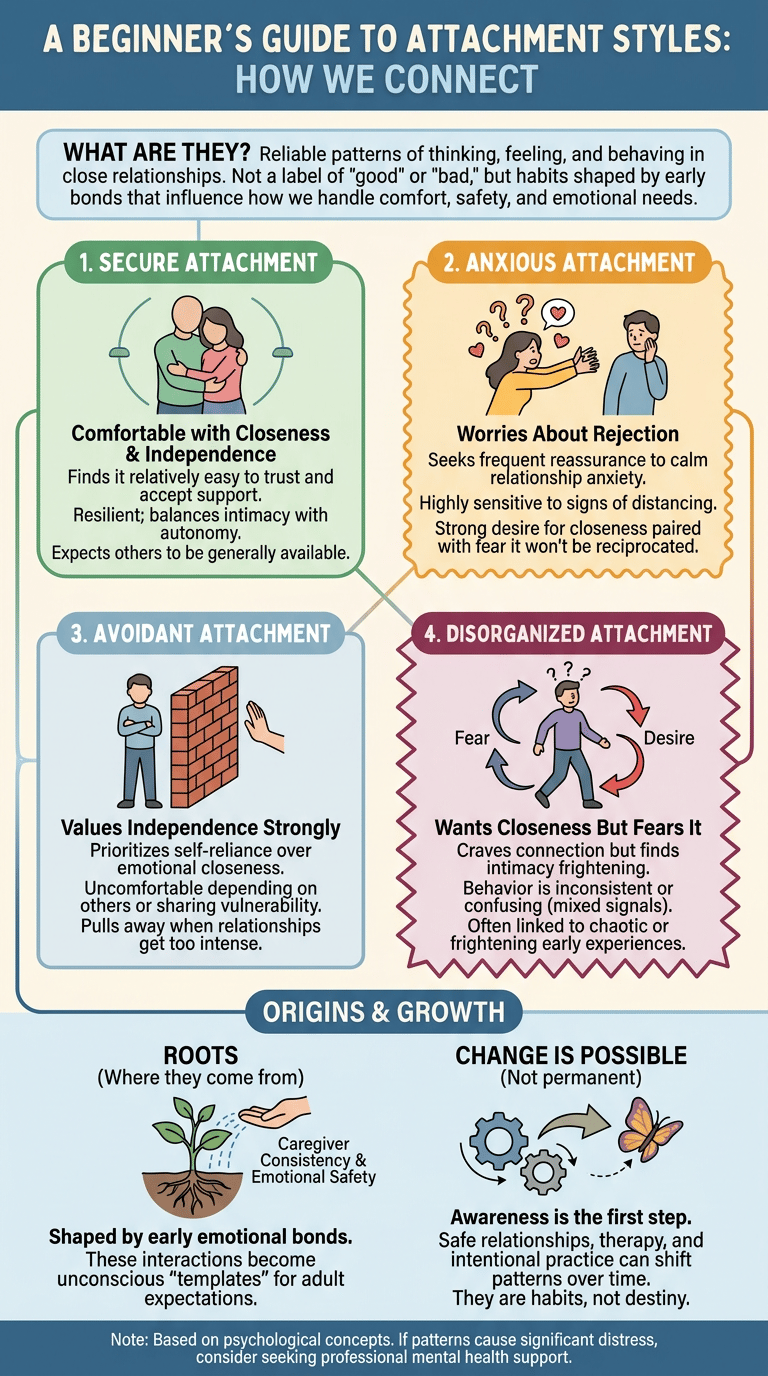
Secure attachment
- Comfortable with closeness
People with secure patterns tend to feel comfortable being close to others. They find it relatively easy to trust, to accept support, and to express affection without a strong fear of being abandoned.
- Comfortable with independence
At the same time, securely attached people can rely on themselves and accept independence in relationships. They balance closeness and autonomy, which helps during times when partners or friends need space.
Secure attachment reflects a general confidence that others can provide support when needed and that relationships can handle stress. Secure patterns do not mean perfect communication or zero conflict. Rather, they describe a resilient tendency to repair and maintain closeness after difficulties.
Anxious attachment
- Worries about rejection
People with anxious tendencies often worry that close others might not be as available or invested as they are. Those worries can lead to heightened vigilance for signs of distancing or rejection.
- Seeks reassurance
Anxious patterns often involve seeking frequent reassurance about a partner’s feelings, wanting closeness to reduce worry, and feeling distressed when contact is limited. This behavior is usually an attempt to manage unease about the relationship.
Anxious attachment reflects a strong desire for closeness paired with concern about whether that closeness will be reciprocated. Learning ways to manage anxiety and to communicate needs clearly can reduce the cycle of worry and reassurance-seeking.
Avoidant attachment
- Values independence strongly
People with avoidant tendencies often value self-reliance and may prioritize independence over emotional closeness. They may prefer to solve problems alone and feel uncomfortable relying on others.
- Pulls away from emotional closeness
In relationships, avoidant patterns can show up as emotional distance, reluctance to share vulnerable feelings, or minimizing the importance of relationship stress. This is usually a strategy to manage discomfort with dependency.
Avoidant behavior is not about being unkind. It is often a protective habit formed when relying on others felt unsafe or disappointing. When someone learns to tolerate dependence gradually, they can expand their comfort with closeness.
Disorganized attachment
- Wants closeness but fears it
Disorganized patterns combine contradictory desires: craving connection while also fearing it. This may lead to confusion in how a person approaches intimacy and to mixed signals during emotional moments.
- May act inconsistently in relationships
People with disorganized tendencies can behave unpredictably in relationships, sometimes reaching for closeness and at other times withdrawing or appearing frightened by intimacy. This inconsistency often reflects internal conflict about safety and trust.
Disorganized patterns are often linked to early experiences that were frightening, confusing, or chaotic. These patterns can be distressing for the person and for their partners, but with supportive help and predictable relationships, people can learn more coherent ways to relate.
Why Knowing Your Attachment Style Can Help
It helps you understand emotional reactions
Labeling a pattern can make responses feel less mysterious and more manageable. When you notice that a particular reaction tends to arise in certain situations, it becomes easier to pause, reflect, and choose how to respond instead of reacting automatically.
For example, recognizing that you habitually withdraw under stress can help you plan small, concrete steps to stay connected, or to communicate that you need space without leaving your partner unsure.
It helps you notice relationship patterns
Attachment language provides a shared vocabulary to describe how relationships usually unfold. Instead of saying “my partner makes me crazy,” you can say, “I notice I feel anxious when we go a day without talking,” which opens the door to practical adjustments and joint problem solving.
Seeing patterns also helps break cycles. If a partner’s avoidance triggers your anxiety, knowing those tendencies invites a deliberate conversation rather than repeated conflict driven by unexamined reactions.
It helps you communicate needs more clearly
Understanding your tendencies can guide clearer requests. For instance, if you learn that reassurance calms your anxiety, you can explain that to a partner in specific terms like, “When I feel uncertain, a short message helps me feel connected.” Specific requests are easier to respond to than vague complaints.
Clear communication reduces misinterpretation and increases the likelihood that both people will feel heard and cared for.
Is Your Attachment Style Permanent?
Attachment styles can change
Attachment tendencies are influenced by experience and can shift across a lifespan. New relationships that feel reliably safe, therapy that teaches emotional regulation, and deliberate practice in communication can all support change. The pattern is not a fixed diagnosis; it is a way of describing how you are likely to respond now, not for all time.
Awareness is the first step
Recognizing a pattern gives you more choices. Awareness helps create a space between feeling and action, so you can test different responses safely. Many people find that simply noticing when an old habit is operating gives them new opportunities to respond differently.
Practical steps include paying attention to triggers, journaling about relationship reactions, and practicing small behavioral experiments such as asking for a specific response or giving clear signals when you need a break.
Healthy relationships can support change
Relationships that offer consistent emotional safety help people develop more secure ways of connecting. When a partner responds reliably, when boundaries are respected, and when communication is clear, old patterns can relax and new patterns can grow.
If worries, avoidance, or unpredictable reactions are severe, long-standing, or interfere with daily life, it can be helpful to seek support from a qualified mental health professional. Trusted mental health resources provide information about how to find care and what to expect from therapy and related services, which can guide decisions about next steps. For trustworthy information about mental health care options and when to seek help, see the National Institute of Mental Health.
Final Summary
Attachment styles are straightforward labels that describe how people tend to connect with others emotionally. They emerge from early relationships and repeated experiences, and they shape expectations, feelings, and behavior in close relationships. The four common styles are secure, anxious, avoidant, and disorganized, each describing a different pattern of comfort with closeness and independence.
Knowing your attachment tendencies is not about blaming yourself or others. It is a tool for understanding patterns, improving communication, and making intentional choices about how you relate.
If relationship patterns cause distress or interfere with daily functioning, consider reaching out to a qualified mental health professional for personalized support. For general definitions and overviews of psychological terms, the APA Dictionary of Psychology is a helpful reference. For information about mental health care and when to seek professional help, consult the National Institute of Mental Health.

Michael Reed is the Founder and Lead Writer at Psychology Exposed. He writes about human behavior, relationships, emotional patterns, self-awareness, and practical psychology topics using research-informed, easy-to-understand content.
Read More About Michael Reed: https://psychologyexposed.com/michael-reed/