
What does anxious attachment look like?
Quick definition
Anxious attachment is an attachment pattern that appears in adult relationships as a strong sensitivity to perceived threats to closeness or connection. People with this pattern often respond to separation, uncertainty, or perceived distance with heightened worry, efforts to regain closeness, and mental preoccupation about the relationship. For a clear clinical overview and checklist-style description of these core signs, see the Cleveland Clinic’s overview of anxious attachment styles for accessible examples.

Why anxious attachment often feels like relationship fear
Anxious attachment is centered on fear related to closeness rather than a generalized fear unrelated to relationships. That fear tends to surface around situations that signal possible rejection, abandonment, or distancing. Because attachment concerns involve expected responses from others, the experience is often intense and focused on relationship scenarios such as someone being emotionally unavailable, delayed in responding, or pulling back. Research on attachment-related emotion regulation describes these reactions as patterns of hyperactivation, rumination, and proximity-seeking, which helps explain why anxious attachment commonly feels like a cycle of fear and attempts to reconnect. A peer-reviewed review on attachment, emotion regulation, and defense strategies provides an overview of these processes and how they influence thoughts and behaviors in relationships in greater detail.
Why signs can vary from person to person
Not everyone with anxious attachment presents the same way. Differences in childhood experiences, adult relationship histories, cultural expectations, and current stressors shape how strongly and in which situations signs appear. Some people express anxiety outwardly with frequent pleas for reassurance, while others internalize worry and become preoccupied without directly asking for contact. Attachment-related behaviors interact with personality, communication styles, and partners’ responses, so the pattern can look different across relationships and over time. For research on how anxious attachment shapes romantic interaction patterns specifically, see a review that examines attachment anxiety in relationship processes from an interactionist perspective.
Emotional signs of anxious attachment
Fear of abandonment
One common emotional sign is persistent worry that a partner or close person will leave, stop caring, or choose someone else. This fear can be triggered by actual separation or by small cues that are interpreted as threats. The worry tends to feel urgent and personally painful, often prompting immediate emotional reactions aimed at re-establishing connection.
Feeling unsafe when someone pulls away
When a close person becomes less available emotionally or physically, people with anxious attachment frequently feel unsafe or unsettled rather than simply disappointed. That feeling may be accompanied by increased vigilance for signs of further distancing and a strong desire to restore closeness quickly.
Strong anxiety after conflict
Arguments or misunderstandings often create more than temporary upset. After conflict, anxious attachment can show up as prolonged rumination, worry about the relationship’s future, or heightened emotional reactivity. The emotional response tends to persist until reassurance or connection is restored, which reinforces a cycle of dependence on external signals for emotional calm.
Emotional dependence on reassurance
Needing reassurance from others to feel emotionally secure is another typical sign. This can include seeking repeated confirmation that a partner cares, is committed, or will not leave. While reassurance can be comforting in the short term, frequent reliance on others for emotional stability can maintain anxiety in the long run.
Thinking patterns of anxious attachment
Overanalyzing messages
People with anxious attachment often spend a lot of mental energy interpreting texts, emails, or brief interactions. A delayed reply or a short message may be parsed for hidden meanings, motives, or evidence of rejection. This pattern of overanalysis is a cognitive habit that fuels emotional arousal and often leads to misinterpretation.
Assuming silence means rejection
Silence or decreased communication is frequently taken as evidence of rejection or loss of interest. Rather than seeing silence as neutral or context-dependent, it is interpreted through an attachment-colored lens that assumes the worst. This assumption can produce escalated worry and behaviors intended to repair the perceived rupture.
Imagining worst-case scenarios
The mind may quickly generate worst-case scenarios about the relationship’s future, the partner’s feelings, or one’s own worth. This pattern of catastrophizing increases emotional intensity and can make calm problem-solving harder. Clinical and theoretical reviews link these tendencies to rumination and hypervigilance associated with anxious attachment strategies in the attachment literature.
Comparing yourself to others
Frequent comparisons with others in the context of romantic or social relationships are common. These comparisons often focus on perceived deficits, imagining that others are more attractive, more secure, or more deserving of a partner’s attention. Habitual comparison increases insecurity and can reinforce the belief that one must compete for closeness.
Behavioral signs of anxious attachment
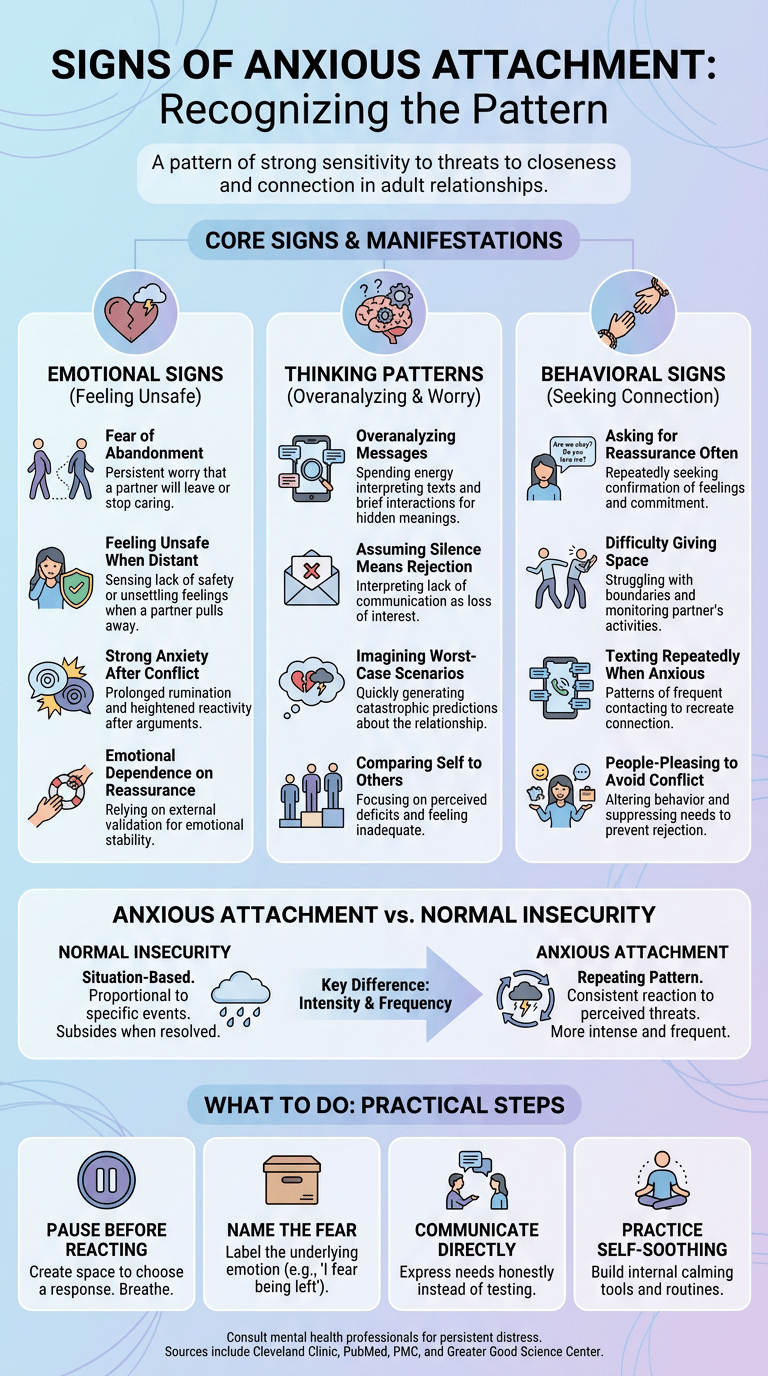
Asking for reassurance often
Repeatedly asking for confirmation about a partner’s feelings, plans, or commitment is a visible behavioral sign. Reassurance-seeking can occur through questions, tests, or seeking frequent expressions of affection. While reassurance can temporarily reduce distress, relying on it repeatedly can keep anxiety activated.
Difficulty giving space
Maintaining healthy boundaries and giving a partner room can be difficult. When another person requests space, the common response may be to increase contact attempts, monitor the partner’s activities, or interpret the request as a sign of rejection. This difficulty with distance is linked to the core attachment concern of losing connection.
Texting repeatedly when anxious
Patterns of repeated texting, calling, or checking for responses are common behavioral signs. These actions are attempts to recreate contact and reduce uncertainty. While they may bring short-term relief, they can also escalate tension in the relationship if the other person feels pressured or overwhelmed.
People-pleasing to prevent rejection
Altering behavior to avoid conflict or to keep someone close, including excessive accommodation or suppressing one’s needs, can indicate anxious attachment. People-pleasing may serve as a strategy to minimize perceived threats to the relationship, but it can erode authenticity and long-term satisfaction.
For broader context, see this guide to attachment styles in psychology.
Signs in romantic relationships
Feeling triggered by delayed replies
Delayed messages or uneven responsiveness commonly trigger strong emotional reactions. Even short delays may generate worry about the partner’s interest or faithfulness. Research on anxious attachment in romantic relationships highlights how responsiveness and communication patterns can interact with attachment anxiety to create recurring cycles of reactivity in relationship contexts.
Becoming anxious when plans change
Unexpected changes to plans or last-minute adjustments can feel threatening rather than merely inconvenient. The emotional meaning attached to change is often related to fears about reliability, priority, and how much one matters to the partner.
Needing constant confirmation of love
Frequent requests for verbal or behavioral signs of love, commitment, or priority are common. This need for continuous confirmation is an effort to maintain emotional equilibrium by repeatedly checking that closeness remains intact.
Feeling jealous or replaced easily
Jealousy and worries about being replaced by someone else can arise quickly and intensely. Those feelings are often less about concrete evidence and more about the attachment system perceiving threats to availability. Such reactions can be self-reinforcing if they lead to behaviors that increase relationship tension.
Anxious attachment versus normal insecurity
Normal insecurity is situation-based
It is normal to feel insecure occasionally in response to specific events, such as a real breach of trust, a clear pattern of unavailability, or major life changes. These situational insecurities are typically proportional to the event and tend to subside as the situation changes or is resolved.
Anxious attachment is a repeating pattern
Anxious attachment differs in that similar patterns of heightened worry and proximity-seeking recur across relationships and time. Rather than being limited to a particular incident, the pattern reflects a consistent way of responding to perceived threats to closeness, often shaped by earlier relational experiences and reinforced by current interactions. This repeating nature is discussed in reviews of attachment strategies and emotion regulation as a stable pattern influencing thoughts, feelings, and behavior in the literature.
The key difference is intensity and frequency
The core differences to notice are how intense the reactions are and how often they occur. When anxiety is frequent, disproportionate to events, and leads to repeated requests for reassurance or protective behaviors, it is more likely to reflect an attachment pattern rather than an isolated bout of insecurity.
What to do if you recognize these signs
Pause before reacting
When anxious feelings start to rise, a short pause can create space to choose a response rather than reacting automatically. Simple grounding steps like taking a few slow breaths, briefly stepping away from the situation, or counting to ten can reduce immediate reactivity and make room for calmer communication.
Name the fear underneath the behavior
Labeling the emotion or fear—for example, “I am afraid of being left” or “I am worried they don’t care”—can help separate the feeling from action. Naming the underlying fear clarifies what is driving the behavior and makes it easier to decide how to address the need behind the feeling.
Communicate directly instead of testing
Direct, honest communication about needs and concerns tends to be more effective than indirect tests or behaviors meant to provoke a response. Expressing a specific request, such as asking for a brief check-in or setting a mutually agreed communication window, invites collaboration and reduces ambiguity. Practical, evidence-aware suggestions for prioritizing your own needs and building healthier habits in relationships are discussed by the Greater Good Science Center with stepwise strategies.
Practice self-soothing
Building internal calming tools reduces dependence on others for immediate emotional relief. Self-soothing can include brief grounding techniques, mindful breathing, journaling to sort through thoughts, and building predictable routines that promote a sense of safety. Over time, strengthening self-soothing skills can lessen the urgency of reassurance-seeking behaviors.
If anxiety or patterns of relationship distress are persistent, severe, worsen over time, or interfere with daily functioning at work, school, or home, consider reaching out to a qualified mental health professional for assessment and support. A clinician can help identify patterns, suggest evidence-informed strategies, and collaborate on treatment goals when needed.
Final thoughts
Recognizing anxious attachment signs is a practical step toward understanding recurring relationship patterns. The signs described here—emotional sensitivity to separation, habitual worry and rumination, reassurance-seeking behaviors, and relationship-specific triggers—often point to an attachment-related pattern rather than a one-time reaction. For a concise clinical checklist and plain-language description, see the Cleveland Clinic overview on anxious attachment from the Cleveland Clinic. For research-based context on how attachment anxiety affects relationship dynamics, consult the interactionist review of anxious attachment in romantic relationships from PubMed. For an integrative review of attachment strategies and emotion regulation, see the narrative review available through PMC on PMC. For practical, stepwise suggestions to prioritize needs and reduce anxious patterns, consider guidance from the Greater Good Science Center on building greater security.

Michael Reed is the Founder and Lead Writer at Psychology Exposed. He writes about human behavior, relationships, emotional patterns, self-awareness, and practical psychology topics using research-informed, easy-to-understand content.
Read More About Michael Reed: https://psychologyexposed.com/michael-reed/