
Disorganized attachment can feel like an emotional puzzle: a strong desire for closeness and comfort at the same time as a deep, often confusing fear of it. This article explains the pattern, why it creates a push-pull in relationships, what early experiences are most commonly linked to it, how it shows up in adults, and trauma-aware approaches that support healing and greater safety in relationships.

What is disorganized attachment style?
Simple definition
Disorganized attachment is an attachment pattern that can develop when a person’s early caregiving environment was frightening, inconsistent, or otherwise failed to provide reliable safety. The caregiver who should be a source of comfort may instead be a source of alarm or unpredictability. For a concise clinical definition and related terminology, see the entry in the APA Dictionary of Psychology.
Why it can feel confusing
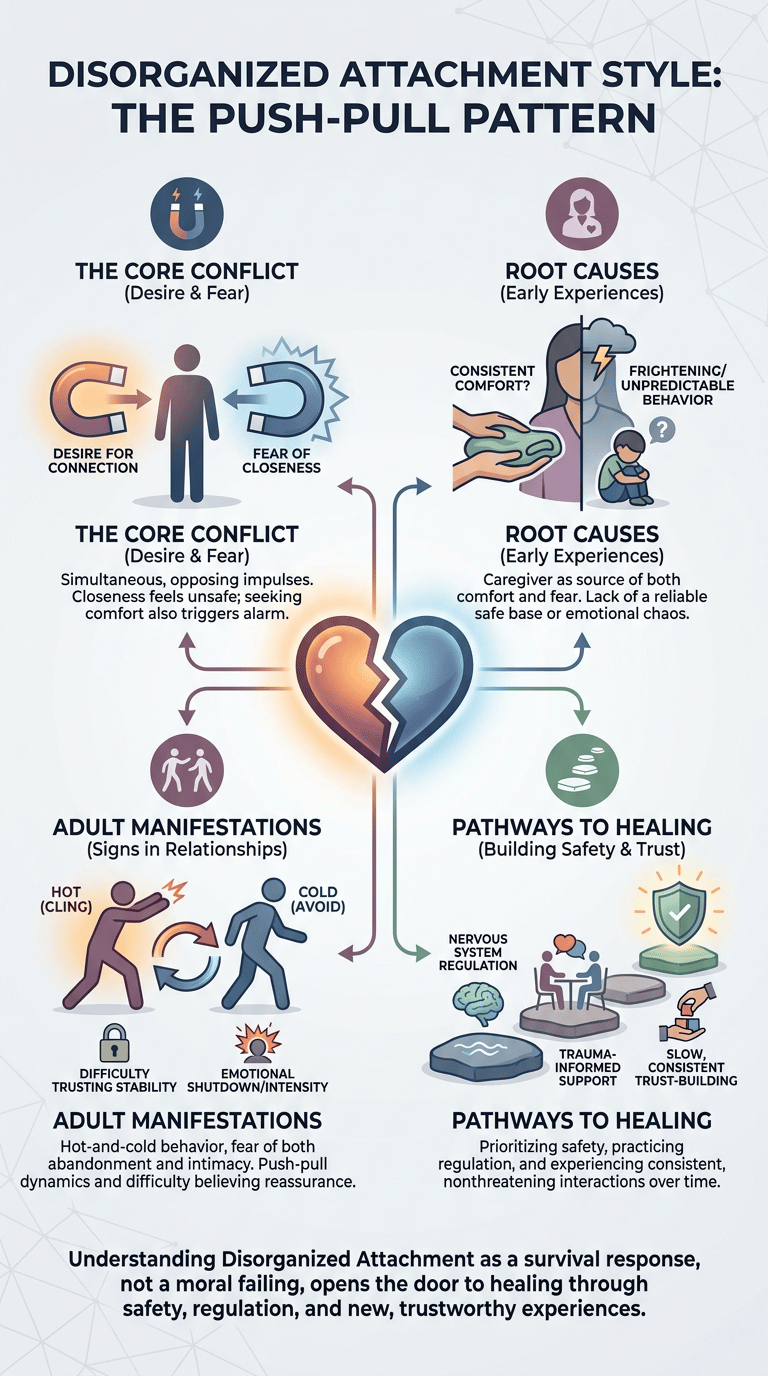
The confusing quality of disorganized attachment comes from simultaneous, opposing impulses. Attachment motivates a person to seek proximity and support when distressed, yet if closeness has been associated with danger, that same need for safety can trigger fear. The result is behavior that looks inconsistent, disoriented, or unpredictable to both the person and their partners.
Why it combines fear and desire for closeness
Feeling torn between wanting and fearing closeness arises because the attachment and threat systems can both be activated. Seeking support feels necessary for regulation, but approaching a person who has been a source of alarm can re-traumatize or trigger defensive responses. Over time, the body and mind can learn to expect both comfort and threat from intimacy, so closeness becomes a contested emotional zone rather than a reliable refuge.
The core pattern of disorganized attachment
Wanting connection
People with disorganized attachment often feel a strong pull toward connection when under stress. The impulse to reach out for help, acceptance, or closeness remains intact and can be intense.
Fearing connection
At the same time, memories or anticipations of threat linked to closeness can trigger fear. This fear may be conscious, such as worry that a partner will become rejecting or harmful, or experienced as a bodily alarm. The fear response can push the person away, create immobilization, or lead to abrupt shifts between approaching and avoiding behavior.
Moving toward and away from people
One hallmark of disorganized attachment is rapid, unpredictable shifts between moving toward and pulling away from others. This can look like urgently seeking reassurance and then suddenly withdrawing, or trying to control interactions to feel safer and then becoming detached when a partner moves in emotionally. These shifts are coping responses to simultaneous drives for safety and self-protection.
Feeling unsafe in emotional closeness
Emotional closeness can feel unsafe because it may activate memories, sensations, or expectations of earlier experiences where safety and danger were mixed. As a result, people with this attachment pattern may avoid vulnerability, keep partners at arm’s length, or respond to intimacy with alarm or dissociation. Recognizing that the sense of threat is often learned rather than a reflection of a partner’s current intentions can be a first step toward change.
For a related next step, see this guide to the avoidant attachment style.
For a related next step, see this guide to the anxious attachment style.
For a simple foundation, see this guide to what attachment styles are.
For broader context, see this guide to attachment styles in psychology.
What causes disorganized attachment?
Frightening or unpredictable caregiving
Disorganized attachment commonly develops when caregivers behave in ways that frighten a child, either through frightening actions themselves or through severe inconsistency that makes the caregiver unpredictable. When the person who should provide protection sometimes causes alarm, the child is left without a coherent strategy for seeking safety. For terminology and clinical context, consult the APA Dictionary of Psychology.
Emotional chaos or unresolved trauma
Households marked by emotional volatility, unresolved parental trauma, or parental mental health crises can contribute to disorganized patterns. Children in those contexts may receive mixed signals about care. Caregivers who are themselves overwhelmed by fear, anger, or disorientation cannot reliably soothe the child, which undermines the formation of a predictable safe base.
Lack of a consistent safe base
Attachment relies on a dependable caregiver who offers a secure base for exploration and a safe haven in distress. When caregiving is inconsistent, neglectful, or alternates with frightening behaviors, the child lacks the consistent safety needed to learn that others are a reliable source of support. Over time, this absence of predictability becomes encoded in expectations about relationships.
Conflicting signals around love and safety
When warmth appears alongside threat, children learn that closeness can include harm or abandonment. Those mixed signals—warmth intertwined with fear—create the core paradox of disorganized attachment: closeness may satisfy a need but also pose danger. That paradox shapes how relationships are experienced later in life.
Signs of disorganized attachment
Hot-and-cold behavior
People with disorganized attachment often display a hot-and-cold pattern in relationships. This can include sudden shifts from warmth to withdrawal, abrupt demands for closeness followed by distancing, or repetitive cycles of clinging and avoidance. These patterns are attempts to negotiate conflicting internal priorities for safety and autonomy.
Fear of abandonment and fear of intimacy
Both fears can coexist. Fear of abandonment motivates efforts to cling, test, or check a partner’s commitment. Fear of intimacy motivates distancing, guardedness, or emotional shutdown. The combination creates chronic uncertainty in relationships and makes consistent reassurance difficult to accept.
Difficulty trusting stable love
Even when partners act consistently and kindly, someone with disorganized attachment may struggle to internalize that predictability. Past patterns of danger tied to closeness can create an expectation that stability is temporary or will turn into threat, which makes it hard to accept steadiness at face value.
Emotional shutdown or sudden intensity
Under stress, a person might shut down, dissociate, or detach to avoid perceived danger. Alternatively, they may respond with sudden, intense emotions that feel disproportionate to the present situation. Both reactions are defensive strategies for dealing with the internal conflict between needing closeness and fearing it.
Disorganized attachment in adult relationships
Push-pull dynamics
In romantic or close relationships, disorganized attachment often creates a push-pull dynamic: approaching for closeness when anxious, then pushing away when closeness feels threatening. Partners may perceive this as unpredictable or confusing behavior. Understanding these cycles as attempts to manage conflicting needs can reduce shame and open pathways for change.
Intense emotional reactions
Emotional reactions in this pattern can be strong and rapid because they carry unresolved alarm responses from earlier caregiving experiences. A minor disagreement might trigger a strong fear of abandonment or a sudden urge to escape closeness. These reactions often signal unresolved safety concerns rather than a moral failing.
Difficulty believing reassurance
Repeated reassurance may not register as credible when someone’s internal model of relationships expects inconsistency or threat. This difficulty is common for people whose early experiences conditioned them to distrust steady care. Recognizing that disbelief in reassurance is a learned response helps frame it as something to work with rather than a personal flaw.
Sabotaging closeness when it feels threatening
Sabotage of closeness—such as picking fights before an expected rejection, withdrawing at crucial moments, or testing a partner’s commitment—can be a protective strategy. It may temporarily confirm expectations, making outcomes feel predictable even if they are painful. Over time, these behaviors can harm relationships but also reflect an attempt to reduce surprise and perceived vulnerability.
Can disorganized attachment heal?
Safety before change
Healing often begins with safety. Establishing a stable, predictable environment and relationships is foundational. Change is more likely when a person experiences consistent, nonthreatening interactions that contradict earlier expectations about closeness.
Trauma-informed support
Trauma-aware approaches acknowledge the role of past frightening experiences and prioritize safety, choice, and empowerment. Seeking support from therapists trained in trauma-informed care or attachment-focused work can help people build new relational experiences and revise expectations about intimacy. Trusted, research-informed mental health information and resources are available from the National Institute of Mental Health.
Nervous system regulation
Because disorganized attachment can involve conflicting activation of attachment and threat responses, practices that support nervous system regulation may be helpful alongside therapy. Grounding strategies, paced breathing, gentle movement, and predictable daily routines can reduce physiological reactivity and make it easier to practice relational skills. These practices are supportive tools rather than cures and tend to work best when combined with relational interventions.
Slow and consistent trust-building
Trust is rebuilt gradually through repeated, small experiences that match words with predictable actions. Partners and therapists can help by maintaining consistent boundaries, responding calmly to distress, and offering steady availability. Progress is typically incremental; small predictable interactions accumulate into a new pattern of expectations about safety and closeness.
Final thoughts
Disorganized attachment describes a pattern in which the need for closeness collides with a learned fear of closeness. This creates confusing push-pull dynamics that can persist into adulthood and affect how people relate to loved ones. Understanding the pattern as a survival response rather than a moral failing can reduce shame and open the door to change.
If emotional patterns tied to relationships cause persistent distress, interfere with daily functioning, or lead to thoughts of harming yourself, consider reaching out to a qualified mental health professional or emergency services. Trusted public resources such as the National Institute of Mental Health provide information on seeking help and treatment options.
Change is possible when safety is prioritized, regulation is practiced, and new trusting experiences are repeated over time.
For clear definitions about attachment terminology and related psychological concepts, see the APA Dictionary of Psychology.

Michael Reed is the Founder and Lead Writer at Psychology Exposed. He writes about human behavior, relationships, emotional patterns, self-awareness, and practical psychology topics using research-informed, easy-to-understand content.
Read More About Michael Reed: https://psychologyexposed.com/michael-reed/