
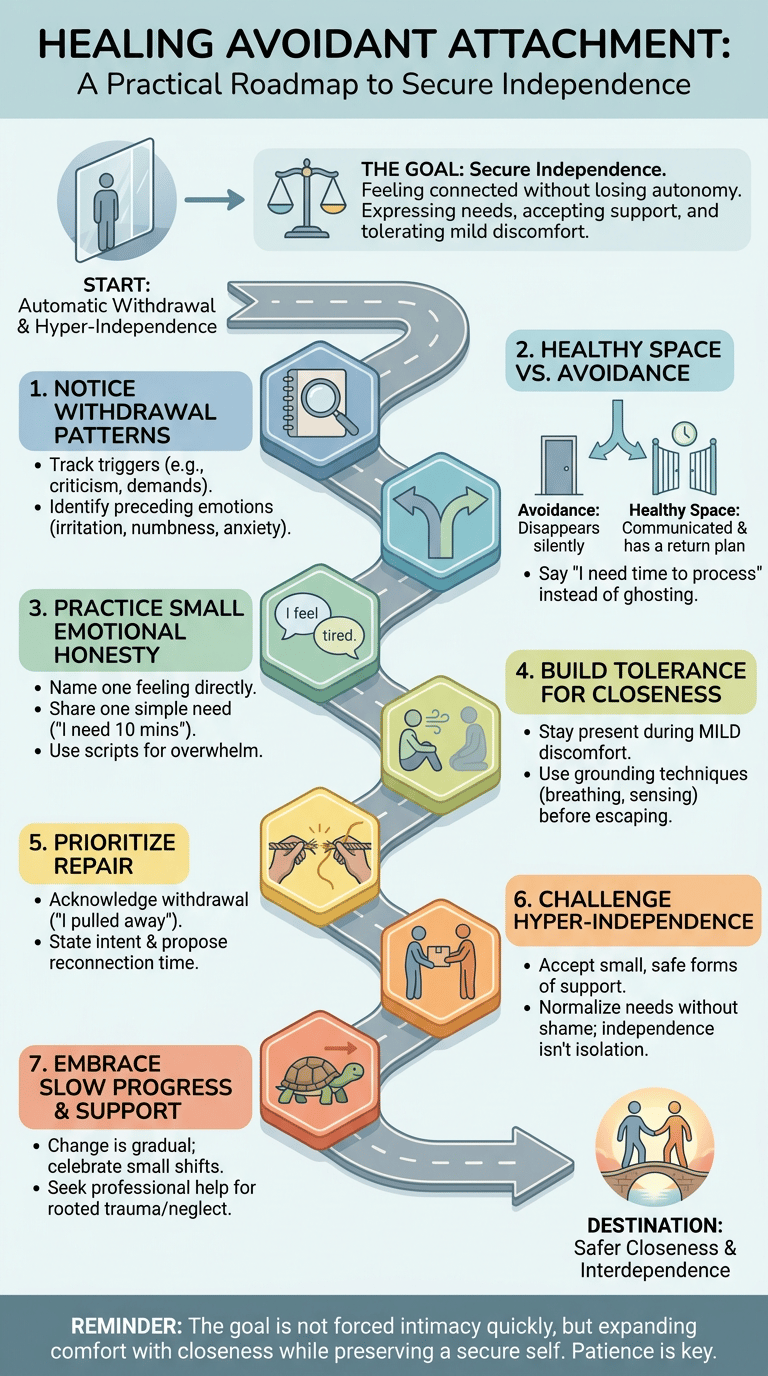
Many people who identify with avoidant attachment want to feel connected without losing their sense of independence or becoming overwhelmed by emotional closeness. This guide offers a gradual, practical roadmap centered on emotional tolerance, communicated space, small vulnerability, and steady repair. The goal is not to force intimacy quickly but to help you expand your comfort with closeness while preserving secure independence.

Can avoidant attachment be healed?
Avoidant attachment describes patterns of keeping emotional distance, minimizing needs, or preferring independence when relationships feel threatening. While attachment patterns can feel ingrained, they are not fixed traits. With intentional practice, relationships and self-regulation can shift toward greater safety and connection.
For accessible, research-based descriptions of behavior and relationship topics, see APA’s topics pages on psychology and relationships. For information about when to seek professional support for mental health and treatment options, consult NIMH’s mental health information.
Why avoidant patterns can change
Avoidant patterns often developed as adaptive responses to early relationship experiences that felt unsafe, intrusive, or inconsistent. Over time those strategies can feel automatic, but patterns can be reshaped by new experiences and repeated practice. Learning to tolerate small doses of closeness, practicing honest communication, and receiving consistent, respectful responses from others all contribute to gradual change.
Why healing does not mean losing independence
Healing avoidant attachment is not about becoming dependent or giving up autonomy. It is about expanding your options: you can keep your independence while also choosing connection when it feels safe and valuable. The aim is secure independence: the ability to rely on yourself and accept support without feeling trapped or suffocated.
What secure independence looks like
Secure independence typically involves:
- Knowing and expressing personal needs without shame.
- Being able to request support and accept it when offered.
- Taking deliberate space when needed and communicating that need to partners.
- Repairing ruptures instead of withdrawing permanently.
- Tolerating mild discomfort in the service of connection.
Step 1: Notice your withdrawal pattern
Healing begins with clear observation. Noticing when and how you withdraw gives you options other than automatic distancing.
When do you pull away?
Track moments you pull away for a week. Note context rather than judging yourself. Useful categories include:
- After feeling criticized or corrected.
- When a partner asks for more time, attention, or emotional disclosure.
- During conflict or discussions about feelings.
- When you sense expectations that feel too demanding.
Keep entries brief and concrete. For example: “After she asked about my day, I looked for excuses to leave the room.” Patterns emerge from many small instances.
What emotions come before distancing?
Avoidant pulling away is often preceded by emotions like irritation, numbness, anxiety, or a sudden sense of being overwhelmed. These feelings can be quick and subtle. Practice naming the immediate emotion in the moment, even if it is just “tight,” “annoyed,” or “flooded.”
What do you fear will happen if you stay close?
Common underlying fears include:
- Being emotionally flooded or losing control.
- Being criticized, dominated, or losing independence.
- Being seen as weak or needy.
- Becoming dependent and losing boundaries.
Identifying specific fears helps you choose targeted strategies, such as communicating boundaries or practicing small disclosures that do not feel overwhelming.
Step 2: Learn the difference between space and avoidance
Space in a relationship can be healthy and restorative. Avoidance is a pattern that erodes trust because it removes opportunities for repair and connection. Learning to distinguish between the two helps you take restorative space without abandoning the relationship.
Healthy space is communicated
Healthy space involves explicit, respectful communication. Saying something like “I need thirty minutes to process this” keeps the connection intact. Communicating your intention signals respect for both your internal needs and the other’s need for predictability.
Avoidance disappears without repair
Avoidant withdrawal tends to end the interaction permanently rather than temporarily. When withdrawal is used repeatedly without repair, the partner may feel confused or rejected. To counter that pattern, pair any necessary space with a plan to reconnect later.
Space should help connection, not replace it
Use space to regulate rather than to escape. The aim is to return in a way that supports mutual understanding. For example, after intentional space you might say: “I stepped away to calm down. Can we talk now about what I found hard?” This keeps the relationship active while respecting your limits.
Step 3: Practice small emotional honesty
Start with tiny, low-risk disclosures that increase the habit of honest emotional communication. Small steps accumulate into larger changes.
Naming one feeling
Practice identifying and naming one feeling when it appears. The label does not need to be perfect. Simple words like “frustrated,” “tired,” or “uneasy” reduce ambiguity and invite understanding.
- Try a one-sentence check-in: “I feel tired right now.”
- Keep it brief and factual when you first start practicing.
Sharing one need
Pair a feeling with a simple need. Needs are future-oriented and actionable, for example:
- “I feel drained and I need a quiet hour.”
- “I feel disconnected and I need a ten-minute chat later.”
Sharing a need helps others respond concretely and reduces guesswork that can trigger distance.
Admitting discomfort without shutting down
You do not have to resolve discomfort immediately. Admitting it openly can be enough to prevent impulsive withdrawal. Use phrases that communicate reality without dramatic self-judgment.
Using simple scripts
Scripts reduce the cognitive load in emotionally charged moments. Here are short examples to practice:
- “I notice I’m feeling overwhelmed. Can I have twenty minutes to breathe and then talk?”
- “That question made me uncomfortable. I’m not ready to answer fully, but I can share this much.”
- “I want to stay connected but I’m starting to pull away. I will step back briefly and come back in an hour.”
Try these phrases in low-stakes situations first until they feel natural.
For a related next step, see this guide to the avoidant attachment style.
Step 4: Build tolerance for closeness
Tolerance means staying present long enough to notice feelings change. Close relationships naturally create discomfort sometimes. Building tolerance is like strengthening a muscle with repeated, manageable effort.
Start with low-risk vulnerability
Choose disclosures that matter but are unlikely to trigger intense scrutiny. Examples include:
- Sharing a tiny irritation and a request to adjust it.
- Describing a pleasant memory you associate with the person.
- Expressing appreciation mixed with one small boundary.
Low-risk practice increases confidence to disclose deeper material later.
Stay present during mild emotional discomfort
When discomfort is mild, practice staying in the moment rather than escaping. Use grounding techniques such as slow breathing, noticing bodily sensations, or naming three things in the room. These strategies help you tolerate sensations without acting on the urge to withdraw immediately.
Notice when your body wants to escape
Physical sensations often signal the urge to flee — a tight chest, shallow breathing, or urge to move away. When you notice these signs, use them as a cue to try a regulatory skill instead of automatically leaving.
Return after taking space
Planned returns rebuild trust. If you take space, set a specific time to reconnect and follow through. Re-entry can be brief and focused, such as: “I stepped away to calm down. I’m back and can listen for ten minutes.” Showing up after space is a powerful form of repair.
Step 5: Repair instead of disappearing
Repair is the process of addressing a rupture and restoring connection. For people with avoidant tendencies, learning to repair rather than disappear is essential for building secure bonds.
Why repair builds trust
Repair signals that both parties value the relationship enough to address hurts. Even small, consistent repairs communicate reliability and make it safer to be vulnerable in the future. Over time, repeated repairs strengthen the sense that closeness is not dangerous.
How to reconnect after withdrawal
Simple, sincere steps work best:
- Acknowledge what happened: “I noticed I pulled away earlier.”
- State your intent: “I didn’t mean to shut you out.”
- Offer a brief reason, not an excuse: “I felt overwhelmed and needed quiet.”
- Ask for permission to fix it or continue: “Can we try again for five minutes?”
Keep the tone calm and avoid over-apologizing in a way that avoids discussing feelings. The point is to reconnect, not to rewrite the whole past.
What to say after needing space
Use concise, honest language that includes a plan for reconnection. Examples:
- “I needed a walk to cool off. I’m ready to talk about it now when you are.”
- “I had to take space. I want to hear your perspective and tell you mine. Can we sit down later?”
- “I stepped back because I was feeling flooded. I’m back and can try to listen.”
These statements respect both your need for space and the other person’s need for acknowledgment.
Step 6: Challenge hyper-independence
Avoidant attachment often includes a strong cultural or personal value on independence. While self-reliance is positive, hyper-independence can become emotional isolation if it prevents healthy mutual support.
Independence vs emotional isolation
Independence means choosing how to meet needs. Emotional isolation happens when needs are consistently hidden or dismissed to avoid closeness. Ask yourself whether choosing independence is your preference in the moment or an automatic defense to keep others at a distance.
Letting support feel safe
Start by accepting small forms of support that feel relatively safe, such as practical help or nonjudgmental listening. Notice how it feels when someone responds predictably and respectfully. Safe, consistent responses help retrain expectations about others.
Allowing needs without shame
Every person has needs. Practicing neutral language about needs reduces shame. Instead of framing a need as evidence of weakness, describe it as a fact: “I get drained after long meetings and need time to recharge.” Normalizing needs makes them easier to express.
Step 7: Get support if avoidance is deeply rooted
Some avoidant patterns come from long-standing emotional neglect, trauma, or attachment experiences that are difficult to change alone. Professional support can provide structured practice, safety, and guidance.
When avoidant patterns come from emotional neglect
If early caregiving lacked consistent emotional responsiveness, closeness can trigger deep insecurity. In those cases, extra care and slower pacing are usually needed. When patterns interfere with important relationships or well-being, getting help is a prudent step.
How therapy can help with vulnerability
Therapy provides a contained setting to practice vulnerability and repair with a trained professional. A clinician can help you identify patterns, experiment with new behaviors, and process underlying fears at a pace that respects your limits. For information about types of mental health support and treatment, see NIMH’s mental health information.
If you are considering therapy, look for options that emphasize relational safety and gradual exposure to emotional material, and discuss pacing with your clinician. Therapy is not a quick fix, but it can help stabilize change when avoidance is pervasive.
Why slow progress is still progress
Change in attachment patterns is typically incremental. Small, consistent shifts such as staying present a bit longer, returning after space, or sharing one additional feeling are meaningful. Celebrate practical gains rather than only big milestones.
Remember that setbacks are part of learning. An instance of withdrawal does not erase progress; it gives new information about triggers and limits to work with compassion.
Final thoughts
Healing avoidant attachment is a gradual process that balances protection of personal boundaries with intentional steps toward connection. The practical path includes noticing withdrawal patterns, communicating when you need space, practicing small emotional honesty, building tolerance for closeness, prioritizing repair, challenging excessive independence, and seeking professional support when patterns are deep or debilitating.
Be patient with yourself. Secure independence grows through repeated, manageable experiments in being both yourself and present with others. If your patterns cause severe distress, persistent relationship problems, or significant interference with work or daily life, consider reaching out to a qualified mental health professional for support and guidance.
Practical next step: this week, pick one low-risk script from Step 3 and use it once. Note what happens and what you learned. Small, consistent practice is the most reliable path to change.

Michael Reed is the Founder and Lead Writer at Psychology Exposed. He writes about human behavior, relationships, emotional patterns, self-awareness, and practical psychology topics using research-informed, easy-to-understand content.
Read More About Michael Reed: https://psychologyexposed.com/michael-reed/