
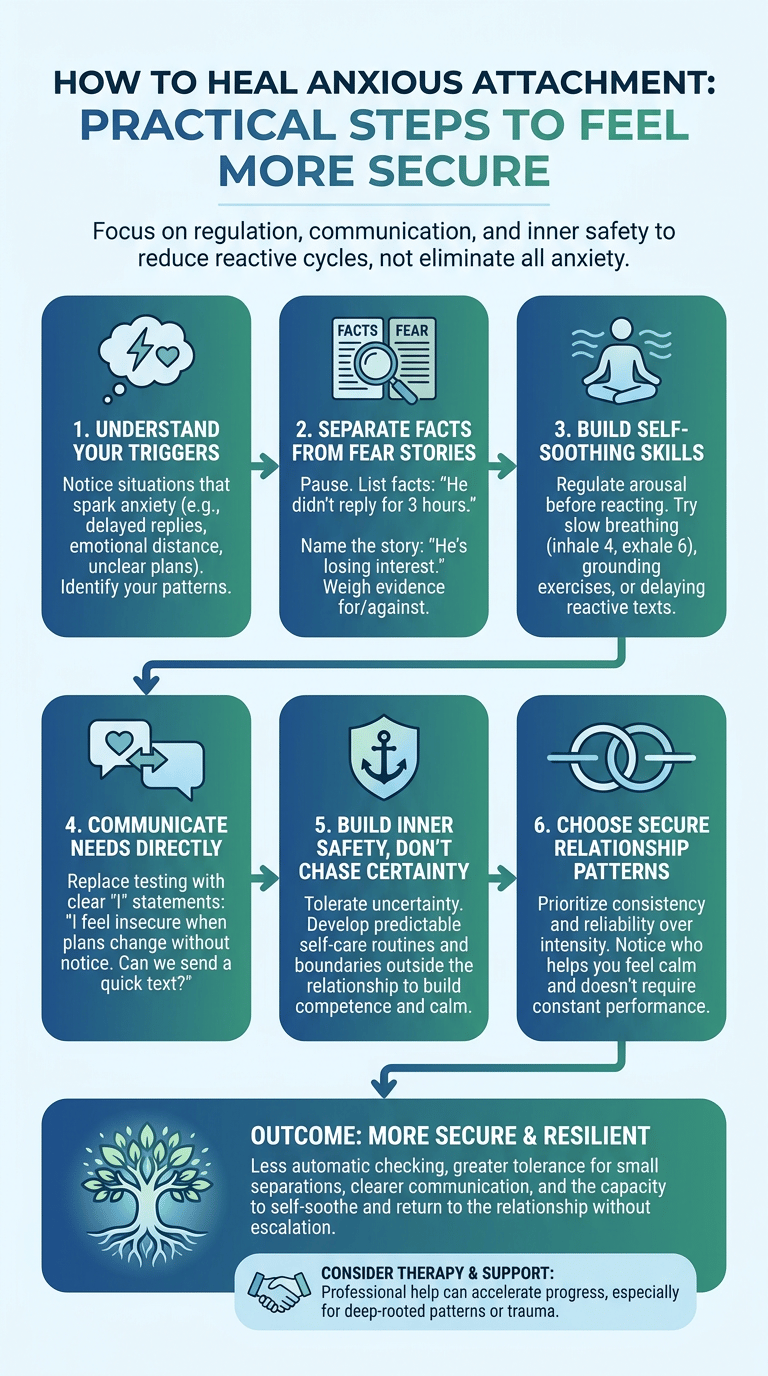
If you notice recurring worry in relationships, frequent need for reassurance, or a tendency to read threat into small signs, you may be experiencing anxious attachment tendencies. This article offers a calm, step-by-step plan that focuses on emotional regulation, clearer communication, and building a sense of inner safety rather than chasing constant certainty from others. The goal is not to eliminate normal anxiety but to reduce the patterns that keep you feeling stuck and reactive.
Can Anxious Attachment Be Healed?
Many people worry that attachment patterns are fixed. Psychology describes attachment as a pattern of relating that emerges from early caregiving experiences and later relationships, and those patterns influence thoughts, feelings, and behavior in close relationships. For a clear definition, see the APA Dictionary entry on attachment.
Why attachment patterns can change
Attachment tendencies are learned ways of organizing emotion and behavior in relationships. Because they are learned, they can also be modified by new experiences, intentional skills practice, and corrective relationships that offer reliable safety over time. Practice, supportive feedback, and repeated reliable experiences help people update old expectations. For broad information on how relationships and emotion are studied in psychology, see APA’s overview of relationships and emotions.
Why healing does not mean never feeling anxious
Becoming more secure does not require eliminating all anxiety. Feeling worried in certain situations is a normal human response. Healing means reducing the intensity and frequency of reactive cycles that undermine closeness, and gaining tools to manage anxiety so it does not automatically lead to testing behaviors, blame, or withdrawal. Expecting zero anxiety creates pressure and can make progress feel fragile; instead, aim for clearer responses and more choices when anxiety arises.
What becoming more secure actually means
Becoming more secure tends to look like the following over time:
- Less automatic need to check or demand reassurance.
- Greater tolerance for small separations and delays in contact.
- Clearer, calmer communication about needs.
- Capacity to soothe yourself and return to the relationship without escalation.
- Choosing partners and patterns that offer consistent reliability rather than excitement that feels unstable.
These are practical, observable changes rather than a personality rewrite. The steps below are designed to be practiced in daily life.
Step 1: Understand Your Attachment Triggers
Begin by noticing the situations that reliably push you into anxiety and reactive behavior. Triggers vary, but they often relate to perceived availability, clarity, and responsiveness from important people.
Delayed replies
A short delay in a text or call can feel catastrophic when you have anxious tendencies. Notice whether a delayed reply summons a cascade of fearful thoughts and urgent messaging, and record the actual delay lengths and your reactions to build perspective.
Emotional distance
Perceived emotional distance can activate old templates of abandonment. Track moments when a partner seems quieter, distracted, or reserved and how quickly that experience prompts worry or assumptions about the relationship’s status.
Conflict
Conflict often activates attachment systems. Notice whether disagreements lead to clinginess, rage, withdrawal, or frantic attempts to restore harmony. Identifying your typical pattern helps you choose a different response next time.
Unclear communication
Ambiguity about plans, expectations, or feelings is a common trigger. When communication is unclear, anxious attachment can fill the gap with worst-case interpretations. Practicing clarifying questions reduces the space for anxiety-driven stories.
Step 2: Separate Facts From Fear Stories
Anxious reactions often come from fear-based stories that the mind creates quickly. Learning to pause and test those stories helps you respond to the situation rather than to an imagined threat.
What actually happened?
When you feel flooded, first list the facts without interpretation. For example: “He did not reply to my text for three hours. He came home from work at 7:15.” Keeping to observable facts slows the mind’s leap into narrative.
What story is your nervous system creating?
Name the story that arose: “He must be losing interest,” or “I did something wrong.” Labeling the story separates it from the facts and makes it easier to examine.
What evidence supports or challenges the fear?
Deliberately weigh evidence on both sides. Ask: “Has he behaved reliably before? Are there alternative explanations for the delay? What would I expect to see if my worry were accurate?” This evidence-check is a simple cognitive habit that reduces automatic escalation.
Step 3: Build Self-Soothing Skills
Self-soothing helps you recover from activation without escalating into testing behaviors. Below are practical techniques for regulating arousal in the moment.
Slow breathing
Slowing the breath for a few minutes can reduce physiological arousal. Try a rhythm such as inhaling for a count of four, exhaling for a count of six, and repeating for several minutes. The goal is to lower heart rate and calm the body so clearer thinking returns. For more on relaxation practices, see MedlinePlus.
Grounding the body
Grounding brings attention back to the present and the body. Simple grounding steps include feeling both feet on the floor, noticing five things you can see, four things you can touch, three things you can hear, two things you can smell, and one thing you can taste. Physical movement like a short walk, stretching, or pressing your palms together can also interrupt a panic loop.
Delaying reactive texts
When anxiety tempts you to send multiple messages, create a short cooling-off routine. Steps can include pausing for 10 minutes, doing a brief breathing exercise, writing a draft message to yourself first, or setting a timer to wait before hitting send. These practices reduce impulsive testing and give space for a calmer message.
Naming the emotion clearly
Labeling an emotion decreases its intensity. Practice sentences such as, “I am feeling anxious and worried about whether she cares right now.” Naming the feeling makes it less likely you will act from it immediately and helps you communicate more clearly later.
Step 4: Communicate Needs Directly
Clear requests are more effective than tests or passive-aggressive behaviors. Communication that states your needs without blame creates more reliable patterns and invites collaboration.
Use clear language instead of testing
Testing behaviors try to prove a partner’s feelings by creating crisis. Replace testing with clear statements such as: “When plans change without notice, I feel insecure. Can we agree to give each other a quick message when plans shift?” Direct language reduces misinterpretation and removes hidden expectations.
Ask for reassurance without demanding it
Requests for reassurance can be stated in ways that respect the other person’s autonomy. For example: “I sometimes worry and find a brief check-in helpful. Would you be willing to text ‘I’m on my way’ when plans change?” This asks for specific behavior rather than demanding constant proof of care.
Express needs without blame
Frame needs as your internal experience, not the other person’s fault. Use “I” statements: “I notice I get anxious when plans are uncertain. It helps me when we set a time to touch base.” Avoid wording that implies the partner is intentionally causing harm.
Example scripts for anxious moments
- “I’m feeling anxious about our plans tonight. Can we confirm the time so I can relax?”
- “When I don’t hear from you, I sometimes assume the worst. Would you be willing to tell me if you need a few hours without messaging?”
- “I want to tell you what I need and also hear how that fits for you. Can we talk about this for five minutes?”
Scripts are practice tools. The content matters less than the habit of asking clearly, calmly, and briefly so you can move back into the relationship without escalation.
Step 5: Stop Chasing Emotional Certainty
Reassurance can feel like a balm, but its effects often wear off quickly. Chasing certainty keeps you in a cycle where comfort must be continuously earned from others rather than developed internally.
Why reassurance feels good but fades quickly
Reassurance temporarily reduces anxiety by resolving a specific worry, but it does not always change underlying expectations of unreliability. Without other work, each calm moment can be followed by renewed doubt, which prompts further requests for reassurance.
How to tolerate uncertainty
Tolerating uncertainty is a learned skill. Start small by choosing low-stakes situations to practice waiting without seeking immediate confirmation. Use self-soothing techniques while you wait, and reflect afterward on how often feared outcomes fail to occur. Over time, tolerance can grow through repeated experience that uncertainty does not always lead to abandonment.
How to build inner safety
Inner safety grows from predictable self-care routines, steady personal boundaries, and reliable habits that create a sense of competence and calm. Examples include regular sleep, modest daily movement, brief reflective practice to check in with how you feel, and maintaining friendships outside of a romantic relationship. Building a consistent life outside the relationship reduces the pressure on any single connection to provide all safety.
Step 6: Choose Secure Relationship Patterns
Attachment healing includes not only changing how you respond but also choosing partners, patterns, and interactions that support steady reliability.
Look for consistency
Consistency tends to support a sense of security more than intensity. Notice whether a person follows through on promises, communicates intentions, and shows up in small, predictable ways. Prioritize patterns of consistent care over grand gestures that are unpredictable.
Avoid confusing intensity with safety
High emotional intensity, drama, or passionate highs can feel addictive but may not provide the dependable care needed for attachment repair. Ask whether a pattern involves steady presence or frequent emotional roller coaster moments that leave you feeling unsettled once the intensity fades.
Notice who helps you feel calm, not addicted
People who help you feel more calm and grounded in their presence are supportive of secure attachment. Notice whether time with someone restores your balance and whether you feel able to be yourself without performing to get reassurance. These are signs of healthier relational fit.
Step 7: Consider Therapy or Support
Self-help tools can produce meaningful change, but therapy or supportive coaching can accelerate progress, especially when attachment patterns are deeply rooted or tied to trauma.
When self-help is not enough
If anxiety is intense, persistent, or interferes with daily functioning, relationships, work, or safety, professional support can be essential. If you find progress stalls, or the behaviors you are trying to change worsen despite your efforts, consider reaching out to a qualified mental health professional. For reliable information on mental health care options and how treatment can help, see NIMH’s information on mental health care.
How therapy can help with attachment patterns
Therapies that focus on relationships, emotion regulation, and interpersonal patterns can offer direct practice in new ways of relating. Therapy provides a corrective relational experience, teaches skills for regulating strong emotions, and helps map the link between early experiences and present behavior. A therapist can also help you design small experiments in communication and boundaries and process setbacks without self-blame.
Why trauma history may need professional support
If anxious attachment is tied to past abuse, neglect, or complex trauma, symptoms can be more intense and may require trauma-informed approaches. Working with a clinician trained in trauma-aware care helps ensure safety while processing difficult memories and building stronger regulation skills.
If you are experiencing severe distress, thoughts of harming yourself, or fear for your safety, please seek immediate professional help or emergency services in your area. Reaching out to a trusted clinician, crisis line, or local emergency services is an important step when immediate safety is a concern. See NIMH guidance for information about getting help.
Final Thoughts
Healing anxious attachment is a gradual process that combines self-awareness, regulation skills, clear communication, and the choice of relationships that support reliability. The steps in this article are practical practices you can start today: track your triggers, test fear-based stories, learn quick self-soothing tools, communicate directly, resist chasing constant reassurance, and prioritize consistent patterns of care. Over time, repeated experience of safety and new habits helps update old expectations.
Be gentle with progress. Change rarely follows a straight line. Expect setbacks, treat them as learning moments, and keep practicing the skills that help you feel more centered and connected. When challenges feel beyond self-help, professional support can provide structure, skills, and a safe space to build lasting security.

Michael Reed is the Founder and Lead Writer at Psychology Exposed. He writes about human behavior, relationships, emotional patterns, self-awareness, and practical psychology topics using research-informed, easy-to-understand content.
Read More About Michael Reed: https://psychologyexposed.com/michael-reed/