
Emotional Blackmail Psychology: How Fear, Obligation, and Guilt Become Control is written for someone facing ultimatums, threats, or pressure that feels urgent and personal. The purpose is not to make you suspicious of every imperfect person. It is to
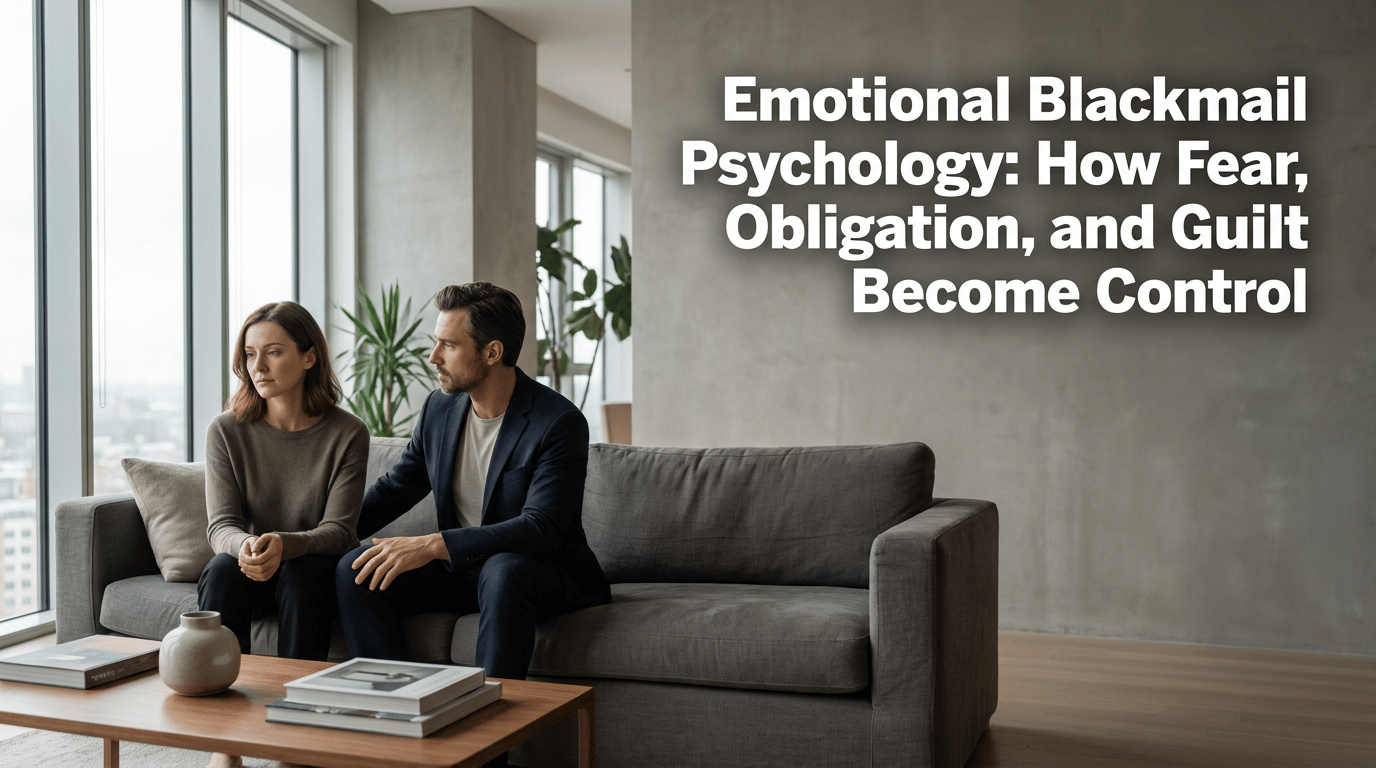
What Is Emotional Blackmail?
This part narrows the topic to fear, obligation, and guilt tied to consequences in breakup threats. Keep looking for repetition, pressure, and the way the other person responds when you ask for clarity or time. emotional abuse guidance.
Quick answer
The quick answer is that emotional blackmail psychology describes fear, obligation, and guilt tied to consequences when it becomes a repeated pattern, not a single awkward moment. It matters when your choices, confidence, safety, or sense of reality keep shrinking. The pattern becomes
Emotional pressure tied to consequences
This point matters because slowing the demand, naming the consequence, and seeking support reduces coercive pressure. For someone facing ultimatums, threats, or pressure that feels urgent and personal, the most useful test is whether the interaction leaves more room for honesty or less room for independent judgment. Put it
Why emotional blackmail is more than normal conflict
The mechanism works because the target starts managing confusion instead of evaluating the request. Attention shifts from what happened to how to calm the other person, prove loyalty, or recover approval. Put it in plain language: notice the behavior, check it against the pattern, and choose the next small step that protects clarity.
Where emotional blackmail fits in the dark psychology map
This point matters because slowing the demand, naming the consequence, and seeking support reduces coercive pressure. For someone facing ultimatums, threats, or pressure that feels urgent and personal, the most useful test is whether the interaction leaves more room for honesty or less room for independent judgment. The
How this fits with Dark Psychology Explained
The mechanism works because the target starts managing confusion instead of evaluating the request. Attention shifts from what happened to how to calm the other person, prove loyalty, or recover approval. Put it in plain language: notice the behavior, check it against the pattern, and choose the next small step that protects clarity.
Why this article focuses on coercive emotional pressure
The mechanism works because the target starts managing confusion instead of evaluating the request. Attention shifts from what happened to how to calm the other person, prove loyalty, or recover approval. Put it in plain language: notice the behavior, check it against the pattern, and choose the next small step that protects clarity.
How Emotional Blackmail Works
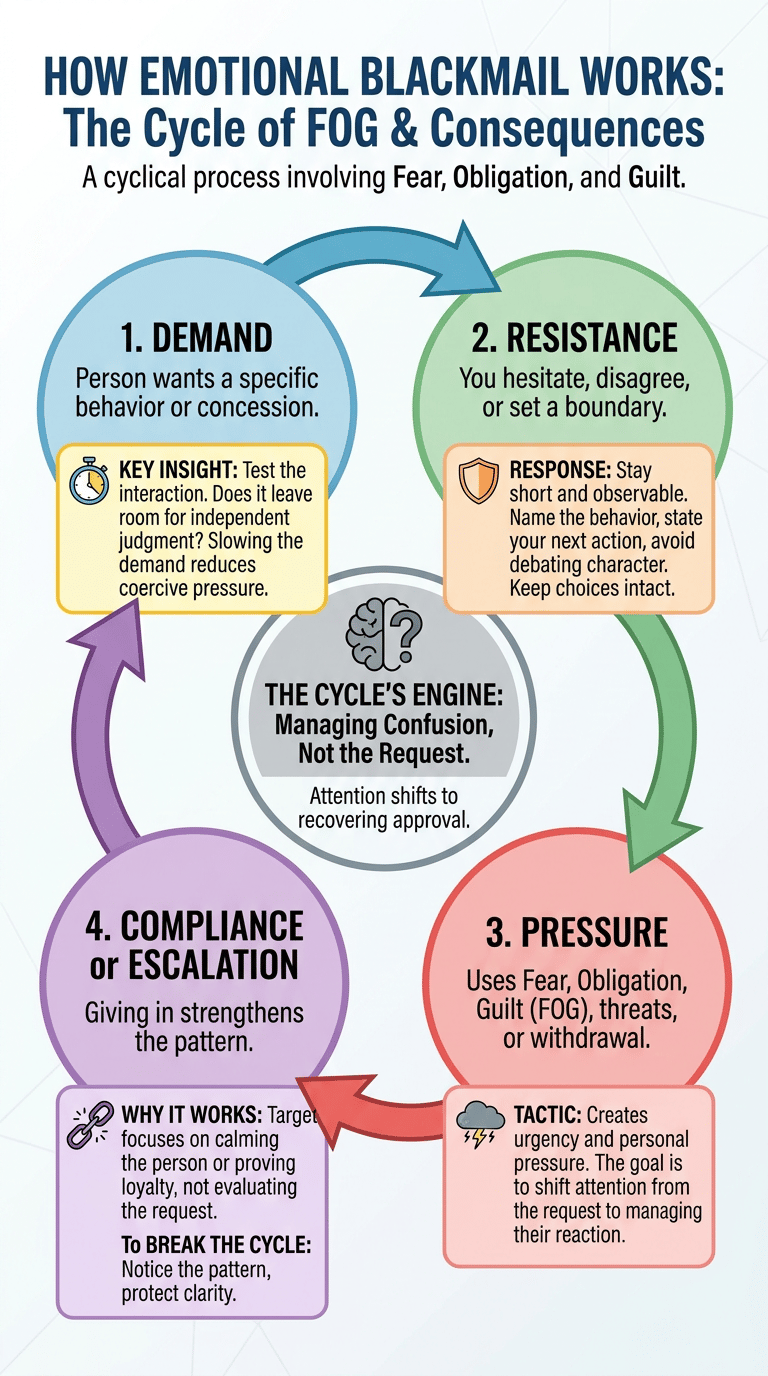
This part narrows the topic to fear, obligation, and guilt tied to consequences in friendship withdrawal. Keep looking for repetition, pressure, and the way the other person responds when you ask for clarity or time.
Demand
This point matters because slowing the demand, naming the consequence, and seeking support reduces coercive pressure. For someone facing ultimatums, threats, or pressure that feels urgent and personal, the most useful test is whether the interaction leaves more room for honesty or less room for independent judgment. The
The person wants a specific behavior or concession
This point matters because slowing the demand, naming the consequence, and seeking support reduces coercive pressure. For someone facing ultimatums, threats, or pressure that feels urgent and personal, the most useful test is whether the interaction leaves more room for honesty or less room for independent judgment. Put it
Resistance
This point matters because slowing the demand, naming the consequence, and seeking support reduces coercive pressure. For someone facing ultimatums, threats, or pressure that feels urgent and personal, the most useful test is whether the interaction leaves more room for honesty or less room for independent judgment. The
You hesitate, disagree, or set a boundary
A grounded response stays short and observable. Name the behavior, state what you will do next, and avoid arguing about your character. The goal is not to win a debate, but to keep your choices intact. Put it in plain language:
For a practical next step, see this guide on how to deal with a manipulative person.
For a related next step, see this guide to guilt tripping psychology.
For a related next step, see this guide to manipulation tactics in relationships.
For broader context, see this guide to dark psychology explained.
Pressure
This point matters because slowing the demand, naming the consequence, and seeking support reduces coercive pressure. For someone facing ultimatums, threats, or pressure that feels urgent and personal, the most useful test is whether the interaction leaves more room for honesty or less room for independent judgment. The
Fear, obligation, guilt, threats, or withdrawal
This point matters because slowing the demand, naming the consequence, and seeking support reduces coercive pressure. For someone facing ultimatums, threats, or pressure that feels urgent and personal, the most useful test is whether the interaction leaves more room for honesty or less room for independent judgment. Put it
Compliance or escalation
This point matters because slowing the demand, naming the consequence, and seeking support reduces coercive pressure. For someone facing ultimatums, threats, or pressure that feels urgent and personal, the most useful test is whether the interaction leaves more room for honesty or less room for independent judgment. The
Why giving in can strengthen the pattern
The mechanism works because the target starts managing confusion instead of evaluating the request. Attention shifts from what happened to how to calm the other person, prove loyalty, or recover approval. Put it in plain language: notice the behavior, check it against the pattern, and choose the next small step that protects clarity.
Fear, Obligation, and Guilt
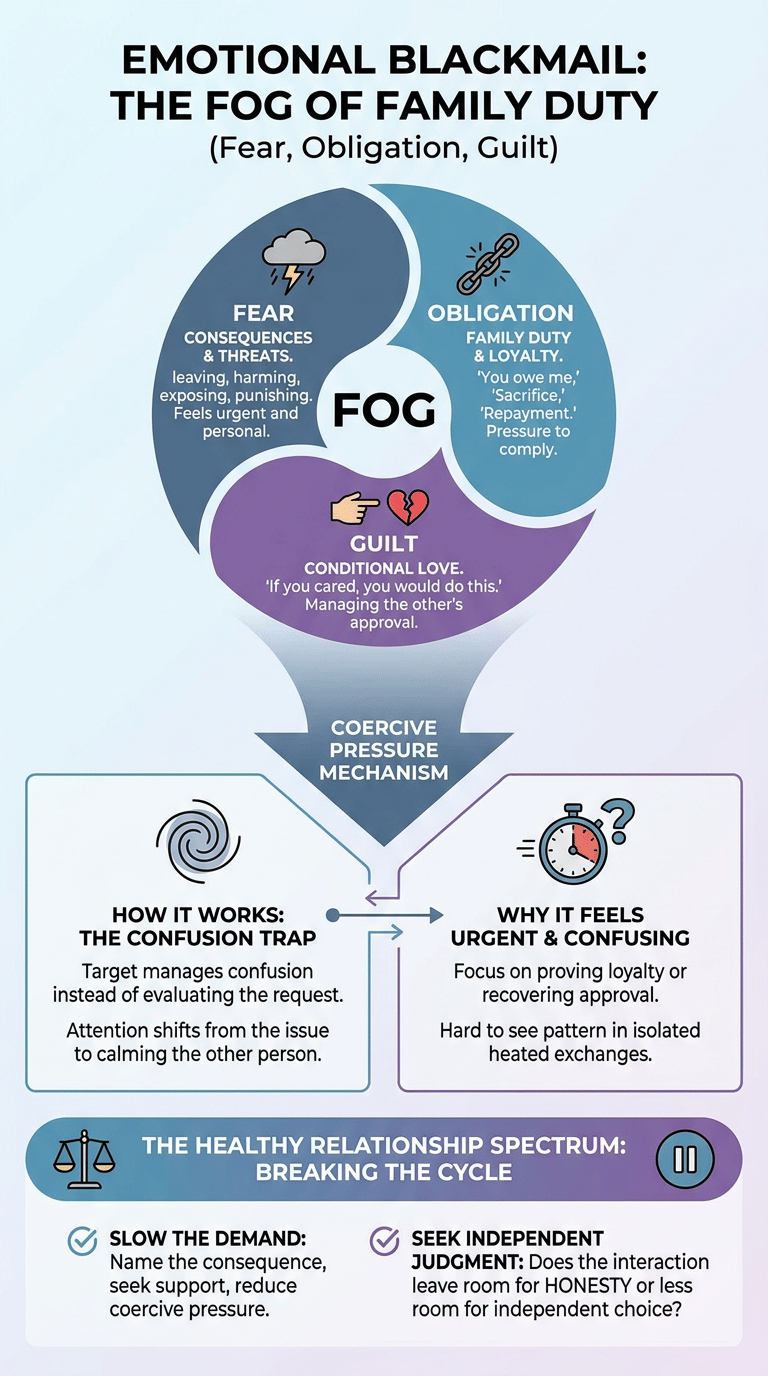
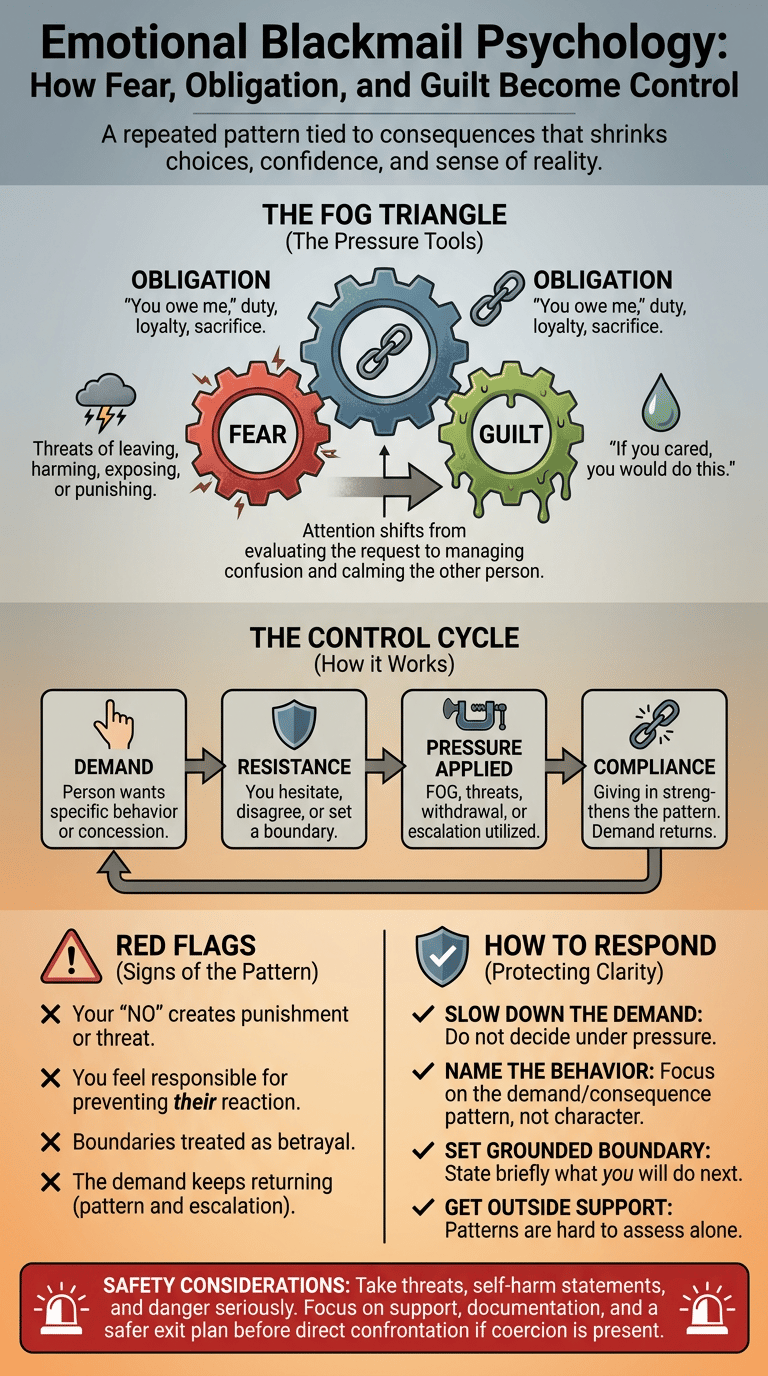
This part narrows the topic to fear, obligation, and guilt tied to consequences in family duty. Keep looking for repetition, pressure, and the way the other person responds when you ask for clarity or time. healthy relationship spectrum.
Fear
This point matters because slowing the demand, naming the consequence, and seeking support reduces coercive pressure. For someone facing ultimatums, threats, or pressure that feels urgent and personal, the most useful test is whether the interaction leaves more room for honesty or less room for independent judgment. The
Threats of leaving, harming, exposing, or punishing
This point matters because slowing the demand, naming the consequence, and seeking support reduces coercive pressure. For someone facing ultimatums, threats, or pressure that feels urgent and personal, the most useful test is whether the interaction leaves more room for honesty or less room for independent judgment. Put it
Obligation
This point matters because slowing the demand, naming the consequence, and seeking support reduces coercive pressure. For someone facing ultimatums, threats, or pressure that feels urgent and personal, the most useful test is whether the interaction leaves more room for honesty or less room for independent judgment. The
You owe me, family duty, loyalty, or sacrifice
This point matters because slowing the demand, naming the consequence, and seeking support reduces coercive pressure. For someone facing ultimatums, threats, or pressure that feels urgent and personal, the most useful test is whether the interaction leaves more room for honesty or less room for independent judgment. Put it
Guilt
This point matters because slowing the demand, naming the consequence, and seeking support reduces coercive pressure. For someone facing ultimatums, threats, or pressure that feels urgent and personal, the most useful test is whether the interaction leaves more room for honesty or less room for independent judgment. The
If you cared, you would do this
This point matters because slowing the demand, naming the consequence, and seeking support reduces coercive pressure. For someone facing ultimatums, threats, or pressure that feels urgent and personal, the most useful test is whether the interaction leaves more room for honesty or less room for independent judgment. Put it
How the three work together
The mechanism works because the target starts managing confusion instead of evaluating the request. Attention shifts from what happened to how to calm the other person, prove loyalty, or recover approval. The pattern becomes easier to see when you compare words with behavior across several moments, not just one heated exchange.
Why emotional blackmail can feel confusing and urgent
The mechanism works because the target starts managing confusion instead of evaluating the request. Attention shifts from what happened to how to calm the other person, prove loyalty, or recover approval. Put it in plain language: notice the behavior, check it against the pattern, and choose the next small step that protects clarity.
Emotional Blackmail Examples
This part narrows the topic to fear, obligation, and guilt tied to consequences in breakup threats. Keep looking for repetition, pressure, and the way the other person responds when you ask for clarity or time.
Romantic relationships
This point matters because slowing the demand, naming the consequence, and seeking support reduces coercive pressure. For someone facing ultimatums, threats, or pressure that feels urgent and personal, the most useful test is whether the interaction leaves more room for honesty or less room for independent judgment. The
Threatening breakup, punishment, or self-destruction to force compliance
This point matters because slowing the demand, naming the consequence, and seeking support reduces coercive pressure. For someone facing ultimatums, threats, or pressure that feels urgent and personal, the most useful test is whether the interaction leaves more room for honesty or less room for independent judgment. Put it
Family dynamics
This point matters because slowing the demand, naming the consequence, and seeking support reduces coercive pressure. For someone facing ultimatums, threats, or pressure that feels urgent and personal, the most useful test is whether the interaction leaves more room for honesty or less room for independent judgment. The
Duty, shame, loyalty, and sacrifice as pressure
This point matters because slowing the demand, naming the consequence, and seeking support reduces coercive pressure. For someone facing ultimatums, threats, or pressure that feels urgent and personal, the most useful test is whether the interaction leaves more room for honesty or less room for independent judgment. Put it
Friendships
This point matters because slowing the demand, naming the consequence, and seeking support reduces coercive pressure. For someone facing ultimatums, threats, or pressure that feels urgent and personal, the most useful test is whether the interaction leaves more room for honesty or less room for independent judgment. The
Threatening withdrawal or public conflict
This point matters because slowing the demand, naming the consequence, and seeking support reduces coercive pressure. For someone facing ultimatums, threats, or pressure that feels urgent and personal, the most useful test is whether the interaction leaves more room for honesty or less room for independent judgment. Put it
Workplace examples
A useful example is specific: what was said, what changed afterward, and whether the pattern made you doubt yourself or surrender a reasonable boundary. In friendship withdrawal, the wording may sound ordinary until it repeats. The pattern becomes easier
Loyalty pressure, reputation threats, and emotional leverage
This point matters because slowing the demand, naming the consequence, and seeking support reduces coercive pressure. For someone facing ultimatums, threats, or pressure that feels urgent and personal, the most useful test is whether the interaction leaves more room for honesty or less room for independent judgment. Put it
Emotional Blackmail vs Nearby Manipulation Tactics
This part narrows the topic to fear, obligation, and guilt tied to consequences in self-harm threats. Keep looking for repetition, pressure, and the way the other person responds when you ask for clarity or time. recovery guidance after emotional abuse.
Emotional blackmail vs guilt tripping
The distinction is practical. Healthy conflict leaves room for repair, facts, and separate feelings. Manipulative pressure keeps narrowing the options until agreement feels like the only way to restore peace. The pattern becomes easier to see when you compare words with behavior across several moments, not just one heated exchange.
Full coercive pattern vs guilt as one pressure tool
The distinction is practical. Healthy conflict leaves room for repair, facts, and separate feelings. Manipulative pressure keeps narrowing the options until agreement feels like the only way to restore peace. Put it in plain language: notice the behavior, check it against the pattern, and choose the next small step that protects clarity.
Emotional blackmail vs gaslighting
The distinction is practical. Healthy conflict leaves room for repair, facts, and separate feelings. Manipulative pressure keeps narrowing the options until agreement feels like the only way to restore peace. The pattern becomes easier to see when you compare words with behavior across several moments, not just one heated exchange.
Threat and obligation vs reality distortion
The distinction is practical. Healthy conflict leaves room for repair, facts, and separate feelings. Manipulative pressure keeps narrowing the options until agreement feels like the only way to restore peace. Put it in plain language: notice the behavior, check it against the pattern, and choose the next small step that protects clarity.
Emotional blackmail vs silent treatment
The distinction is practical. Healthy conflict leaves room for repair, facts, and separate feelings. Manipulative pressure keeps narrowing the options until agreement feels like the only way to restore peace. The pattern becomes easier to see when you compare words with behavior across several moments, not just one heated exchange.
Explicit pressure vs withdrawal pressure
The distinction is practical. Healthy conflict leaves room for repair, facts, and separate feelings. Manipulative pressure keeps narrowing the options until agreement feels like the only way to restore peace. Put it in plain language: notice the behavior, check it against the pattern, and choose the next small step that protects clarity.
Emotional blackmail vs triangulation
The distinction is practical. Healthy conflict leaves room for repair, facts, and separate feelings. Manipulative pressure keeps narrowing the options until agreement feels like the only way to restore peace. The pattern becomes easier to see when you compare words with behavior across several moments, not just one heated exchange.
Direct coercion vs third-party pressure
The distinction is practical. Healthy conflict leaves room for repair, facts, and separate feelings. Manipulative pressure keeps narrowing the options until agreement feels like the only way to restore peace. Put it in plain language: notice the behavior, check it against the pattern, and choose the next small step that protects clarity.
Signs You Are Experiencing Emotional Blackmail
This part narrows the topic to fear, obligation, and guilt tied to consequences in workplace loyalty. Keep looking for repetition, pressure, and the way the other person responds when you ask for clarity or time.
Your no creates punishment or threat
This point matters because slowing the demand, naming the consequence, and seeking support reduces coercive pressure. For someone facing ultimatums, threats, or pressure that feels urgent and personal, the most useful test is whether the interaction leaves more room for honesty or less room for independent judgment. The
Why disagreement becomes unsafe
The mechanism works because the target starts managing confusion instead of evaluating the request. Attention shifts from what happened to how to calm the other person, prove loyalty, or recover approval. Put it in plain language: notice the behavior, check it against the pattern, and choose the next small step that protects clarity.
You feel responsible for preventing someone else’s reaction
This point matters because slowing the demand, naming the consequence, and seeking support reduces coercive pressure. For someone facing ultimatums, threats, or pressure that feels urgent and personal, the most useful test is whether the interaction leaves more room for honesty or less room for independent judgment. The
Fear of consequences replaces free choice
This point matters because slowing the demand, naming the consequence, and seeking support reduces coercive pressure. For someone facing ultimatums, threats, or pressure that feels urgent and personal, the most useful test is whether the interaction leaves more room for honesty or less room for independent judgment. Put it
Boundaries are treated as betrayal
This point matters because slowing the demand, naming the consequence, and seeking support reduces coercive pressure. For someone facing ultimatums, threats, or pressure that feels urgent and personal, the most useful test is whether the interaction leaves more room for honesty or less room for independent judgment. The
How autonomy becomes framed as harm
The mechanism works because the target starts managing confusion instead of evaluating the request. Attention shifts from what happened to how to calm the other person, prove loyalty, or recover approval. Put it in plain language: notice the behavior, check it against the pattern, and choose the next small step that protects clarity.
The demand keeps returning
This point matters because slowing the demand, naming the consequence, and seeking support reduces coercive pressure. For someone facing ultimatums, threats, or pressure that feels urgent and personal, the most useful test is whether the interaction leaves more room for honesty or less room for independent judgment. The
Pattern, escalation, and repetition
This point matters because slowing the demand, naming the consequence, and seeking support reduces coercive pressure. For someone facing ultimatums, threats, or pressure that feels urgent and personal, the most useful test is whether the interaction leaves more room for honesty or less room for independent judgment. Put it
How to Respond to Emotional Blackmail
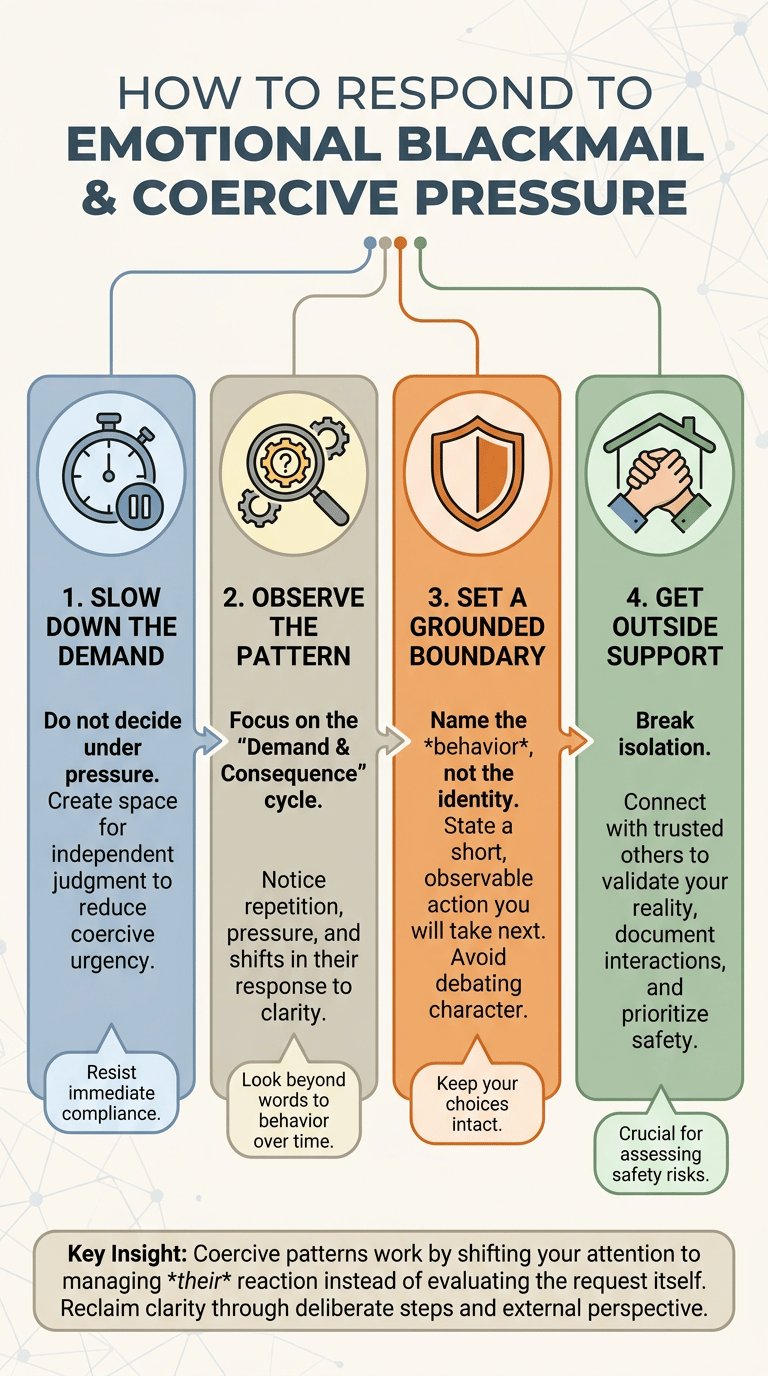
This part narrows the topic to fear, obligation, and guilt tied to consequences in friendship withdrawal. Keep looking for repetition, pressure, and the way the other person responds when you ask for clarity or time. coercive control research.
Slow down the demand
This point matters because slowing the demand, naming the consequence, and seeking support reduces coercive pressure. For someone facing ultimatums, threats, or pressure that feels urgent and personal, the most useful test is whether the interaction leaves more room for honesty or less room for independent judgment. The
Do not decide under pressure when possible
This point matters because slowing the demand, naming the consequence, and seeking support reduces coercive pressure. For someone facing ultimatums, threats, or pressure that feels urgent and personal, the most useful test is whether the interaction leaves more room for honesty or less room for independent judgment. Put it
Name the behavior, not the person’s identity
This point matters because slowing the demand, naming the consequence, and seeking support reduces coercive pressure. For someone facing ultimatums, threats, or pressure that feels urgent and personal, the most useful test is whether the interaction leaves more room for honesty or less room for independent judgment. The
Focus on the demand and consequence pattern
This point matters because slowing the demand, naming the consequence, and seeking support reduces coercive pressure. For someone facing ultimatums, threats, or pressure that feels urgent and personal, the most useful test is whether the interaction leaves more room for honesty or less room for independent judgment. Put it
Set a specific boundary
A grounded response stays short and observable. Name the behavior, state what you will do next, and avoid arguing about your character. The goal is not to win a debate, but to keep your choices intact. The pattern becomes easier
What you will do if pressure continues
This point matters because slowing the demand, naming the consequence, and seeking support reduces coercive pressure. For someone facing ultimatums, threats, or pressure that feels urgent and personal, the most useful test is whether the interaction leaves more room for honesty or less room for independent judgment. Put it
Get outside support
Safety changes the priority. If there is fear, coercion, stalking, threats, isolation, or pressure that escalates when you say no, focus on support, documentation, and a safer exit plan before direct confrontation. The pattern becomes easier to see when you compare words with behavior across several moments, not just one heated exchange.
Why coercive patterns are hard to assess alone
The mechanism works because the target starts managing confusion instead of evaluating the request. Attention shifts from what happened to how to calm the other person, prove loyalty, or recover approval. Put it in plain language: notice the behavior, check it against the pattern, and choose the next small step that protects clarity.
Safety Considerations
This part narrows the topic to fear, obligation, and guilt tied to consequences in family duty. Keep looking for repetition, pressure, and the way the other person responds when you ask for clarity or time.
Threats, self-harm statements, and danger
Safety changes the priority. If there is fear, coercion, stalking, threats, isolation, or pressure that escalates when you say no, focus on support, documentation, and a safer exit plan before direct confrontation. The pattern becomes easier to see when you compare words with behavior across several moments, not just one heated exchange.
Take immediate risk seriously and involve appropriate support
Safety changes the priority. If there is fear, coercion, stalking, threats, isolation, or pressure that escalates when you say no, focus on support, documentation, and a safer exit plan before direct confrontation. Put it in plain language: notice the behavior, check it against the pattern, and choose the next small step that protects clarity.
Coercive control patterns
This point matters because slowing the demand, naming the consequence, and seeking support reduces coercive pressure. For someone facing ultimatums, threats, or pressure that feels urgent and personal, the most useful test is whether the interaction leaves more room for honesty or less room for independent judgment. The
When emotional blackmail is part of abuse
Safety changes the priority. If there is fear, coercion, stalking, threats, isolation, or pressure that escalates when you say no, focus on support, documentation, and a safer exit plan before direct confrontation. Put it in plain language: notice the behavior, check it against the pattern, and choose the next small step that protects clarity.
Documentation and planning
This point matters because slowing the demand, naming the consequence, and seeking support reduces coercive pressure. For someone facing ultimatums, threats, or pressure that feels urgent and personal, the most useful test is whether the interaction leaves more room for honesty or less room for independent judgment. The
Safe records, trusted contacts, and professional help
Safety changes the priority. If there is fear, coercion, stalking, threats, isolation, or pressure that escalates when you say no, focus on support, documentation, and a safer exit plan before direct confrontation. Put it in plain language: notice the behavior, check it against the pattern, and choose the next small step that protects clarity.
FAQ
This part narrows the topic to fear, obligation, and guilt tied to consequences in workplace loyalty. Keep looking for repetition, pressure, and the way the other person responds when you ask for clarity or time.
What is emotional blackmail in simple terms?
The answer depends on repetition, stakes, and the response to boundaries. A single mistake can be repaired. A controlling pattern usually becomes clearer when you slow the pace and stop over-explaining. The pattern becomes easier to see when you compare words with behavior across several moments, not just one heated exchange.
What are examples of emotional blackmail?
A useful example is specific: what was said, what changed afterward, and whether the pattern made you doubt yourself or surrender a reasonable boundary. In breakup threats, the wording may sound ordinary until it repeats. The pattern becomes easier
What is fear, obligation, and guilt?
The answer depends on repetition, stakes, and the response to boundaries. A single mistake can be repaired. A controlling pattern usually becomes clearer when you slow the pace and stop over-explaining. The pattern becomes easier to see when you compare words with behavior across several moments, not just one heated exchange.
How do you respond to emotional blackmail?
A grounded response stays short and observable. Name the behavior, state what you will do next, and avoid arguing about your character. The goal is not to win a debate, but to keep your choices intact. The pattern becomes easier
Is emotional blackmail emotional abuse?
Safety changes the priority. If there is fear, coercion, stalking, threats, isolation, or pressure that escalates when you say no, focus on support, documentation, and a safer exit plan before direct confrontation. The pattern becomes easier to see when you compare words with behavior across several moments, not just one heated exchange.
Key Takeaways
This part narrows the topic to fear, obligation, and guilt tied to consequences in self-harm threats. Keep looking for repetition, pressure, and the way the other person responds when you ask for clarity or time.

Michael Reed is the Founder and Lead Writer at Psychology Exposed. He writes about human behavior, relationships, emotional patterns, self-awareness, and practical psychology topics using research-informed, easy-to-understand content.
Read More About Michael Reed: https://psychologyexposed.com/michael-reed/