

You may speak one way with a close friend, another way in a job interview, and another way with a child who needs reassurance. You may share personal details with one person and keep them private from someone else. You may dress differently for a formal event, soften your humor around a new group, or choose a more careful tone when the stakes are high.
That does not automatically make you fake. Human behavior is context-sensitive. The more useful question is whether the version of yourself you present is still grounded in reality, important values, and genuine intentions, or whether you are creating a false belief that would matter to the other person.
This distinction matters because “just be yourself” sounds simple but can become confusing in real life. Authenticity does not require identical behavior in every setting, and self-presentation does not automatically mean deception. The difficult part is recognizing where ordinary adaptation ends and misrepresentation begins.
Quick Answer
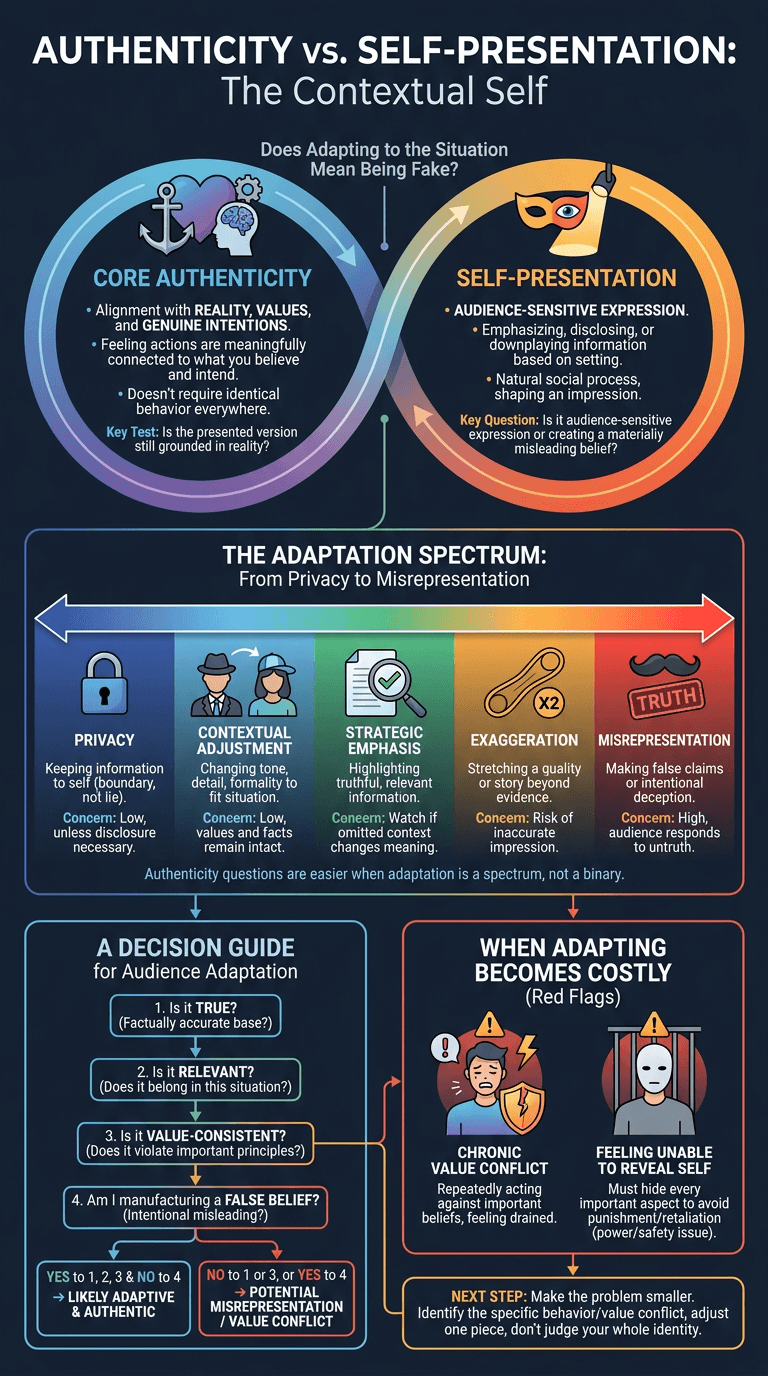
Authenticity and self-presentation are not opposites. You can adjust your language, formality, disclosure, or emphasis for a particular audience while remaining truthful and aligned with your values. The concern becomes stronger when adaptation requires repeated value conflict, false claims, or omissions designed to create a materially misleading belief. Consistency of values matters more than behaving exactly the same everywhere.
What Authenticity and Self-Presentation Each Mean
Psychologists do not have a single universally accepted definition of authenticity. Research often treats it as involving some form of congruence between a person’s experience, values, self-understanding, and behavior. A useful everyday version is this: authenticity concerns whether your actions feel meaningfully connected to what you believe, value, and intend.
Self-presentation, by contrast, concerns what you show, emphasize, disclose, or downplay in a setting where other people can form an impression of you. It is audience-sensitive by definition. Someone may present their competence during an interview, their playfulness with friends, and their patience with a child. These presentations can all be genuine even though they are different.
Authenticity as alignment among values, self-understanding, and genuine intentions
One influential way of studying authenticity focuses on whether people experience their behavior as expressing the self rather than merely performing for external pressure. Research also shows that the construct is more complex than simple trait consistency. In experience-sampling studies, people varied their behavior considerably across situations, yet behavioral variation itself did not automatically make them feel inauthentic. You can see this nuance in peer-reviewed research on behavioral variability and subjective authenticity.
This matters because a person can be quiet in one setting and energetic in another without either version being false. Different contexts activate different skills, responsibilities, emotional states, and social roles. The question is not “Did I behave the same?” but “Was what I did compatible with what I actually believed, knew, intended, or valued in that moment?”
Self-presentation as audience-sensitive expression
Self-presentation begins with the fact that audiences matter. When other people can evaluate us, remember us, or respond to us, we naturally make choices about what information is relevant. A physician does not tell every patient the same personal stories they tell a sibling. A student may speak more formally to a professor than to a roommate. A new employee may initially emphasize reliability rather than their more eccentric hobbies.
Those choices shape an impression, but shaping an impression is not the same as fabricating one. Recent work comparing the “authentic self” and the “presented self” also treats them as related but psychologically distinguishable aspects of self-representation rather than assuming that the presented self is inherently false. See this open-access study on authentic and presented selves.
Why Different Contexts Bring Out Different Real Parts of the Same Person
People contain more than one socially relevant trait, role, interest, and responsibility. A person can be playful, serious, private, generous, competitive, cautious, warm, and analytical at different times. Context helps determine which of those qualities is useful or appropriate to express.
Problems arise when we confuse “not showing everything” with “showing something false.” No one presents their entire biography, every emotion, and every opinion in every interaction. Human conversation depends on selection. The psychological issue is what that selection is doing.
Roles, responsibilities, formality, and audience needs
Imagine the same person in four situations. At a funeral, they speak softly and give others room. At a team meeting, they state a disagreement directly. At home with a five-year-old, they simplify an explanation. At a reunion with old friends, they become more animated and informal. The shifts are not necessarily masks. They can be expressions of care, competence, role responsibility, and social awareness.
A useful distinction is between role-responsive behavior and role-controlled identity. Role-responsive behavior means adapting enough to meet the legitimate needs of the situation. Role-controlled identity means feeling that a role requires you to repeatedly deny or falsify something important about yourself. The first is often ordinary social functioning. The second may deserve closer reflection.
Privacy and selective disclosure
Privacy is another reason presentation changes. You do not owe every audience the same level of access to your personal history, relationships, fears, finances, health concerns, or future plans. Choosing not to disclose something is often a boundary, not a lie.
The ethical tension grows when withholding information is specifically intended to create a false conclusion that matters to another person’s decision. Saying “I would rather keep that private” is different from presenting invented facts. Saying nothing about a hobby on a professional profile is different from falsely claiming qualifications you do not have.
Values Consistency Is Not the Same as Behavioral Sameness
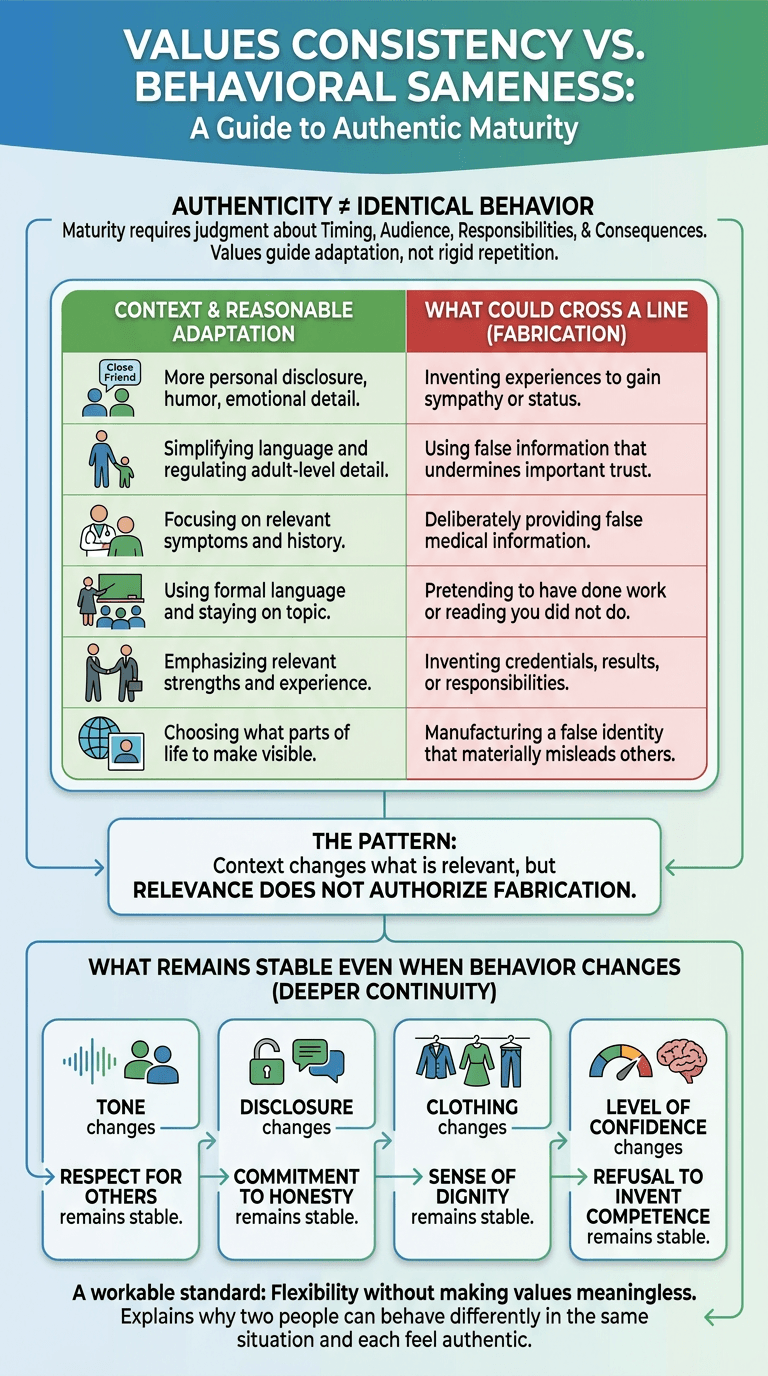
If authenticity required identical behavior across situations, ordinary maturity would look suspicious. We expect adults to use judgment about timing, audience, responsibilities, and consequences. A person can value honesty without saying every thought aloud. They can value warmth without being equally intimate with everyone. They can value independence while still accepting help in a difficult situation.
A close friend, child, doctor, classroom, interview, and public profile may require different expression
| Setting | Reasonable adaptation | What could cross a line |
|---|---|---|
| Close friend | More personal disclosure, humor, emotional detail | Inventing experiences to gain sympathy or status |
| Young child | Simplifying language and regulating adult-level detail | Using false information that undermines important trust |
| Doctor | Focusing on relevant symptoms and history | Deliberately providing false medical information |
| Classroom | Using formal language and staying on topic | Pretending to have done work or reading you did not do |
| Interview | Emphasizing relevant strengths and experience | Inventing credentials, results, or responsibilities |
| Public profile | Choosing what parts of life to make visible | Manufacturing a false identity that materially misleads others |
The pattern is clear: context changes what is relevant, but relevance does not authorize fabrication.
What can remain stable even when behavior changes
Instead of demanding sameness, look for deeper forms of continuity. Your tone may change while your respect for others remains stable. Your disclosure may change while your commitment to honesty remains stable. Your clothing may change while your sense of dignity remains stable. Your level of confidence may change while your refusal to invent competence remains stable.
This is a more workable standard because it allows flexibility without making values meaningless. It also explains why two people can behave very differently in the same situation and still each feel authentic.
The Adaptation Spectrum: Privacy → Contextual Adjustment → Strategic Emphasis → Exaggeration → Misrepresentation
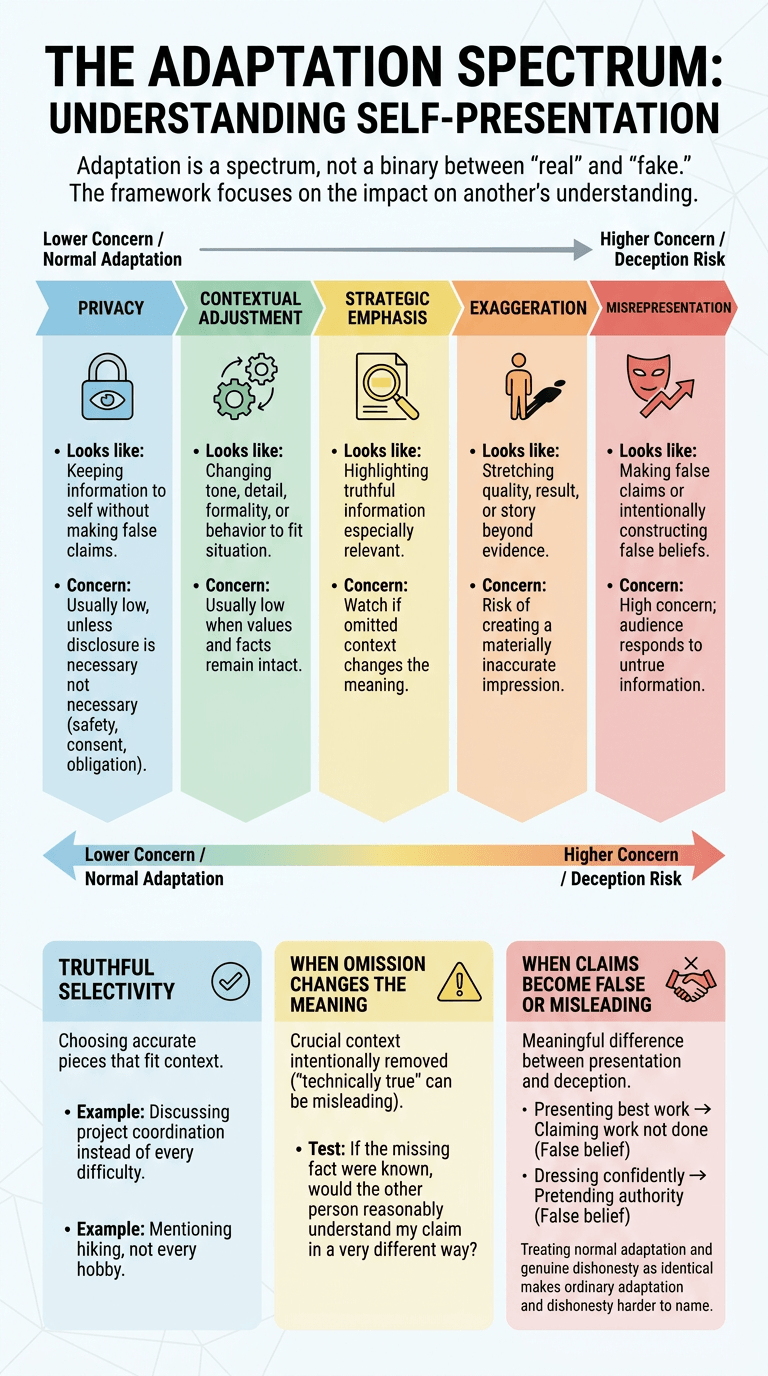
Authenticity questions become easier when adaptation is treated as a spectrum rather than a binary choice between “real” and “fake.” The following framework focuses on what the presentation does to another person’s understanding.
| Point on the spectrum | What it looks like | Typical concern |
|---|---|---|
| Privacy | You keep information to yourself without making a false claim | Usually low, unless disclosure is necessary for safety, consent, or an agreed obligation |
| Contextual adjustment | You change tone, detail, formality, or behavior to fit the situation | Usually low when values and facts remain intact |
| Strategic emphasis | You highlight truthful information that is especially relevant | Watch whether omitted context changes the meaning |
| Exaggeration | You stretch a quality, result, or story beyond what the evidence supports | Risk of creating a materially inaccurate impression |
| Misrepresentation | You make false claims or intentionally construct a false belief | High concern because the audience is responding to information that is not true |
Truthful selectivity
Truthful selectivity means choosing accurate pieces of information that fit the context. If a teacher asks about your experience leading a project, you may discuss the part where you coordinated people rather than every difficulty you faced. If a new acquaintance asks what you do for fun, you may mention hiking and not the dozen other things you occasionally enjoy.
Selection becomes misleading when the selected facts are arranged to imply something you know is false. The difference often depends on what a reasonable listener would conclude and whether that conclusion would matter.
When omission changes the meaning materially
Omission deserves more care when the missing information would substantially change another person’s decision, consent, risk assessment, or understanding of your claim. This is not a demand for total disclosure. It is a reminder that “technically true” can still be misleading when crucial context is intentionally removed.
A useful test is: If the missing fact were known, would the other person reasonably understand my claim in a very different way? If the answer is yes, the issue is no longer just presentation style.
When claims become false or intentionally misleading
There is a meaningful difference between presenting your best work and claiming work you did not do, between dressing confidently and pretending to hold authority you do not have, or between choosing a flattering photo and using someone else’s identity. The first examples involve presentation. The second create false beliefs about facts.
That line matters because self-presentation is a normal social process, while deception depends on false or intentionally misleading representation. Treating them as identical makes ordinary adaptation look suspicious and can also make genuine dishonesty harder to name clearly.
Authenticity vs Self-Presentation vs Deception
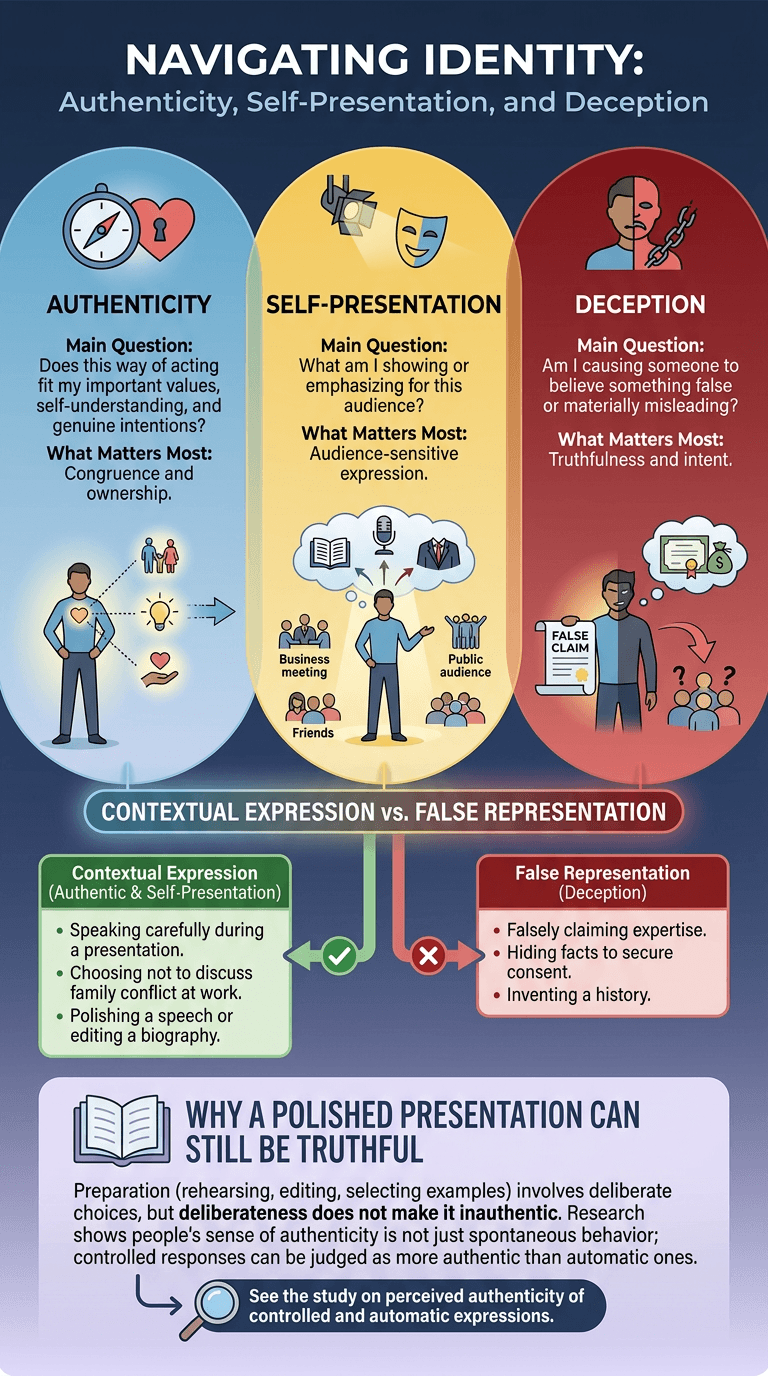
These concepts overlap, but they answer different questions.
| Concept | Main question | What matters most |
|---|---|---|
| Authenticity | Does this way of acting fit my important values, self-understanding, and genuine intentions? | Congruence and ownership |
| Self-presentation | What am I showing or emphasizing for this audience? | Audience-sensitive expression |
| Deception | Am I causing someone to believe something false or materially misleading? | Truthfulness and intent |
Contextual expression versus false representation
A person who speaks more carefully during a presentation is not necessarily pretending to be someone else. They may simply be bringing forward the part of themselves suited to a public task. Likewise, someone who chooses not to discuss a family conflict at work is not automatically hiding their “real self.” They are deciding that the information does not belong in that setting.
By contrast, falsely claiming expertise, hiding a fact specifically to secure consent under false assumptions, or inventing a history is not merely contextual expression. It changes the audience’s factual picture.
Why a polished presentation can still be truthful
Preparation often improves presentation. Rehearsing a speech, choosing clear examples for an interview, editing a biography, or selecting a professional photo all involve deliberate choices. Deliberateness alone does not make the result inauthentic.
Research on authenticity itself shows that people’s sense of being authentic cannot be reduced to spontaneous behavior. In one recent study, participants sometimes judged controlled responses as more authentic than automatic responses, illustrating that “unfiltered” and “authentic” are not synonyms. See the study on perceived authenticity of controlled and automatic expressions.
Professionalism, Politeness, and Cultural Context
Social settings come with norms. Some are practical, some are cultural, and some reflect power differences. The same level of eye contact, directness, emotional expression, humor, or personal disclosure does not carry the same meaning everywhere. Calling every adjustment “fake” ignores how much social behavior depends on context.
Why norms can change appropriate expression
Politeness often requires filtering. Professionalism often requires choosing relevant information. Family roles may require patience that you do not need with peers. Cultural expectations may affect formality, turn-taking, greetings, modesty, and how directly disagreement is expressed.
None of this means every norm should be obeyed unquestioningly. A norm can conflict with a person’s values or place unfair pressure on them. The point is narrower: adapting to social expectations does not, by itself, demonstrate inauthenticity.
Code-switching requires context, not pathologizing
People may shift language, dialect, vocabulary, accent, or register depending on who they are with. This is often called code-switching. It can reflect communication skill, group belonging, cultural navigation, safety concerns, or pressure to meet dominant norms. The meaning depends heavily on context.
An APA discussion of language, identity, and code-switching notes that changing language by context can serve belonging and navigation across groups. It would be a mistake to treat the behavior itself as evidence that a person lacks a stable or genuine identity.
When Adapting Starts to Feel Psychologically Costly
Contextual flexibility can be useful, but adaptation may become exhausting when the required presentation repeatedly conflicts with important values or when a person feels they are never allowed to reveal any meaningful part of themselves. The problem is not simply that behavior changes. The problem is the cost and direction of the change.
Chronic value conflict
Suppose a workplace expects you to sound enthusiastic about practices you believe are harmful, or a social group rewards you only when you laugh at jokes that violate your values. Repeatedly performing agreement may create a different kind of strain than simply dressing more formally or using careful language.
A practical sign is that you leave the situation thinking, “I did not just adapt. I repeatedly acted against something that matters to me.” That is worth examining. The answer may involve changing one behavior, clarifying a boundary, finding a different role, or accepting that some environments are a poor fit.
Feeling unable to reveal any important aspect of oneself
Selective disclosure is normal. Permanent self-erasure is different. If every important opinion, interest, relationship, cultural identity, or emotional reality must stay hidden to avoid punishment or retaliation, the issue may involve power and safety rather than ordinary self-presentation.
In such situations, the first priority is not to become “more authentic” in a dramatic confrontation. Consider the likely consequences, available support, privacy, and personal safety before disclosing more. Authenticity is not an obligation to reveal yourself to people who may misuse that information.
Discomfort does not automatically prove inauthenticity
New roles often feel awkward. Giving a speech in formal clothing, speaking confidently about your work, or setting a boundary may feel unlike your usual behavior precisely because it is unfamiliar. That discomfort does not necessarily mean the behavior is false.
Research using narratives of authentic and inauthentic experiences finds that people describe authenticity in several ways, including genuine expression, resisting unwanted external pressure, relational connection, and owning their actions. That complexity is visible in open-access research on authenticity in narrative identity. Feeling awkward is only one piece of information, not a verdict.
A Decision Guide for Audience Adaptation
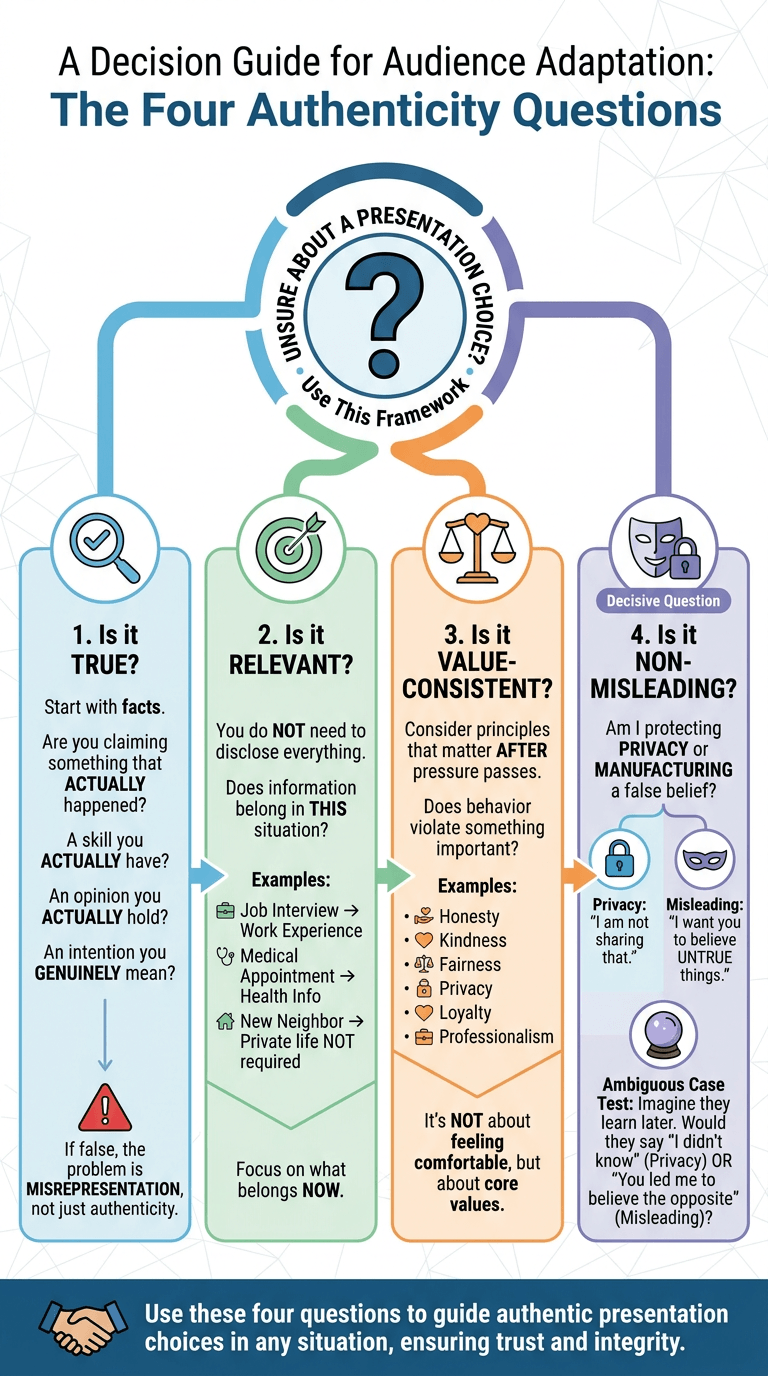
When you are unsure whether a presentation choice feels authentic, use four questions. The framework is intentionally practical: True, Relevant, Value-Consistent, Non-Misleading.
Is it true?
Start with facts. Are you claiming something that actually happened, a skill you actually have, an opinion you actually hold, or an intention you genuinely mean? If the factual base is false, concerns about authenticity are secondary to the more basic problem of misrepresentation.
Is it relevant?
You do not need to disclose everything. Ask whether the information you are emphasizing belongs in this situation. A job interview reasonably highlights work experience. A medical appointment highlights health information. A first meeting with a new neighbor does not require a complete account of your private life.
Is it consistent with important values?
Consider the principles you would still care about after the immediate pressure passes. Perhaps honesty, kindness, fairness, privacy, loyalty, independence, or professionalism matters here. The question is not whether you feel perfectly comfortable. It is whether the behavior violates something you consider important.
Am I protecting privacy or manufacturing a false belief?
This is often the decisive question. Privacy says, “I am not sharing that.” Misleading presentation says, “I want you to believe something that is not true.” In ambiguous cases, imagine the other person later learning the missing context. Would they reasonably say, “I did not know that,” or “You intentionally led me to believe the opposite”? Those reactions point to different ethical situations.
Why Online Audiences Make Authenticity Harder to Judge
Digital spaces complicate self-presentation because people can edit before posting, select images, write biographies, maintain separate accounts, and communicate to audiences that may include friends, coworkers, relatives, strangers, and future readers all at once. A carefully chosen post can be truthful while still representing only a narrow slice of life.
Research on social media has tried to measure the fit between people’s self-views and their observable online expression. One open-access study found that more authentic self-expression on social media was associated with higher subjective well-being, while also acknowledging the challenge of defining and measuring authenticity. The study is available through PubMed Central.
The key caution is not to conclude that curated equals fake. Online presentation raises separate questions about audience mixing, persistence, selective disclosure, and what a profile leaves out. Those questions deserve their own analysis.
Why Self-Verification Can Pull Toward Consistent Recognition
Sometimes the tension is not “Am I being authentic?” but “Do other people see me in a way that fits how I already understand myself?” A person who sees themselves as quiet and analytical may feel strange when others describe them as the life of the party, even if the praise is positive.
That is closer to self-verification: a preference for social feedback that fits an existing self-view. Authenticity is broader. You might act in a new, value-consistent way that initially feels unfamiliar and gradually changes how you see yourself. Wanting consistency with an old self-description does not automatically tell you whether the new behavior is genuine.
What to Do Next When You Feel Fake
Do not force yourself to answer the huge question “Am I being fake?” all at once. Make the problem smaller. Identify the exact behavior that bothered you and compare it with the demands of the situation.
Name the role demand, the value at stake, and the specific behavior that feels misaligned
Try writing three short sentences:
- The situation asked me to: describe the role demand without judging it.
- I care about: name the value that feels relevant.
- The behavior that bothered me was: name one concrete action, omission, exaggeration, or statement.
For example: “The interview asked me to describe my strengths. I care about honesty. What bothered me was saying I ‘led’ a project when I actually supported the person who led it.” That points to a specific correction. By contrast, “I spoke more confidently than I usually do” may simply reflect practicing a useful skill.
Adjust one behavior rather than demanding identical behavior everywhere
If something does feel misaligned, change the smallest meaningful piece. Correct an exaggerated claim. Stop pretending to agree with a value you reject. State a privacy boundary instead of inventing an excuse. Use a tone that feels respectful without forcing cheerfulness you do not feel.
This approach avoids two extremes: performing a version of yourself that feels false, and assuming that authenticity requires unfiltered behavior in every context. Flexibility and integrity can coexist.
FAQ About Authenticity and Self-Presentation
These questions focus on the gray areas that most often make ordinary adaptation feel suspicious: formality, privacy, audience differences, misleading impressions, and the pressure to say everything you think.
Is acting more formal at work inauthentic?
Not by itself. Formality is often a role-appropriate adjustment in language, dress, timing, or disclosure. It becomes more concerning when the role repeatedly requires false claims, denial of important values, or a level of concealment that causes substantial strain. The fact that your work behavior differs from your behavior with close friends does not prove that either version is false.
Is keeping something private a form of deception?
Usually not. Privacy means controlling access to personal information. Deception involves false or intentionally misleading representation. The distinction becomes harder when an omission is used to create a materially false belief, especially when the missing information affects consent, safety, or an agreed responsibility. You can often protect privacy more clearly by saying you prefer not to discuss something rather than creating a false explanation.
Can different audiences see different genuine sides of one person?
Yes. People have multiple roles, traits, interests, and ways of relating. A person can be serious with a client, playful with a sibling, reserved in a large group, and expressive with a trusted friend. Those differences may reflect context rather than contradiction. What matters is whether each presentation remains grounded in reality and does not require abandoning important values.
When does self-presentation become misleading?
A useful threshold is whether you are intentionally creating a belief that is materially inaccurate. Highlighting real strengths is different from inventing credentials. Choosing a flattering photo is different from using another person’s identity. Leaving irrelevant information out is different from hiding crucial context specifically so someone will make a decision they would otherwise reconsider.
Does authenticity require saying exactly what you think in every setting?
No. Authenticity is not the same as complete disclosure or impulsive expression. Timing, tact, privacy, responsibility, and audience needs all matter. You can decline to share an opinion, phrase disagreement respectfully, or wait for a safer setting without betraying yourself. The more useful question is whether your restraint is a deliberate, value-consistent choice or a repeated requirement to deny something important about yourself.
Key Takeaways
- Changing your tone, formality, disclosure, or behavior across situations does not automatically make you inauthentic.
- Values consistency is usually a better test than behavioral sameness. Different roles can bring forward different genuine parts of the same person.
- Privacy, contextual adjustment, and strategic emphasis can remain truthful; exaggeration and misrepresentation create different concerns.
- A useful check is: Is it true, relevant, consistent with important values, and unlikely to manufacture a false belief?
- Feeling awkward in a new role is not proof that the role is fake. Unfamiliar but value-consistent behavior can still be genuine.
- If adaptation requires chronic value conflict, severe self-erasure, or disclosure under fear of retaliation, the issue may involve power or safety rather than ordinary social flexibility.
One concrete next step: choose one recent moment when you thought, “That did not feel like me.” Instead of judging your whole identity, identify the exact behavior, the audience demand, the value involved, and whether the presentation was truthful. That narrower question is much easier to answer usefully.

Michael Reed is the Founder and Lead Writer at Psychology Exposed. He writes about human behavior, relationships, emotional patterns, self-awareness, and practical psychology topics using research-informed, easy-to-understand content.
Read More About Michael Reed: https://psychologyexposed.com/michael-reed/