
You may play a familiar song more sharply when friends are listening, type faster when other people are working beside you, or suddenly struggle with a new skill the moment someone watches. Those shifts are not simply a matter of confidence. In social psychology, they sit within a long line of research on how the presence of other people can alter performance.
The effect is easy to oversimplify. An audience does not automatically make people better at easy tasks and worse at hard ones. Task familiarity, attentional demands, the kind of audience, whether people expect judgment, and the exact performance measure can all matter. Understanding those conditions makes social facilitation more useful than treating it as a one-line rule.
Quick Answer
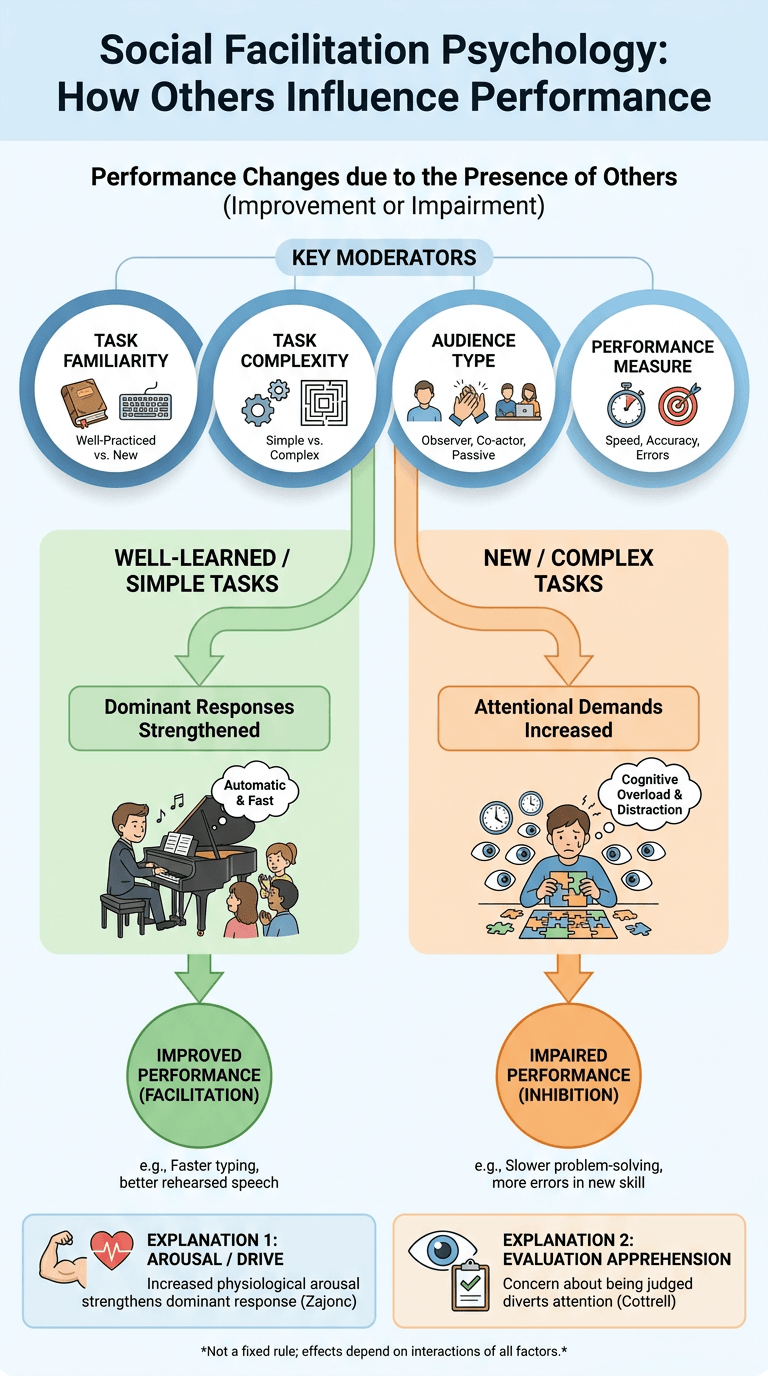
Social facilitation psychology examines how performing around other people can change what we do. Familiar or well-practiced responses may sometimes become faster or more dominant, while complex or unfamiliar tasks may suffer. However, the effect depends on task demands, audience conditions, attention, and evaluation. Being observed can influence performance without proving that anxiety, confidence, or judgment is the only cause.
What Social Facilitation Means
Social facilitation refers to changes in performance associated with the presence of other people. The term sounds as if performance must improve, but historically it covers both improvement and impairment. Some researchers therefore distinguish facilitation from social inhibition, while broader discussions use social facilitation to describe the full family of audience and co-action effects.
A large classic meta-analysis of 241 social facilitation studies helped establish that the effects are real but highly dependent on the task and conditions. That is a useful starting point: other people can matter, yet there is no single performance outcome that appears in every setting.
Performance in the presence of other people
Imagine three versions of the same activity. In the first, you practice a well-known piano passage alone. In the second, one friend quietly listens. In the third, several musicians are evaluating your accuracy. All three involve the same fingers and notes, but the social situation has changed what competes for your attention and what the performance means.
Social facilitation research asks whether those social conditions alter speed, accuracy, persistence, error rate, or another measurable feature of performance. It does not assume the performer consciously tries to impress anyone. Sometimes the relevant change may arise even when the social presence is relatively passive.
Audience settings versus co-action settings
An audience setting involves one or more people observing while the performer does the task. A co-action setting involves other people doing the same or a similar activity at the same time. Running beside other runners, typing in a room where others are typing, or practicing drills alongside teammates can create co-action conditions even when nobody is formally judging anyone.
Those arrangements should not be treated as interchangeable. Co-actors can provide pace cues, distraction, comparison, or coordination demands. An audience can create visibility without requiring joint action. A useful review of audience effects and social presence highlights how different forms of being seen can recruit different psychological processes.
The Classic Pattern and Why It Is Only a Starting Point
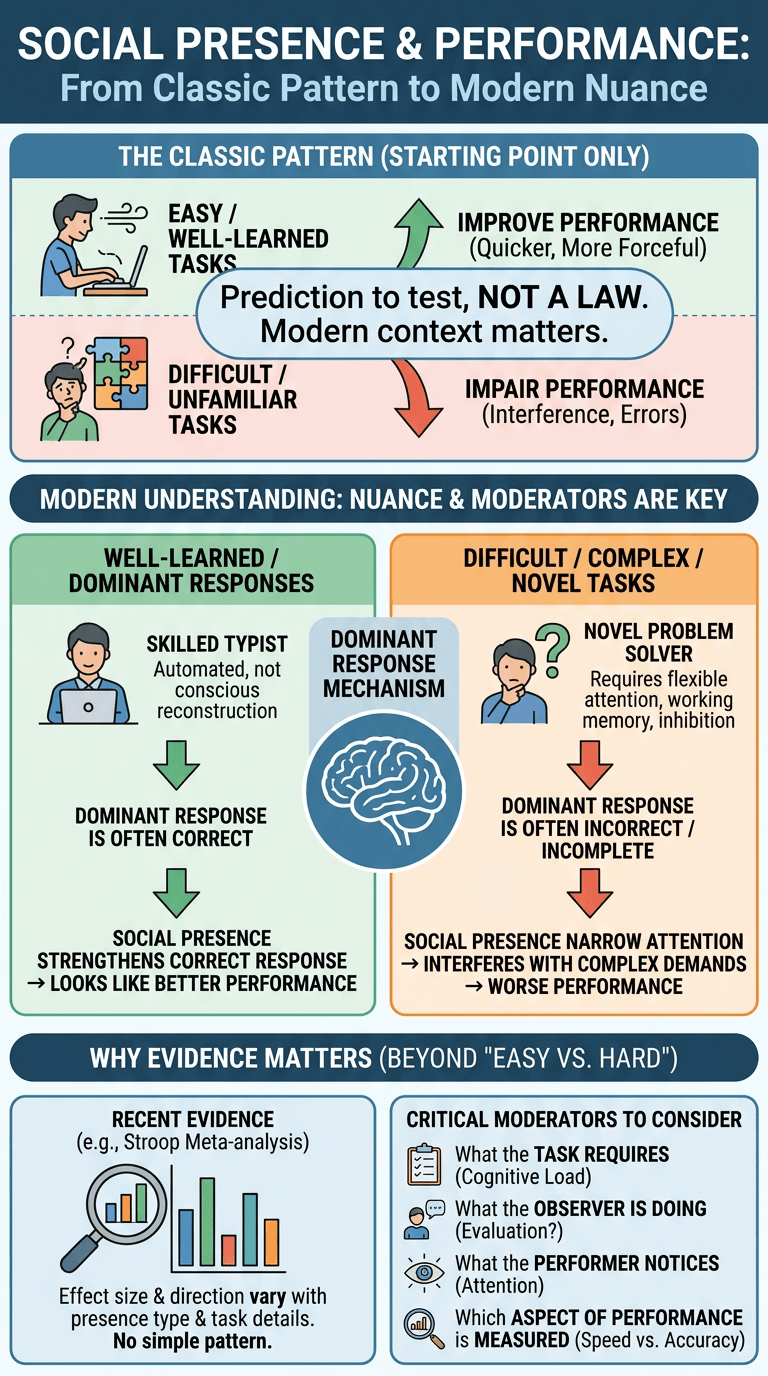
The familiar summary is that other people improve performance on easy or well-learned tasks and impair performance on difficult or unfamiliar ones. That summary captures an important historical idea, but it is better treated as a prediction to test than as a law.
Modern studies use very different tasks, audiences, settings, and performance measures. A routine motor response is not the same as a memory test, a visual search, a musical performance, or solving an unfamiliar problem. Even within the same task, speed and accuracy can move differently.
Well-learned or dominant responses
A dominant response is the response that is most likely to occur in a given situation. When a task has been practiced extensively, the dominant response may be correct. A skilled typist, for example, does not consciously reconstruct every keystroke. A practiced tennis serve or familiar presentation opening can also become highly accessible.
If social presence makes the dominant response more likely, well-practiced behavior may become quicker or more forceful. That can look like better performance. But greater response strength is only helpful when the dominant response fits the task.
Difficult, unfamiliar, or complex tasks
During a new or complicated task, the most immediately available response may be incomplete or wrong. A person learning a dance sequence may revert to the step they know best instead of the step the routine now requires. Someone solving a novel problem may grab the first familiar method rather than hold several possibilities in mind.
This is one reason audience presence can sometimes interfere with performance. Complex tasks often need flexible attention, inhibition of automatic responses, working memory, or careful error checking. Anything that narrows attention too much or increases competition for attention can make those demands harder.
Why modern evidence requires attention to moderators
Recent evidence reinforces the need for nuance. A meta-analysis of social presence effects on the Stroop task found that the presence of others changed cognitive control, but the size and direction of the effect varied with the type of presence and details of the task. The authors did not find a simple pattern in which explicit evaluation always explained the result. See the open-access Stroop social-presence meta-analysis for the full analysis.
That matters because “easy versus hard” is not enough by itself. Researchers also have to ask what the task requires, what the observer is doing, what the performer notices, and which aspect of performance is being measured.
Dominant-Response and Arousal Accounts
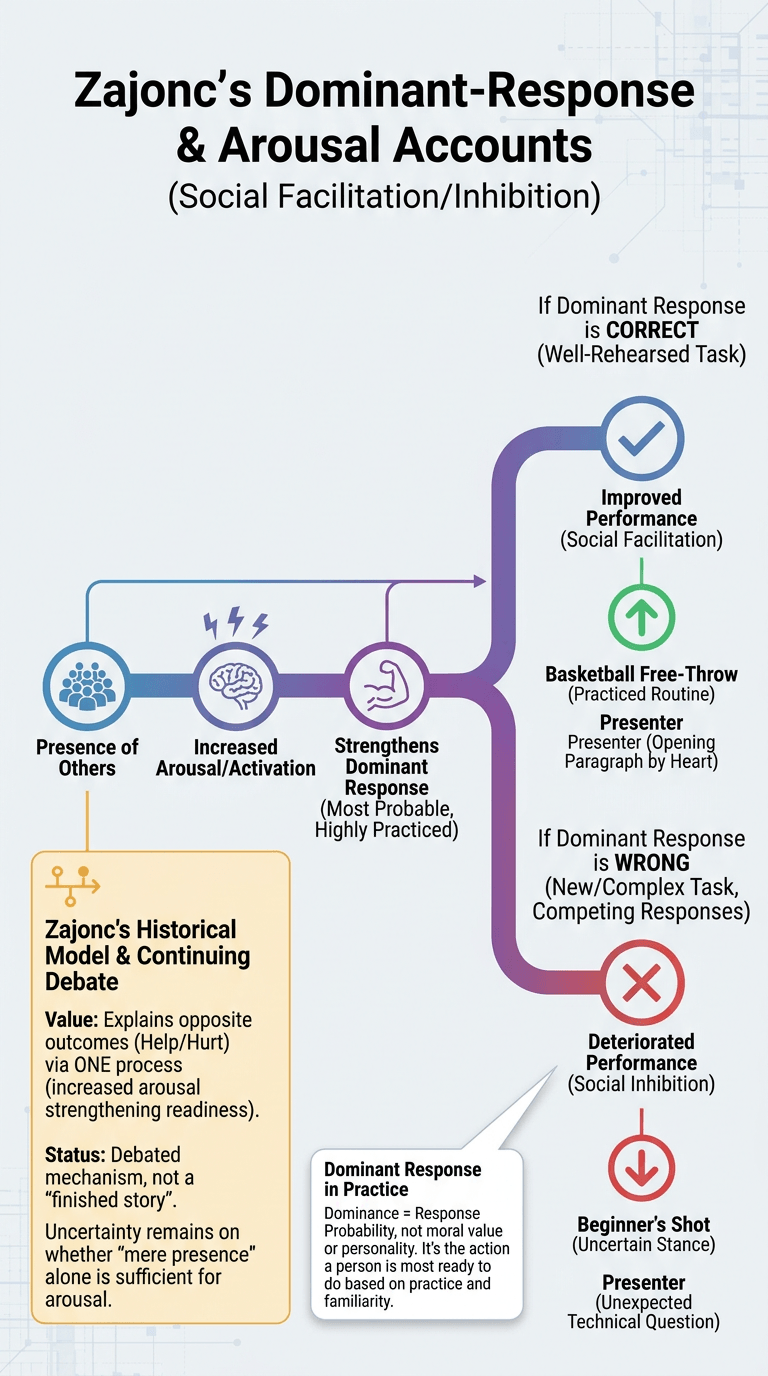
One influential explanation comes from Robert Zajonc’s work on drive and dominant responses. In simplified form, the idea is that the presence of others can increase activation or arousal, making the dominant response more likely. When that response is correct, performance may improve. When it is wrong, performance may deteriorate.
Zajonc’s historical model
The value of Zajonc’s model is that it explains how the same social condition could produce opposite outcomes without assuming two unrelated processes. The audience does not have to “help” on one task and “hurt” on another. Instead, increased activation may strengthen what the person is already most ready to do.
Later work has tested and revised that account rather than treating it as settled fact. One open-access study that re-examined the drive explanation notes both the historical importance of the model and the continuing uncertainty about whether mere presence by itself is sufficient to create the proposed arousal pathway. The re-examination of Zajonc’s drive theory is useful precisely because it shows how social facilitation remains a debated mechanism, not a finished story.
What a dominant response means in practice
Dominance is about response probability, not moral value or personality. Consider a basketball player who has practiced a free-throw routine thousands of times. The familiar sequence of stance, breath, dribble, and release may be dominant. A beginner, by contrast, may still have several competing ways of positioning the hands and feet.
The same distinction can appear in non-sport tasks. A presenter who knows an opening paragraph by heart may deliver it fluently under observation, then stumble when answering an unexpected technical question. The audience has not changed the person’s intelligence. The task has shifted from a highly practiced response to a flexible, less rehearsed one.
Evaluation Apprehension as One Proposed Explanation
Another account argues that people are not affected merely because others are present. What matters, at least in some situations, is the expectation that those people can evaluate performance. An expert panel, teacher, supervisor, coach, or respected peer may feel very different from a stranger who is physically nearby but paying no attention.
Why expected judgment can intensify audience effects
Expected judgment can change the meaning of a mistake. Missing a note alone in rehearsal is information about what needs practice. Missing the same note during an audition may also feel relevant to competence, selection, or reputation. That extra meaning can increase monitoring of one’s own behavior and make the audience harder to ignore.
However, evaluation apprehension should not be used as an all-purpose explanation. Social presence effects have also been studied when evaluation is weak, ambiguous, or absent. The recent Stroop meta-analysis mentioned above, for example, did not support the idea that explicit evaluation was necessary for the observed cognitive effect.
Why evaluation is not the only explanation
If being judged were the entire story, non-evaluative presence should have little effect. Yet the literature includes findings that point toward additional mechanisms, including arousal, attentional conflict, self-focused attention, comparison, and task-specific cognitive changes.
This is the cleanest distinction to keep in mind: social facilitation asks what happens to performance around other people; evaluation apprehension asks what happens when expected judgment becomes psychologically important. They overlap, but neither concept fully replaces the other.
Distraction-Conflict and Attention Accounts
Attention-based explanations start with a different problem. A person trying to perform has limited attention. If another person is salient, attention may be divided between the focal task and the social environment. That competition can change how broadly or narrowly the performer processes information.
Divided attention between task and audience
Picture a student solving a complex logic problem while a classmate sits nearby and occasionally looks over. The student may keep switching between the problem and thoughts about the other person. That switching consumes resources even if the classmate never speaks.
On a simple task, a narrower attentional focus may sometimes filter irrelevant information and make the central response more efficient. On a complex task, the same narrowing can remove cues that are actually needed. The effect depends on what the task demands rather than on distraction being universally good or bad.
When attentional load can help or hinder
A useful way to think about this is task demand versus available attention. If the task needs only a small set of familiar cues, social presence may leave enough capacity to perform well. If the task requires broad monitoring, multiple rules, memory updating, or inhibition of an obvious response, even a modest social demand can become costly.
This also explains why two people can react differently in the same room. The task may be automatic for one person and cognitively expensive for another. “Difficulty” is partly a property of the task, but it is also related to the performer’s current level of practice.
What Changes the Effect
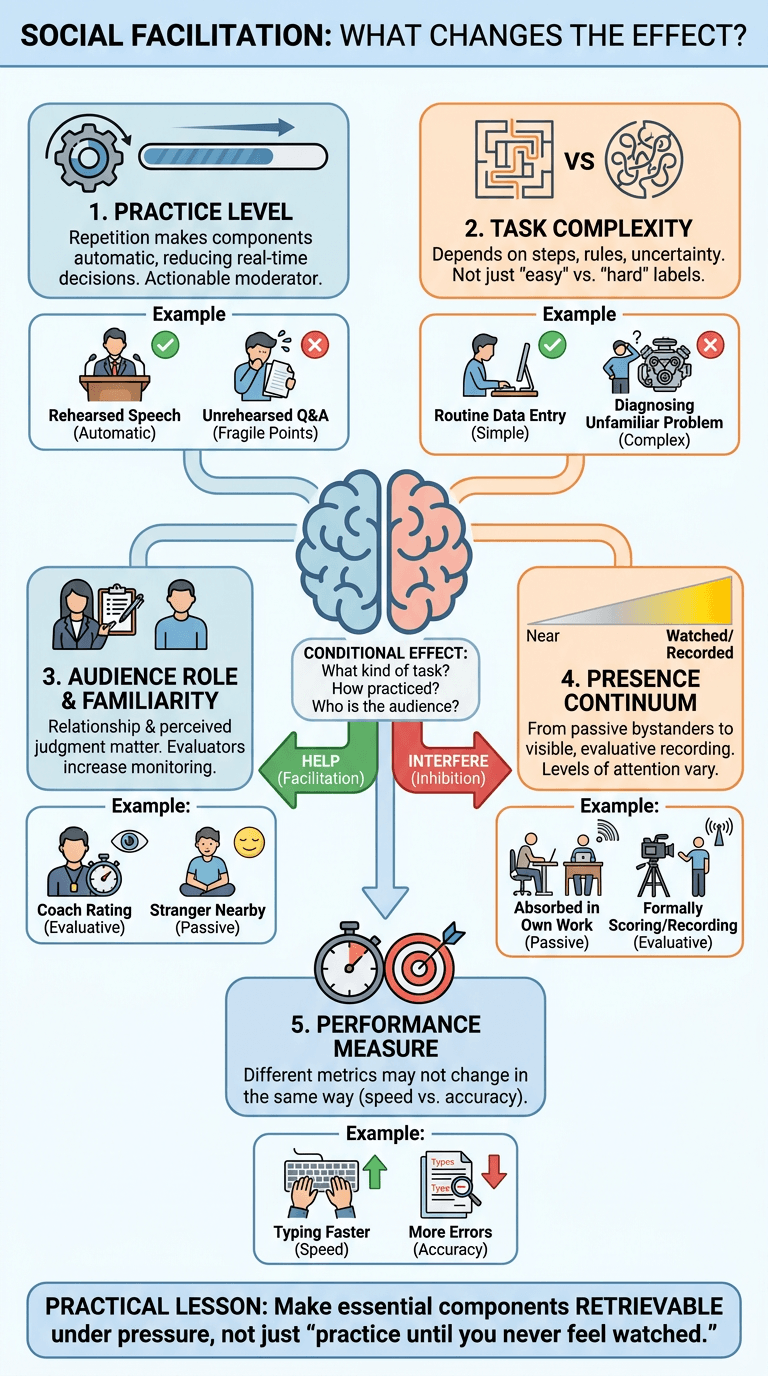
Social facilitation is best understood as a conditional effect. Before predicting whether other people will help or interfere, ask what kind of task is being performed, how practiced it is, and what the audience actually represents to the performer.
| Factor | Why it may matter | Example |
|---|---|---|
| Practice level | Practice changes which response is most dominant | A rehearsed speech opening versus an unrehearsed Q&A |
| Task complexity | Complex tasks often need broader attention and flexible control | Routine data entry versus diagnosing an unfamiliar technical problem |
| Audience role | An evaluator may create different demands from a passive bystander | A coach rating performance versus a stranger waiting nearby |
| Audience familiarity | Familiar people may feel supportive, distracting, competitive, or evaluative depending on context | Practicing music for a close friend versus a selection panel |
| Performance measure | Speed, accuracy, memory, and persistence may not change in the same way | Typing faster but making more errors |
Practice level and task familiarity
Practice is one of the most actionable moderators because it changes what becomes automatic. Repetition can reduce the number of decisions a performer must make in real time. It can also expose fragile points that only appear under pressure, such as a transition in a song or a step in a presentation that has not been rehearsed aloud.
The practical lesson is not “practice until you never feel watched.” It is to make essential task components more retrievable when attention is partly occupied by the social setting.
Task complexity
A task can be difficult for several reasons. It may require many steps, unfamiliar rules, rapid updating, fine motor control, or uncertainty about what counts as correct. These different forms of complexity can interact with observation differently.
That is why labels such as easy and hard should be used cautiously. A complex activity can contain highly practiced subskills, while an apparently simple task may be difficult for someone who is new to it.
Audience expertise and familiarity
An audience is not a neutral unit. A knowledgeable observer may increase monitoring because their judgment feels diagnostic. A familiar peer may reduce threat for one person but increase comparison for another. A supportive coach can still be highly evaluative if the performer believes a place on the team depends on the result.
The observer’s relationship to the performer therefore matters alongside the number of observers. The psychological question is not only “Who is there?” but “What does their presence mean in this situation?”
Being watched versus merely being near others
Presence exists on a continuum. Someone may be in the same room but absorbed in their own work, visibly watching, recording a performance, or formally scoring it. Those conditions create different levels of attention and evaluation.
A meta-analysis of third-party observation during neuropsychological testing found that observer presence was associated with poorer performance overall, with effects varying by cognitive domain, observer visibility, and number of observers. The observer-effect meta-analysis in neuropsychological testing is a useful reminder that context and measurement can substantially change the outcome.
Everyday Examples of Social Facilitation
The concept becomes clearer when the examples preserve the distinction between task performance and emotional diagnosis. A performance change around other people may reflect several interacting processes, not proof that the person is confident, anxious, competitive, or approval-seeking.
Sport and rehearsed physical skills
A practiced sprinter may run with greater intensity in a competitive setting, while a beginner trying to remember a new starting technique may lose form. A basketball player may execute a familiar warm-up drill smoothly in front of teammates but make more mistakes when learning a new movement sequence.
What to notice next: separate the skill that is already automatic from the skill that still requires conscious control. If the audience effect changes sharply at that boundary, practice level may be more informative than a global label such as “bad under pressure.”
Music and public demonstrations
A guitarist may play a familiar song with more energy for a small audience yet stumble when sight-reading an unfamiliar passage. A person demonstrating a craft may perform the standard steps smoothly but lose track when an observer asks an unexpected question halfway through.
What to notice next: rehearse transitions and interruptions, not only the ideal sequence. Public performance often becomes difficult at the points where the task shifts from automatic execution to flexible problem solving.
Typing and routine work
Someone doing familiar data entry in a shared workspace may increase pace simply because others are active nearby. But faster output does not automatically mean better performance. If error rate also rises, the social condition may have strengthened speed at the cost of accuracy.
What to notice next: choose the metric that actually matters. “I work better around others” may be true for speed but false for precision, memory, or complex judgment.
New problem solving and complex tasks
A student may solve familiar practice problems comfortably in a study group, then struggle when the group watches them work through a new problem on a board. The social setting adds attention demands at the same moment the task requires exploration, inhibition of premature answers, and tolerance for uncertainty.
What to notice next: build private practice for the genuinely new material, then gradually add observation once the solution process is more stable. This is not about hiding weakness. It is about matching the practice environment to the stage of learning.
Social Facilitation vs Evaluation Apprehension
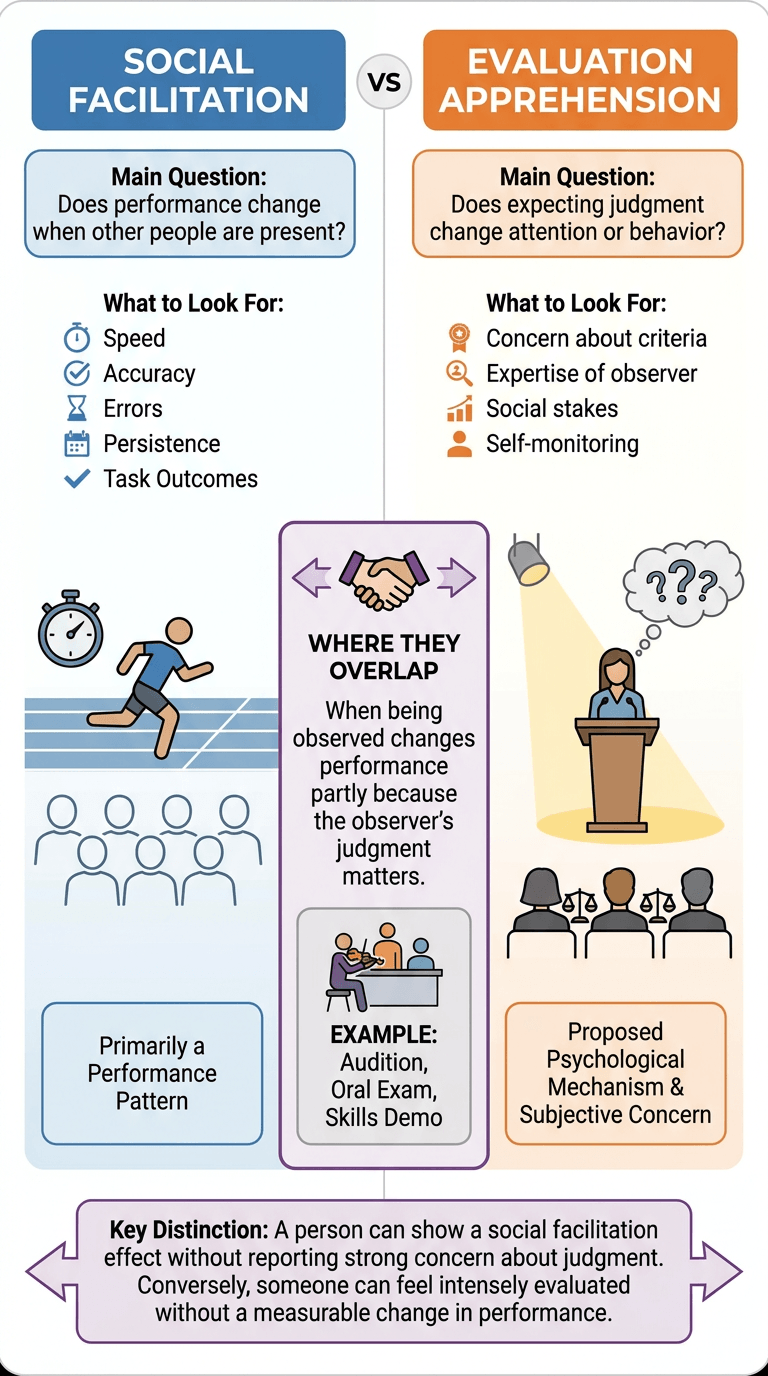
These concepts are related enough that they are often blurred together, but they answer different questions.
| Concept | Main question | What to look for |
|---|---|---|
| Social facilitation | Does performance change when other people are present? | Speed, accuracy, errors, persistence, or other task outcomes |
| Evaluation apprehension | Does expecting judgment change attention or behavior? | Concern about criteria, expertise of observer, social stakes, self-monitoring |
| Co-action | Does doing a task alongside others change performance? | Pacing, comparison, shared activity, attentional competition |
Performance outcome versus concern about judgment
A person can show a social facilitation effect without reporting strong concern about judgment. Conversely, someone can feel intensely evaluated without showing a measurable change on the task. One is primarily a performance pattern; the other is a proposed psychological mechanism and subjective concern.
Where the concepts overlap
They overlap when being observed changes performance partly because the observer’s judgment matters. An audition, oral exam, skills demonstration, or formal review may combine social presence with explicit evaluation. In those situations, it can be useful to ask both questions: what changed in performance, and how much did expected judgment occupy attention?
Social Facilitation vs Social Anxiety and Performance Anxiety
A person performing differently around others does not, by itself, indicate an anxiety disorder. Social facilitation is a social-psychological effect studied across many ordinary performance settings. It can occur in people who feel little conscious fear and can involve improvement as well as impairment.
A social psychology effect is not a diagnosis
Clinical social anxiety involves a broader pattern of fear, avoidance, distress, and impairment that cannot be inferred from a single audience effect. Likewise, the everyday phrase “performance anxiety” can describe many levels of discomfort and does not identify a specific cause.
If someone experiences persistent fear of scrutiny that substantially interferes with school, work, relationships, or daily activities, a qualified professional can help assess the broader picture. The point is to avoid turning a common audience effect into a diagnosis based on one performance.
Why clinically significant fear requires a different frame
When fear becomes the central problem, the most useful questions change. The issue is no longer only whether presence alters task performance, but whether the person is avoiding important activities, experiencing severe distress, or organizing daily life around preventing evaluation.
That distinction protects both accuracy and self-understanding. A missed note in front of an audience, a slower answer during an observed test, or a shaky first presentation may simply show that social conditions changed performance on that occasion.
What Preparation Can Change
You cannot control every audience or every reaction, but preparation can change the task itself. The goal is not to eliminate awareness of other people. It is to reduce the amount of fragile, unpracticed processing that must happen while attention is already divided.
Increase task familiarity
Practice the parts most likely to become bottlenecks. For a presentation, that may be the first minute, slide transitions, and answers to predictable questions. For music, it may be recovery after an error. For a technical demonstration, it may be explaining each step aloud while performing it.
This kind of practice changes the probability of a useful response being available when the social setting adds activation or distraction.
Rehearse under realistic audience conditions
Private practice and public practice train different demands. Once a skill is stable enough, add realistic social conditions gradually: one familiar observer, a small group, a camera, questions, time pressure, or the actual room if possible.
A 2026 study on videoconferencing found that social-presence effects can also appear in remote performance settings, with outcomes depending on how the other person is presented through the interface. That research on videoconferencing and audience-related performance changes is a reminder that “being watched” is no longer limited to a physically shared room.
Reduce avoidable attentional conflict
Some distractions are part of the performance, but others can be removed. Close unnecessary windows before a screen-share, simplify notes, arrange equipment consistently, and decide in advance where to look after a mistake. These steps preserve attention for the task rather than for preventable decisions.
A useful preparation question is: Which part of this task still requires so much conscious attention that an audience could easily crowd it out? That answer often points to the highest-value practice target.
When the Important Issue Is the Audience’s Judgment Rather Than Presence
Sometimes the performer does fine around other people until those people become evaluators. A musician may rehearse comfortably with peers but struggle during an audition. An employee may explain a process clearly to coworkers but become highly self-monitoring when a senior reviewer scores the demonstration.
In that case, the central issue is not simply social presence. Expected judgment, uncertainty about criteria, and the stakes attached to the evaluation deserve separate attention. That is the territory of evaluation apprehension rather than social facilitation alone.
FAQ About Social Facilitation Psychology
Social facilitation is often taught with a memorable rule, but the questions below show why the real phenomenon is more conditional.
Does an audience always improve easy tasks?
No. The classic model predicts that dominant or well-learned responses may be strengthened around others, but modern findings depend on task design, audience conditions, performance measures, and individual context. An apparently easy task can still suffer if the audience is distracting, the performer changes strategy, or speed improves while accuracy declines.
Can people perform worse even on familiar tasks?
Yes. Familiarity makes one prediction more plausible, not inevitable. Fatigue, explicit evaluation, divided attention, unusual stakes, equipment changes, or over-monitoring can interfere with a skill that is normally automatic. It is more useful to examine what changed in the situation than to assume familiarity guarantees facilitation.
Is evaluation apprehension the same as social facilitation?
No. Social facilitation concerns changes in task performance associated with the presence of others. Evaluation apprehension concerns the expectation of being judged and is one proposed explanation for some audience effects. A person can experience one without a strong measurable version of the other.
Does social facilitation require being directly watched?
Not necessarily. Research distinguishes direct audiences, co-actors, passive presence, and other forms of social context. Effects vary across those conditions. What matters is not simply whether another person exists nearby, but how that social presence interacts with attention, task demands, and the meaning of the situation.
Why do researchers distinguish co-action from an audience?
Because doing a task beside other performers can introduce pacing, comparison, coordination, and shared activity that a passive audience may not. Separating the conditions helps researchers test whether the change comes from observation, joint activity, evaluation, distraction, or some combination of these processes.
Key Takeaways
- Social facilitation describes performance changes around other people, not only improvement.
- Well-practiced responses may sometimes become more dominant under social presence, while new or complex tasks can require attention that an audience competes for.
- Evaluation apprehension is one possible mechanism, but it is not identical to social facilitation and does not explain every finding.
- Practice level, task complexity, audience role, observer visibility, and the performance metric can all change the outcome.
- A useful next step is to identify which part of a task is still effortful, then practice that part before adding realistic audience conditions.

Michael Reed is the Founder and Lead Writer at Psychology Exposed. He writes about human behavior, relationships, emotional patterns, self-awareness, and practical psychology topics using research-informed, easy-to-understand content.
Read More About Michael Reed: https://psychologyexposed.com/michael-reed/