
You can know your material, understand the task, and still feel your attention change the moment someone important starts judging what you do. A student may answer easily in a study group but second-guess every sentence during an oral exam. An employee may explain a process clearly to a coworker, then become unusually careful when a supervisor scores the same explanation. A musician may play comfortably around friends but monitor every note during an audition.
That shift is not always about lacking skill, and it is not automatically a mental health condition. Evaluation apprehension is a social-psychology concept that focuses on what happens when people expect their behavior or performance to be judged. The key issue is not simply that another person is present. It is that the other person seems able to evaluate, compare, approve, reject, reward, penalize, remember, or communicate what they see.
Understanding that distinction helps separate ordinary concern about judgment from social facilitation, the spotlight effect, and clinically significant social anxiety. It also points toward practical changes, especially when unclear criteria, high stakes, or excessive self-monitoring are making a task harder than it needs to be.
Quick Answer
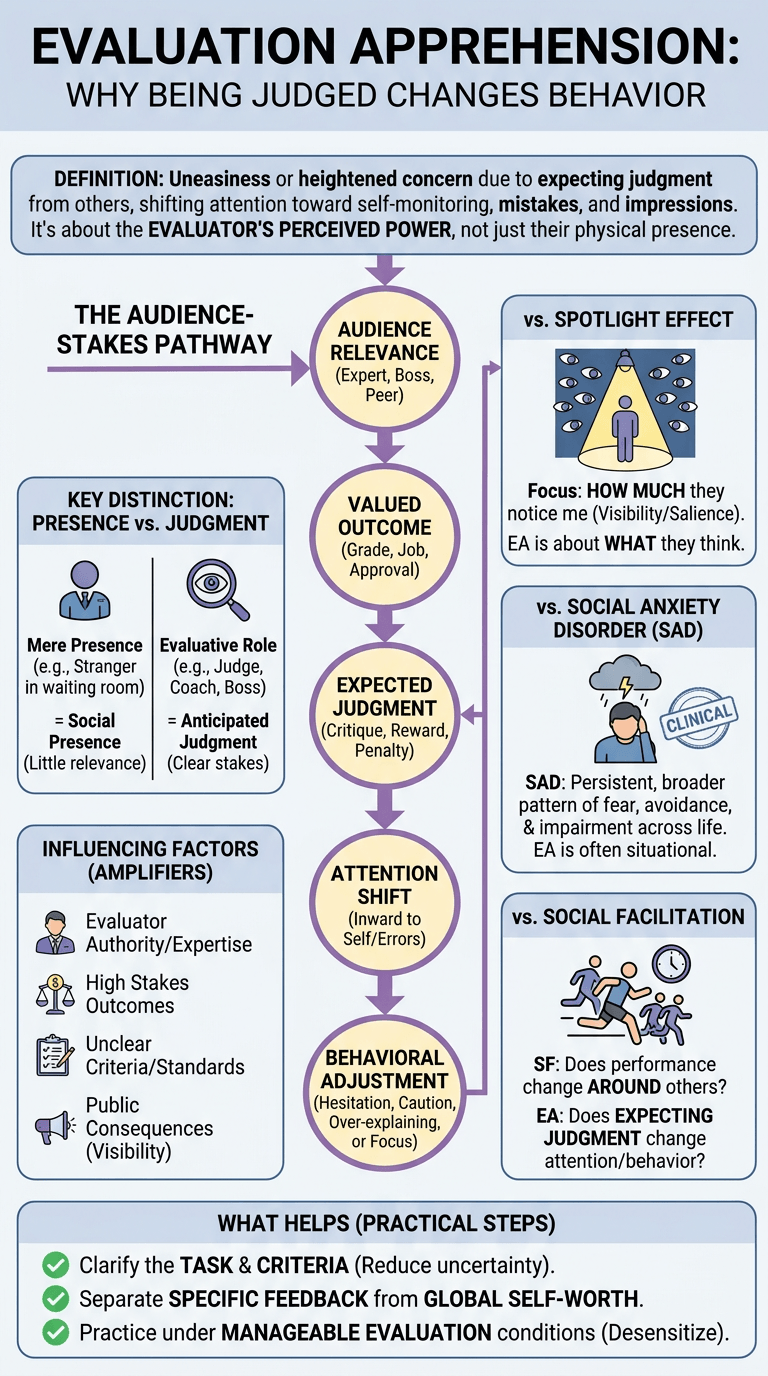
Evaluation apprehension is uneasiness or heightened concern that appears when people expect others to judge them. It may shift attention toward mistakes, impressions, consequences, and self-monitoring, which can change behavior or performance. The effect is different from simply being observed, from overestimating how much people notice you, and from Social Anxiety Disorder, which involves a broader pattern of clinically significant fear and impairment.
What Evaluation Apprehension Means
The APA Dictionary of Psychology definition of evaluation apprehension centers on worry about being judged by others. In everyday settings, that concern can range from mild alertness before a presentation to intense self-monitoring during a high-stakes interview. The concept does not require panic, nor does it mean the person believes the evaluator is hostile.
The simplest way to understand it is this: the audience matters because its judgment matters. A stranger quietly sitting in a waiting room is socially present, but may have little relevance to your performance. A teacher grading an answer, a coach selecting a lineup, a panel evaluating a demonstration, or a respected peer giving feedback has a clearer evaluative role.
Anticipated judgment rather than simple audience presence
Imagine practicing a short speech in three rooms. In the first, you are alone. In the second, another person is nearby but wearing headphones and working on something unrelated. In the third, the same person holds a scoring sheet and has been asked to rate your clarity. Physical presence changes between the first and second rooms, but the meaning of the audience changes most sharply in the third.
Classic research tried to separate these conditions. Cottrell and colleagues compared an audience with people who were present but not acting as spectators, helping establish the idea that the potential for evaluation may matter beyond mere presence. Later research has complicated the picture, but the distinction remains useful: being around people and expecting judgment are not psychologically identical situations.
Why ordinary concern about evaluation is not automatically a disorder
Most people care more about some judgments than others. You may pay extra attention when your work affects a grade, job decision, competition result, public reputation, or opportunity you value. That concern may be uncomfortable, but discomfort alone does not establish a diagnosis.
A useful first question is not, “Why am I anxious around people?” but, “What exactly do I think is being evaluated here?” The answer may be accuracy, competence, likability, professionalism, creativity, reliability, or simply whether you meet a stated standard. Naming the perceived criterion often makes the experience more specific and less mysterious.
Observed vs Evaluated
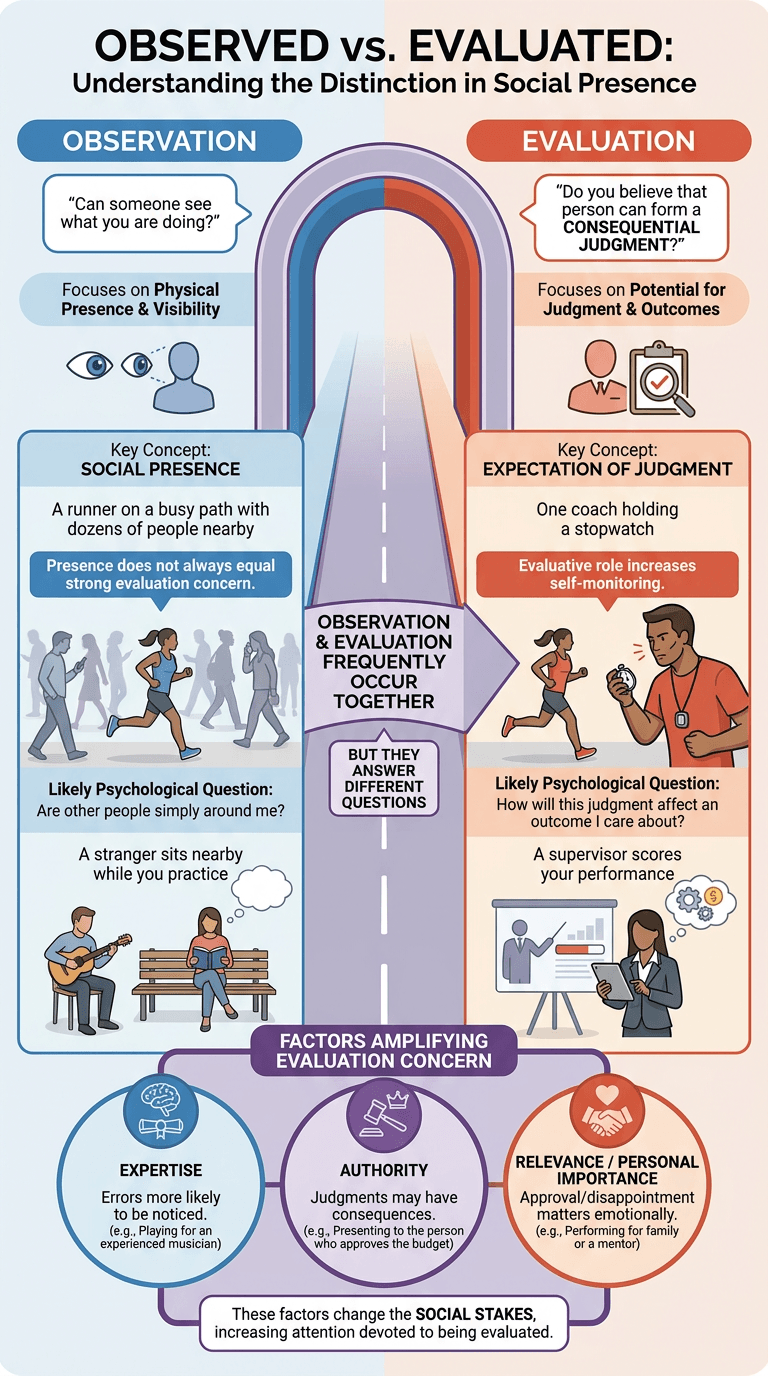
Observation and evaluation frequently occur together, which is why they are easy to confuse. Yet they answer different questions. Observation concerns whether someone can see what you are doing. Evaluation concerns whether you believe that person can form a consequential judgment about it.
| Situation | What is present | Likely psychological question |
|---|---|---|
| A stranger sits nearby while you practice | Social presence | Are other people simply around me? |
| A colleague watches informally | Observation with uncertain stakes | Are they paying attention, and does their opinion matter? |
| A supervisor scores your performance | Explicit evaluation | How will this judgment affect an outcome I care about? |
| A respected expert watches without stating criteria | Implied evaluation | What standard might they be using? |
Someone can be present without being seen as an evaluator
A room full of people does not always create strong evaluation concern. Consider a runner on a busy path. Dozens of people may see the runner, but most are occupied with their own activity. By contrast, one coach holding a stopwatch may produce more self-monitoring than the entire crowd because the coach has an obvious evaluative role.
This is also why privacy alone does not remove evaluation apprehension. A recorded test, a reviewed portfolio, or an asynchronous performance can still feel evaluative even when nobody is physically present at the moment. What matters is the expectation that someone will later judge what was captured.
Why expertise, authority, or relevance changes the meaning of an audience
Judgment tends to carry more weight when the evaluator is seen as knowledgeable, powerful, personally important, or connected to an outcome. A beginner guitarist may tolerate mistakes around family but become highly vigilant when playing for an experienced musician. An employee may feel relaxed explaining an idea to a friend and much more careful when presenting it to the person who approves the budget.
The evaluator’s role changes the social stakes. Expertise suggests that errors may be noticed. Authority suggests that judgments may have consequences. Personal importance means approval or disappointment may matter emotionally. None of these guarantees worse performance, but each can increase how much attention is devoted to being evaluated.
The Audience-Stakes Pathway
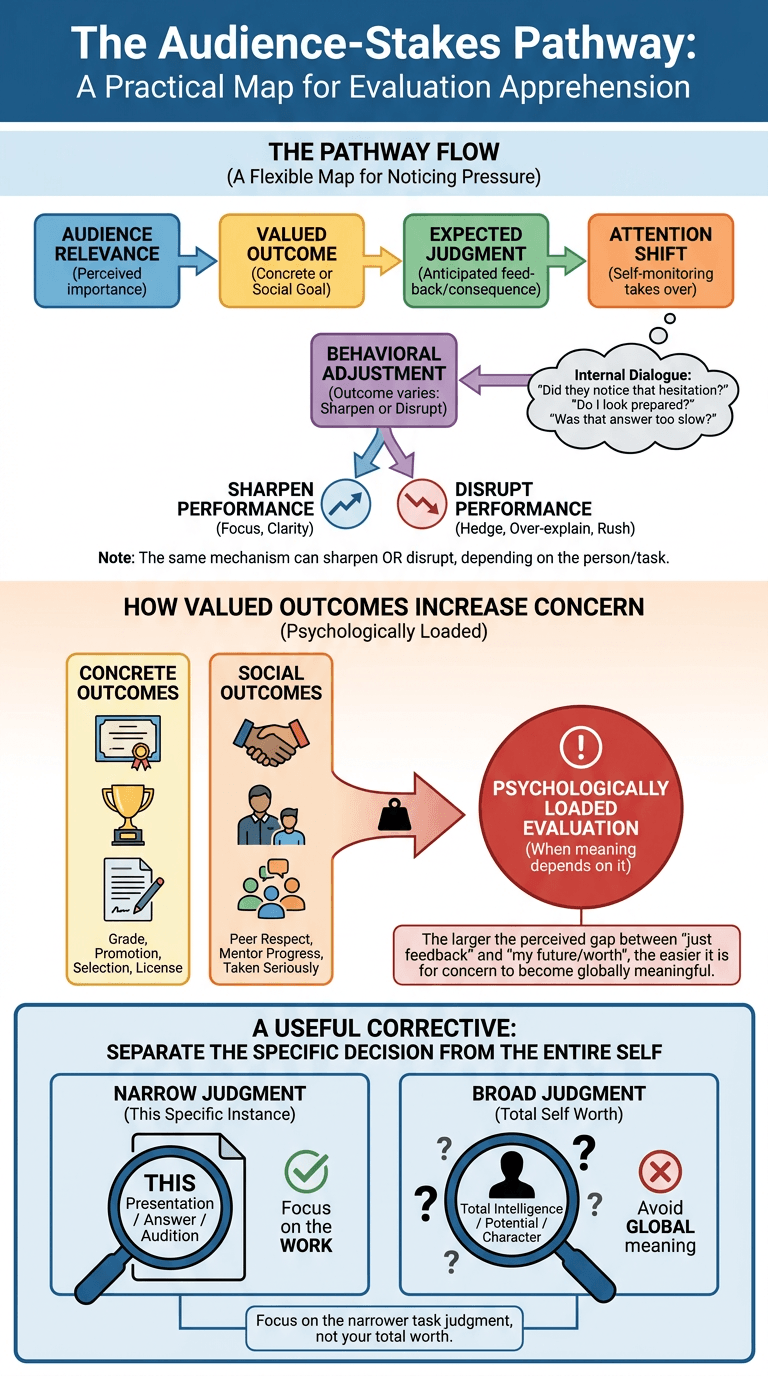
A useful way to organize evaluation apprehension is:
Audience relevance → valued outcome → expected judgment → attention shift → behavioral adjustment
This pathway is not a claim that every evaluation follows the same sequence. It is a practical map for noticing where pressure enters. Two people can face the same evaluator and react differently because they value different outcomes, expect different consequences, or interpret the criteria differently.
Audience importance → expected judgment → self-focused attention → behavioral adjustment
Suppose you are demonstrating a skill to a respected instructor. Before the evaluation begins, part of your attention may move away from the task and toward questions such as: “Did they notice that hesitation?” “Do I look prepared?” “Was that answer too slow?” “What will this mistake mean?” The task is still present, but now the mind is also monitoring the self as an object of judgment.
That extra monitoring can lead to different behaviors. Some people speak less, hedge more, check work repeatedly, rush to avoid silence, over-explain, or stick closely to familiar responses. Others become more focused because the evaluation gives the task clear importance. The same social mechanism can therefore sharpen or disrupt performance depending on the person, task, and setting.
How valued outcomes increase evaluation concern
Evaluation becomes more psychologically loaded when something meaningful appears to depend on it. The outcome may be concrete, such as a grade, promotion, selection decision, or license. It may also be social, such as wanting to be taken seriously by peers or wanting a mentor to see genuine progress.
The larger the perceived gap between “this is just feedback” and “this judgment says something important about me or my future,” the easier it is for evaluation to become globally meaningful. One useful corrective is to separate the specific decision from the entire self. A reviewer may be judging this presentation, this answer, this audition, or this piece of work. That is narrower than judging your total intelligence, worth, potential, or character.
What Evaluation Concern Can Change
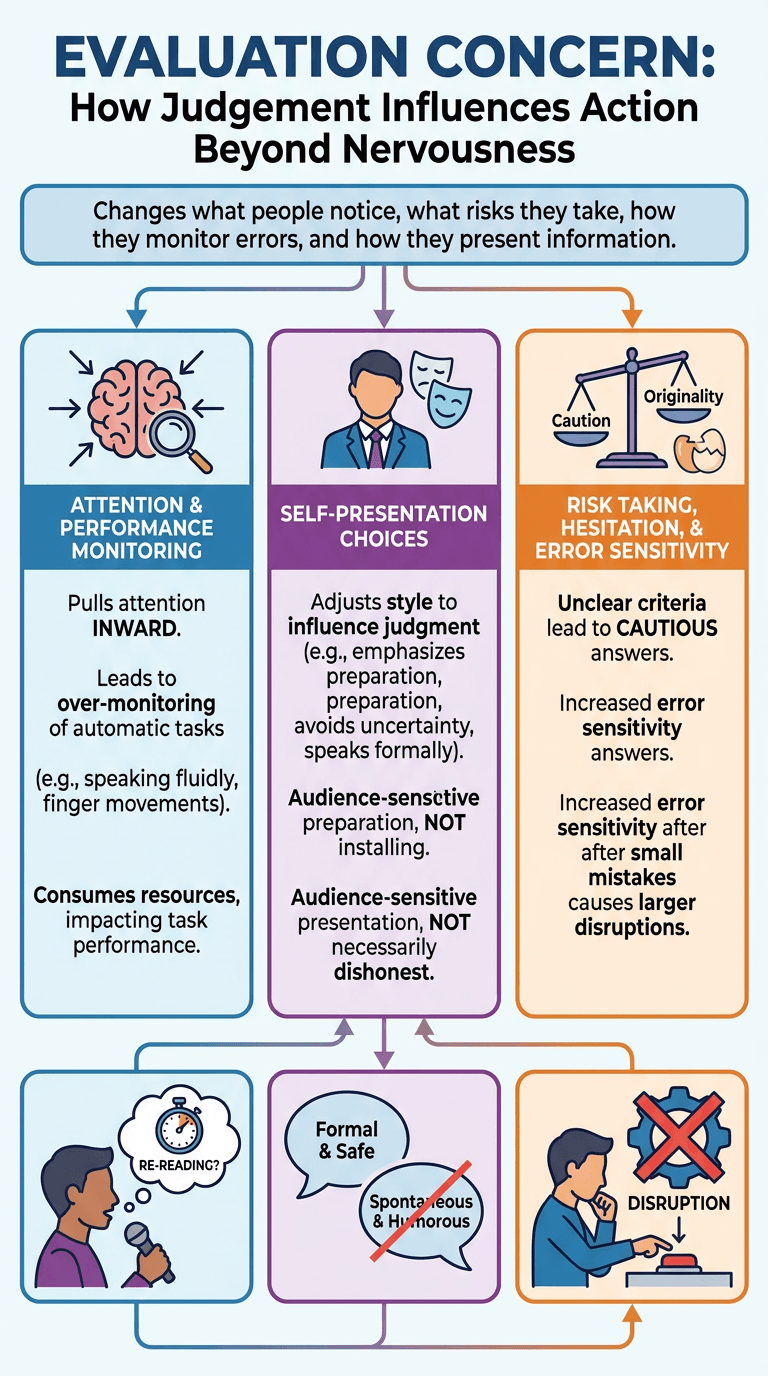
Expected judgment can influence more than visible nervousness. It may change what people notice, what risks they take, how they monitor errors, how they present information, and how quickly they abandon an uncertain response.
Attention and performance monitoring
Evaluation can pull attention inward. A person who normally speaks fluidly may begin listening to their own voice while simultaneously trying to remember what to say. A pianist may start consciously controlling finger movements that usually run automatically. A student may reread a simple answer several times because each possible error feels more consequential.
This kind of monitoring is not always harmful. Quality control matters when accuracy is important. The problem arises when monitoring consumes resources needed for the task itself or keeps restarting decisions that were already adequate.
Self-presentation choices
Evaluation also changes what people choose to show. Someone may emphasize preparation, avoid admitting uncertainty, choose safer examples, speak more formally, or reduce spontaneous humor when they believe those choices will affect how they are judged.
That does not automatically mean the person is being fake. Audience-sensitive presentation is common in ordinary social life. The important distinction is whether the person is selecting truthful information and adjusting style, or creating a materially false impression. Evaluation apprehension explains why the judgment becomes salient; it does not prove anything about honesty.
Risk taking, hesitation, and error sensitivity
Some evaluations reward originality, experimentation, or fast decisions. Others reward precision and rule-following. If the criteria are unclear, people may default to the option that feels least socially costly. That can produce cautious answers, reduced participation, or excessive reliance on familiar methods.
Error sensitivity can also increase after a small mistake. One missed word during a presentation may become the center of attention, causing the speaker to monitor the next sentence so intensely that fluency decreases. The original error may have been minor, while the response to the error creates the larger disruption.
Unclear Criteria and High-Stakes Evaluation
Judgment tends to be easier to manage when the standard is understandable. “Explain the process accurately in five minutes” provides a clearer target than “Make a strong impression.” Ambiguous standards force the performer to guess what the evaluator values, which adds another task on top of the task itself.
Why uncertainty about what counts as ‘good’ can increase monitoring
When criteria are vague, people often monitor multiple possibilities at once: Am I being too detailed? Too brief? Too confident? Not confident enough? Too formal? Too casual? The person is no longer just doing the work. They are trying to infer an invisible scoring system while doing it.
That uncertainty is especially demanding when feedback is delayed. Without clear information, the mind may treat every facial expression, pause, or note-taking gesture as possible evidence. Those guesses can be wrong. An evaluator looking serious may simply be concentrating.
Why public consequences can increase impression motivation
Evaluation often feels stronger when results are visible to other people or likely to affect future interactions. A private coaching note may feel different from a score posted to a team. A draft reviewed by one colleague may feel different from a live demonstration in front of a group that will remember it.
The psychology here is not limited to embarrassment. Public consequences can affect reputation, opportunities, belonging, or future expectations. That is why two evaluations with identical technical criteria may feel very different if one is private and the other is socially visible.
Evaluation Apprehension and Social Facilitation
Evaluation apprehension became influential partly because researchers were trying to explain social facilitation, the finding that performance can change in the presence of other people. One proposal was that presence matters because people learn that observers often evaluate them.
Modern reviews treat that explanation as important but not complete. A broad review of social facilitation theories and audience evaluation notes that researchers have not isolated one single process that explains every social-presence effect. Mere presence, evaluation, distraction, attention, motivation, and task structure have all played roles in different accounts.
Evaluation as one proposed explanation for some audience-performance effects
Evaluation apprehension is especially relevant when observers seem capable of judging performance. A knowledgeable audience, visible scoring system, explicit review, or meaningful consequence makes the evaluation hypothesis more plausible than in a setting where other people are simply nearby.
Even then, evaluation is not the only thing happening. The audience may distract attention, change effort, create competition, alter arousal, or make familiar responses more dominant. A good explanation stays conditional rather than forcing every effect into one mechanism.
Why the concepts are not synonyms
Social facilitation asks: Does performance change when other people are present?
Evaluation apprehension asks: Does expecting judgment change attention, behavior, or performance?
A person can experience strong evaluation concern without showing a measurable change in performance. Another person can show an audience-related performance change without reporting strong conscious worry about judgment. The concepts overlap in some situations, but they are not interchangeable.
Evaluation Apprehension vs Spotlight Effect
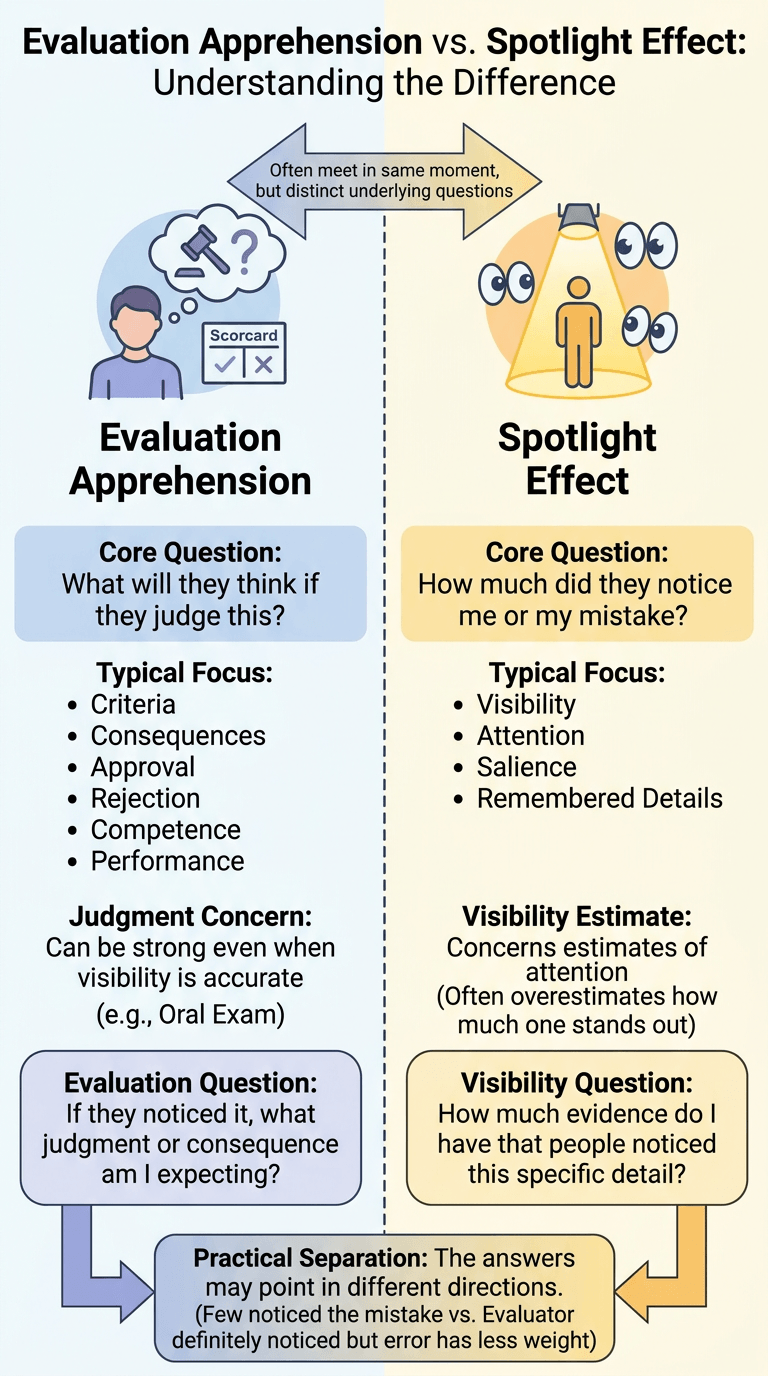
These two ideas often meet in the same moment. You may both worry about being judged and overestimate how much other people noticed a small mistake. Still, the underlying questions are different.
| Concept | Core question | Typical focus |
|---|---|---|
| Evaluation apprehension | What will they think if they judge this? | Criteria, consequences, approval, rejection, competence, performance |
| Spotlight effect | How much did they notice me or my mistake? | Visibility, attention, salience, remembered details |
What will people think versus how much are people noticing
The spotlight effect concerns estimates of other people’s attention. Foundational research found that people often overestimate how much their appearance and actions stand out to observers. The original spotlight effect study focused on perceived salience, not the broader question of whether an evaluator’s judgment carries consequences.
By contrast, evaluation apprehension can be strong even when visibility is accurate. During an oral exam, the examiner really is paying attention. The issue is not whether you imagined the attention. The issue is how expected judgment changes what you think, notice, and do.
Judgment concern versus visibility estimate
A practical way to separate them is to ask two questions:
- Visibility question: How much evidence do I have that people noticed this specific detail?
- Evaluation question: If they noticed it, what judgment or consequence am I expecting?
The answers may point in different directions. You might realize that few people noticed the mistake, which lowers the visibility concern. Or you may recognize that the evaluator definitely noticed it, but one error carries less weight than you assumed.
Evaluation Apprehension vs Social Anxiety
Concern about evaluation is part of ordinary social life. Social Anxiety Disorder is a clinical condition that requires a broader pattern of symptoms, distress, duration, avoidance, and impairment. One stressful interview, presentation, audition, or classroom response is not enough to establish it.
Common situational concern versus persistent, impairing clinical symptoms
The National Institute of Mental Health overview of Social Anxiety Disorder describes fear in situations involving scrutiny, evaluation, or judgment, along with patterns that may interfere with everyday life. That is much broader than feeling extra self-conscious during an important evaluation.
Ordinary evaluation apprehension may be limited to a specific setting, rise with the stakes, and settle when the event is over. Clinically significant social anxiety may involve persistent fear across multiple situations, substantial avoidance, intense distress, or interference with school, work, relationships, or daily activities.
Why diagnosis requires broader assessment
The same outward behavior can have many explanations. A person may speak little during a meeting because they are still learning the topic, because the hierarchy is unclear, because they dislike interrupting, because they are tired, or because fear of negative evaluation is severe. Behavior alone does not reveal the diagnosis.
If fear of judgment is frequent, difficult to control, and meaningfully restricting daily life, professional assessment can help identify what is actually happening. The purpose of that assessment is not to turn ordinary self-consciousness into pathology, but to understand persistent impairment accurately.
What Helps When Evaluation Is the Main Problem
You cannot remove all judgment from school, work, performance, or social life. The more useful goal is to reduce unnecessary uncertainty and keep the evaluation specific enough that it does not consume the whole task.
Clarify the task and evaluation criteria
If possible, find out what is actually being judged. Ask for the rubric, examples of successful work, decision criteria, time limits, or the relative importance of different dimensions. “Accuracy matters more than speed” creates a different strategy from “You have three minutes and we mainly want the core idea.”
When formal criteria are unavailable, write your own narrow version before starting: “My job is to explain the recommendation clearly and answer questions honestly.” A specific task target gives attention somewhere useful to return when the mind starts guessing what every facial expression means.
Separate task feedback from global self-worth
Evaluation is easier to use when the judgment stays attached to the thing that was evaluated. “This explanation needs a clearer example” is specific. “I am bad at explaining things” turns one piece of feedback into a broad identity conclusion.
Try translating global thoughts back into task language. “They think I am incompetent” becomes “I am worried they will judge this answer as incomplete.” The second statement may still feel uncomfortable, but it is more precise and gives you something concrete to improve or check.
Practice under realistic but manageable evaluation conditions
Private preparation matters, but it does not fully reproduce the attentional demands of being judged. Once the task is reasonably stable, add modest evaluation: record yourself, ask one person to use a simple scoring sheet, rehearse with timed questions, or practice in the actual setting if available.
The point is not to create maximum pressure. It is to make the evaluative cues less novel while preserving enough challenge to learn how your attention changes. Afterward, review one or two observable behaviors instead of replaying the entire performance as a verdict on you.
When the Main Problem Is Overestimating Attention
Sometimes the key concern is not “They will judge me badly,” but “Everyone noticed that.” You spill a drink, stumble over one sentence, wear something you later dislike, or make a small error and then imagine that the whole room registered it.
That is better examined through perceived visibility. Ask what evidence shows that others noticed, remembered, or cared about the detail. If the worry is mainly about how much attention others gave you, the spotlight effect offers a more precise explanation than evaluation apprehension.
When the Main Problem Is Performance Around Other People
In other situations, the judgment may be weak or absent, yet performance still changes when people are present. You run faster beside others, type differently in a shared workspace, or perform a practiced skill more smoothly with an audience even though you do not feel strongly judged.
That question belongs more directly to social facilitation. Evaluation apprehension may contribute in some settings, but it should not be assumed whenever social presence changes performance.
When to Get Support
Feeling evaluated can be unpleasant without requiring treatment. Support becomes more worth considering when fear of judgment is severe, persistent, or increasingly controls what you are willing to do.
Severe, persistent fear, major avoidance, or substantial impairment
Consider speaking with a qualified mental health professional if fear of evaluation repeatedly keeps you from attending school, doing essential work, participating in relationships, seeking needed services, or taking part in ordinary daily activities. The same applies if the distress feels overwhelming, produces extensive avoidance, or is getting worse rather than remaining tied to a few high-stakes situations.
If thoughts of self-harm appear, seek immediate crisis or emergency support available in your location. Evaluation apprehension itself is not a diagnosis, and severe distress deserves individualized care rather than self-labeling from a single psychology concept.
FAQ About Evaluation Apprehension
Evaluation apprehension is easiest to understand when the expected judgment, the audience, and the consequences are kept specific.
Is evaluation apprehension the same as fear of judgment?
They overlap, but evaluation apprehension is a more specific social-psychology concept. It refers to uneasiness or behavioral change linked to expecting evaluation from others. “Fear of judgment” is a broader everyday phrase that can refer to many experiences, from mild self-consciousness to clinically significant anxiety.
Can evaluation apprehension happen when no one is giving feedback yet?
Yes. The expectation of later judgment can be enough. An applicant completing a recorded interview, a student submitting an essay, or a performer waiting for a score may adjust behavior before any evaluator responds. Anticipated evaluation, not immediate feedback, is the key feature.
How is evaluation apprehension different from the spotlight effect?
Evaluation apprehension concerns the judgment you expect others to make. The spotlight effect concerns how much attention you believe others are paying to you. You can accurately know that an evaluator is watching and still feel evaluation apprehension without overestimating visibility.
How does evaluation apprehension relate to social facilitation?
They are related but distinct. Social facilitation concerns changes in performance around other people, while evaluation apprehension describes concern about being judged. Expected evaluation may contribute to some audience effects, especially when observers can meaningfully rate the performer, but other mechanisms may also shape social facilitation.
When can fear of evaluation warrant professional assessment?
Assessment may be useful when fear is persistent, causes major distress, leads to extensive avoidance, or substantially interferes with school, work, relationships, or daily functioning. A clinician can look at the broader pattern rather than inferring a disorder from one uncomfortable performance or social event.
Key Takeaways
- Evaluation apprehension focuses on expected judgment, not merely the physical presence of other people.
- Audience expertise, authority, personal importance, unclear criteria, and meaningful consequences can increase self-monitoring and behavioral adjustment.
- Social facilitation asks whether performance changes around others; evaluation apprehension asks whether anticipated judgment is part of what changes attention or behavior.
- The spotlight effect is about estimating how much others notice you, while evaluation apprehension is about what you expect those observers to think or decide.
- Ordinary concern about evaluation is not automatically Social Anxiety Disorder. Persistent fear, avoidance, distress, or functional impairment requires a broader assessment.
- A practical first step is to clarify the actual criteria, keep feedback tied to the specific task, and rehearse under manageable evaluation conditions.

Michael Reed is the Founder and Lead Writer at Psychology Exposed. He writes about human behavior, relationships, emotional patterns, self-awareness, and practical psychology topics using research-informed, easy-to-understand content.
Read More About Michael Reed: https://psychologyexposed.com/michael-reed/