
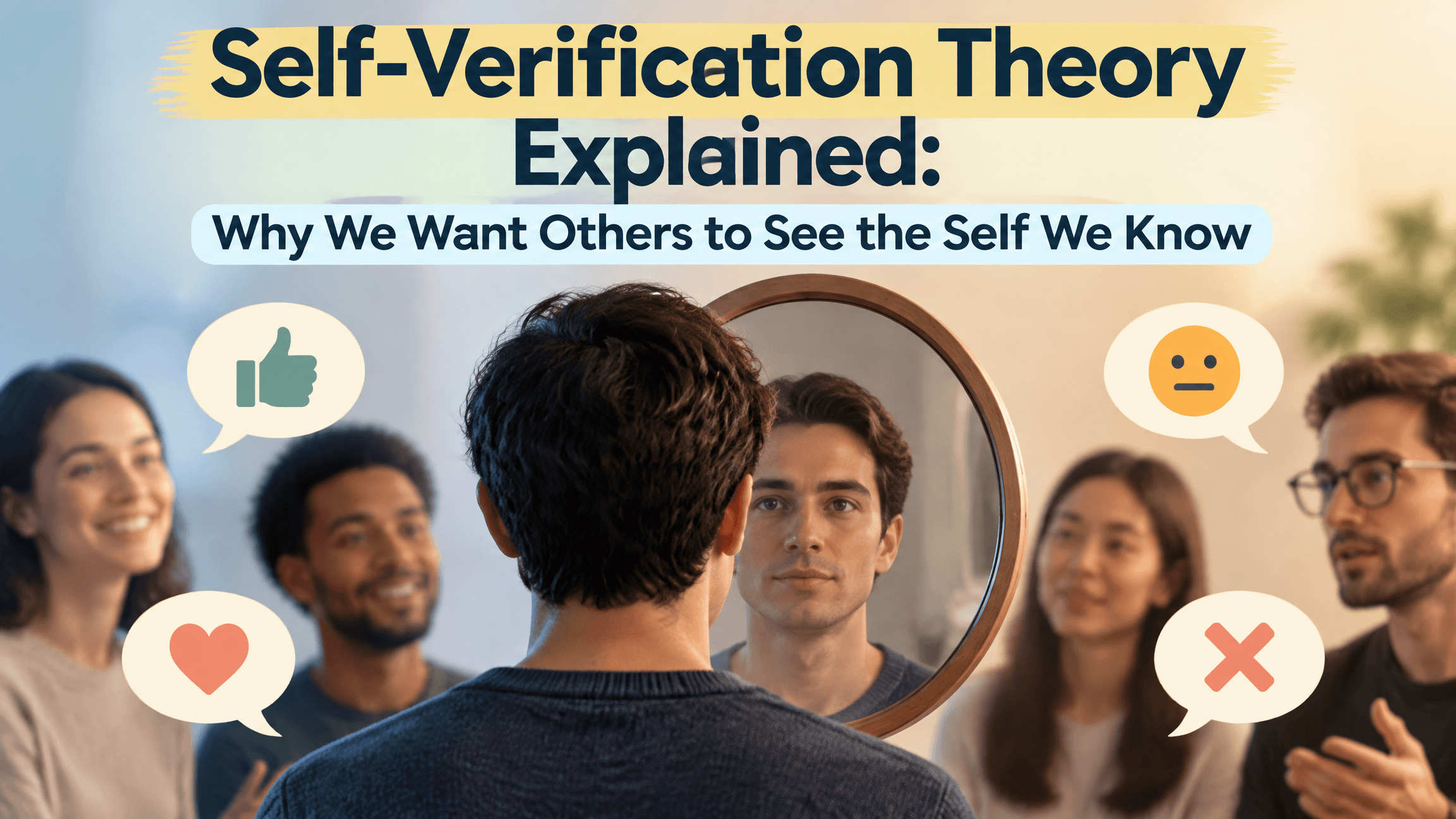
A compliment is supposed to feel good. Yet sometimes a positive comment lands strangely. A person who has long thought of themselves as awkward may hear, “You are great with people,” and immediately wonder whether the speaker is just being polite. Someone who sees themselves as unreliable may feel more convinced by criticism than by evidence that they have actually become dependable. The surprising part is not that people dislike criticism. It is that feedback can feel more believable when it fits an existing self-view, even when that view is unflattering.
Self-verification theory explains this pull toward consistency. The basic idea is that people often want others to see them in ways that match how they already see themselves. That can make social life feel more predictable and coherent. It can also create a trap when an old self-view is harsh, incomplete, or outdated. Familiarity can feel like accuracy without actually proving it.
This theory is most useful when treated as a description of a psychological motive, not a rule about what feedback people should accept. Wanting consistency and wanting positive feedback can both matter. The interesting question is what happens when those motives agree, and what happens when they collide.
Quick Answer
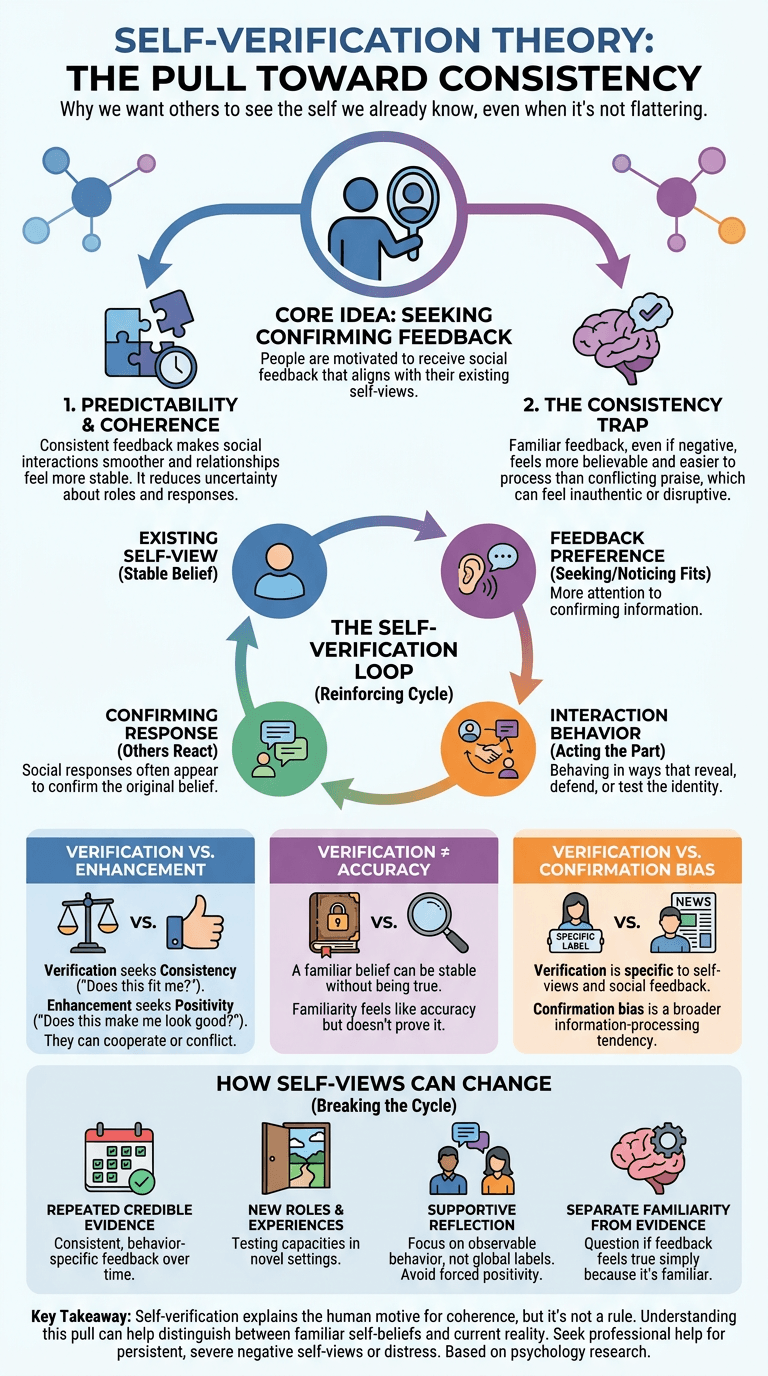
Self-verification theory proposes that people are often motivated to receive social feedback that confirms their existing self-views. Consistent feedback can make relationships and social situations feel more predictable, even when the self-view is negative. This does not mean a familiar self-belief is objectively true. People may also want positive feedback, and established self-views can change when credible new evidence accumulates.
What Self-Verification Theory Proposes
Psychologist William Swann developed self-verification theory to explain why people do not always prefer the most flattering possible social feedback. A central claim is that people invest in self-views because those views help organize expectations about themselves and their relationships. Feedback that confirms those expectations can therefore feel useful, familiar, and easier to integrate.
William Swann’s core idea
In a widely cited overview, Swann argued that a desire for evaluations that verify existing self-views can sometimes compete with the desire for positive evaluation. His paper, “The Trouble with Change”, described how people may seek, elicit, or interpret feedback in self-confirming ways. The theory is especially revealing when someone holds a negative self-view, because a flattering evaluation may feel pleasant yet somehow “not like me.”
That does not mean people enjoy being insulted or rejected. Emotional preference and perceived accuracy are not always the same. Someone can dislike a negative evaluation while also thinking, “That sounds more believable.” This tension is one reason self-verification cannot be reduced to a simple preference for praise or criticism.
Existing self-views as a reference point for social feedback
Think of an established self-view as a working reference point. It might concern being organized, shy, dependable, creative, difficult, warm, impatient, competent, or socially awkward. When another person gives feedback, that feedback is not judged in a vacuum. It is compared with what the person already believes.
If the feedback fits, it may be absorbed quickly. If it clashes, the person may question the speaker, reinterpret the comment, look for exceptions, or wait for more evidence. A mismatch can be useful because it may signal growth or reveal a blind spot. But large mismatches can also feel destabilizing, particularly when the original self-view has been repeated for years.
Why Consistency Can Feel Psychologically Useful
Self-verification is easier to understand when the goal is framed as predictability rather than stubbornness. A stable map of the self can help a person anticipate how situations will go, what roles they can perform, and how other people are likely to respond. Even an imperfect map reduces uncertainty.
Predictability in social interaction
Imagine that you strongly see yourself as quiet and reserved. Friends who recognize that trait may feel easy to be around because you know what they expect. If someone suddenly treats you as the person who should lead every conversation, you may feel pressure even if the expectation is meant positively.
Consistent feedback can therefore reduce social guesswork. It tells you, “The way I understand myself and the way this person understands me roughly match.” That agreement can make interaction smoother because fewer assumptions need renegotiation in the moment.
Identity coherence and expectations
Coherence matters because people make plans based partly on self-knowledge. A person who sees themselves as methodical may choose roles where preparation matters. Someone who believes they are spontaneous may expect to improvise. When other people repeatedly respond in ways that fit those expectations, the self-story feels stable.
Research on self-verification often treats this coherence motive as distinct from simply wanting approval. A later chapter by Ashwini Ashokkumar and William Swann reviews the uncomfortable experience of praise that sharply contradicts a firm self-view and explains why self-inconsistent praise can be difficult to absorb. The point is not that praise is harmful. It is that feedback has to compete with an established model of the self.
Why verification is not the same as accuracy
This distinction is essential. A belief can be stable without being accurate. Someone may have learned to think, “I am bad at speaking up,” after a few difficult experiences early in life. Years later, they may communicate clearly in many settings, yet the old label can still organize how they interpret feedback.
Verification means “this matches my existing view,” not “this has been proven true.” When a familiar belief is negative, it is worth separating the comfort of consistency from the quality of the evidence. Repetition, emotional intensity, or long history can make a belief feel authoritative without making it complete.
The Self-Verification Loop
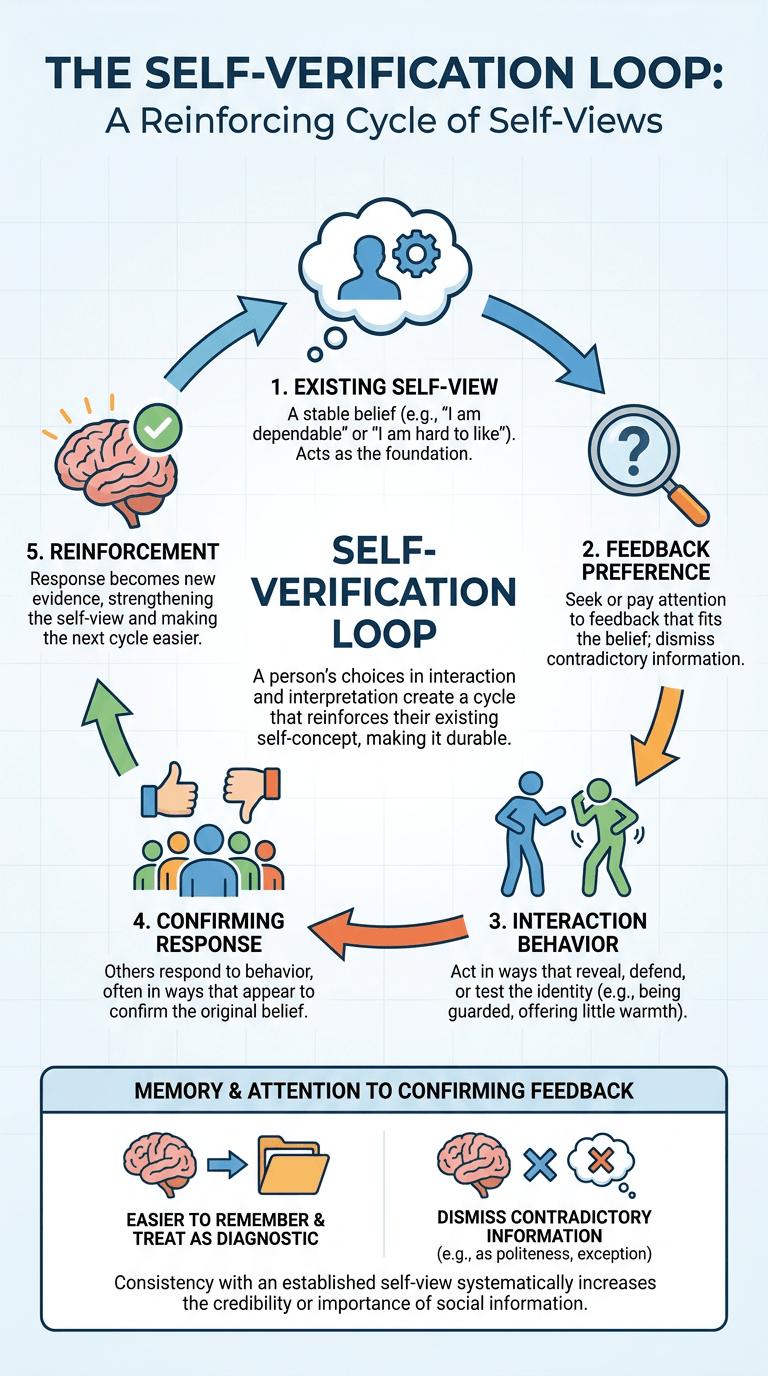
One reason self-views can become durable is that people do more than passively receive feedback. They choose what to ask, how to present themselves, which reactions to notice, and how to interpret what happens next. These small choices can create a reinforcing cycle.
Existing self-view → feedback preference → interaction behavior → confirming response
- Existing self-view: A person begins with a relatively stable belief, such as “I am dependable” or “I am hard to like.”
- Feedback preference: Feedback that fits the belief may seem more relevant, credible, or worth asking about.
- Interaction behavior: The person may behave in ways that reveal, defend, or test that identity.
- Confirming response: Other people respond to the behavior, sometimes in ways that appear to confirm the original belief.
- Reinforcement: The response becomes new evidence for the same self-view, making the next cycle easier to repeat.
Consider someone who expects others to find them difficult. They enter a group conversation guarded, offer little warmth, and interpret neutral questions as criticism. Other people become cautious in response. The person then concludes, “See, people never feel comfortable around me.” The original self-view did not mechanically cause the outcome, but it helped shape the interaction that produced confirming evidence.
Memory and attention to confirming feedback
Confirmation can also happen after the interaction. Feedback that fits a strong self-view may be easier to remember or easier to treat as diagnostic. Contradictory information may be dismissed as politeness, an exception, or a misunderstanding.
This does not require conscious cherry-picking. The mind is constantly deciding what information deserves weight. A self-verifying pattern appears when consistency with an established self-view systematically increases the credibility or importance of certain social information.
Positive and Negative Self-Views
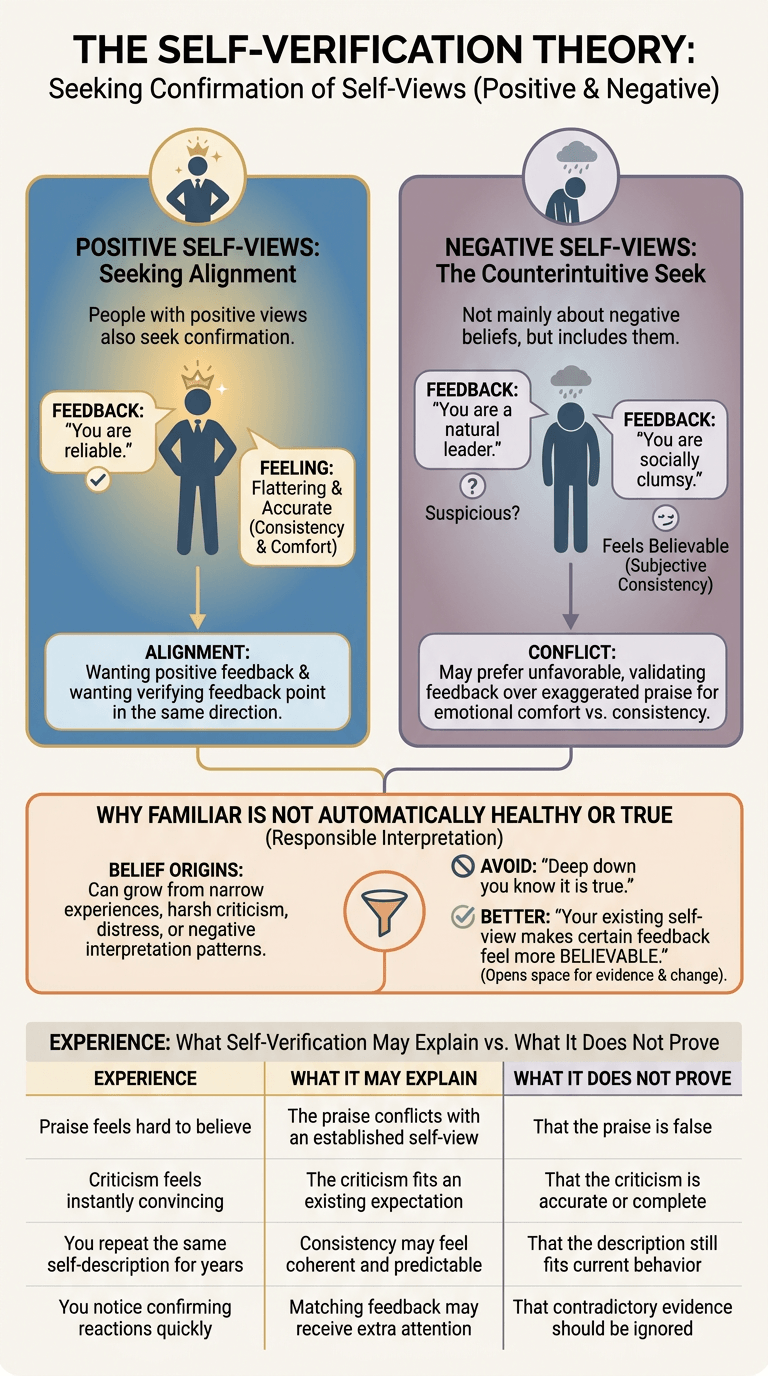
Self-verification is not mainly a theory about negative self-beliefs. People with positive self-views also seek confirmation. If you see yourself as reliable, being trusted with an important task may feel both flattering and accurate. In that case, wanting positive feedback and wanting verifying feedback point in the same direction.
Why people can seek verification of unflattering self-beliefs
The theory becomes more counterintuitive when the self-view is negative. A person who firmly believes they are socially clumsy may prefer feedback that acknowledges awkwardness over praise that feels exaggerated. Someone who thinks they are poor at leadership may be suspicious when a colleague describes them as a natural leader.
Classic research found situations in which people with negative self-views sought unfavorable evaluations even though receiving such evaluations made them feel worse. A study contrasting self-enhancement and self-verification found that people could prefer favorable feedback about positive self-views while seeking unfavorable feedback about negative self-views. This is a useful reminder that people can want emotional comfort and subjective consistency at the same time.
Why familiar feedback is not automatically healthy or true
If a person believes “I am a burden,” feedback that seems to confirm that belief may feel familiar. Familiarity does not validate the conclusion. The belief may have grown from a narrow set of experiences, harsh criticism, current distress, or a pattern of interpreting ambiguous reactions negatively.
A responsible use of self-verification theory therefore avoids saying, “You seek negative feedback because deep down you know it is true.” The better interpretation is, “Your existing self-view may make certain feedback feel more believable.” That opens space for evidence, context, and change.
| Experience | What self-verification may explain | What it does not prove |
|---|---|---|
| Praise feels hard to believe | The praise conflicts with an established self-view | That the praise is false |
| Criticism feels instantly convincing | The criticism fits an existing expectation | That the criticism is accurate or complete |
| You repeat the same self-description for years | Consistency may feel coherent and predictable | That the description still fits current behavior |
| You notice confirming reactions quickly | Matching feedback may receive extra attention | That contradictory evidence should be ignored |
Why Praise Can Sometimes Feel Uncomfortable
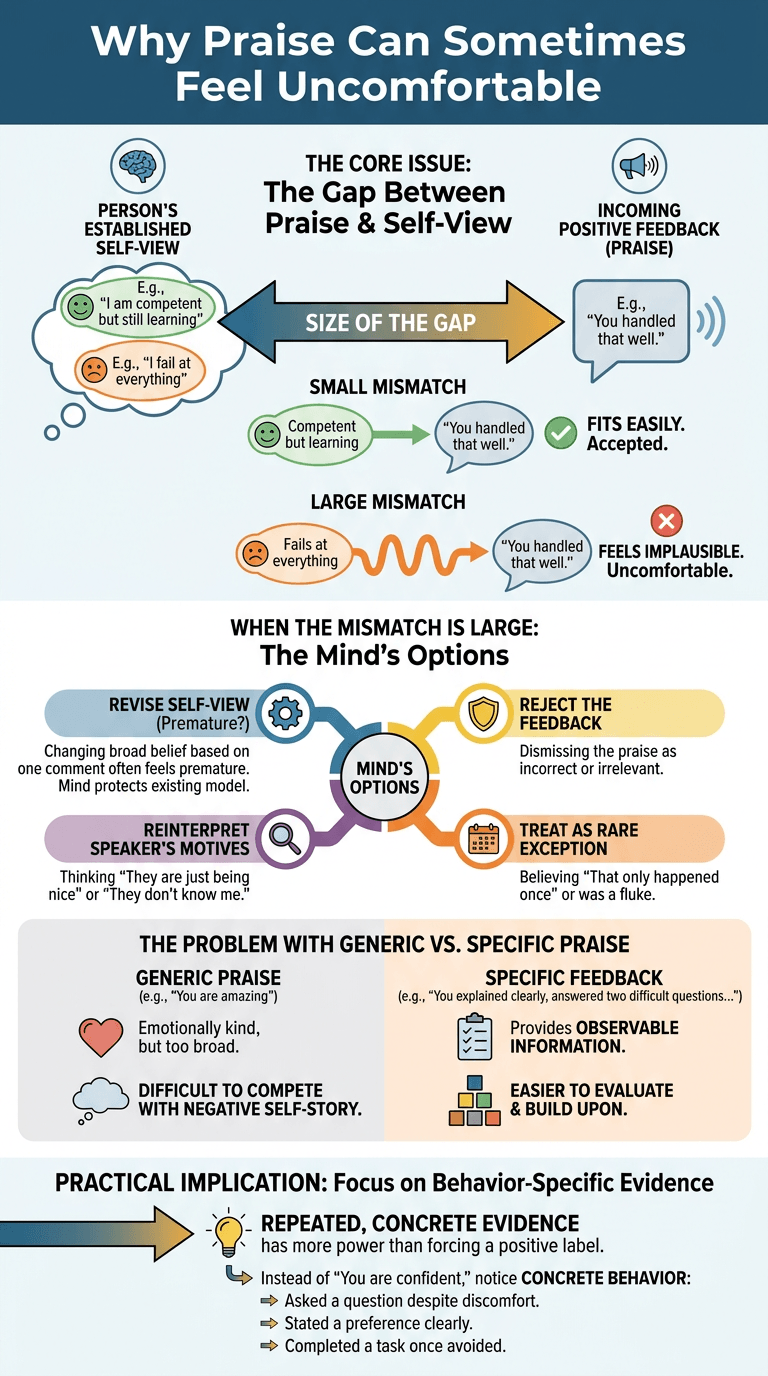
Positive feedback is often pleasant, but not all praise is easy to accept. The problem may be the size of the gap between the praise and the person’s established self-view. If someone believes “I am competent but still learning,” hearing “You handled that well” may fit easily. If they believe “I fail at everything,” the same comment may feel implausible.
Large mismatch between feedback and self-belief
When the mismatch is large, the mind has several options. It can revise the self-view, reject the feedback, reinterpret the speaker’s motives, or treat the feedback as a rare exception. Revising a broad self-belief on the basis of one comment may feel premature, so people often protect the existing model until stronger evidence appears.
This is one reason generic praise sometimes has limited impact. “You are amazing” may be emotionally kind but too broad to compete with a detailed negative self-story. Specific feedback such as “You explained the problem clearly and answered two difficult questions without rushing” provides observable information that is easier to evaluate.
Suspicion, disbelief, or discounting as possible responses
A person may respond to discrepant praise by thinking, “They are just being nice,” “They do not know me well enough,” or “That only happened once.” Those reactions do not necessarily show low self-esteem, and they do not prove the praise is correct. They show that the incoming evaluation is being tested against an established belief.
One practical implication is that repeated, behavior-specific evidence often has more power than forcing a positive label. If someone cannot accept “You are confident,” it may be more useful to notice concrete behavior: they asked a question despite discomfort, stated a preference clearly, or completed a task they once avoided.
Self-Verification vs Self-Enhancement
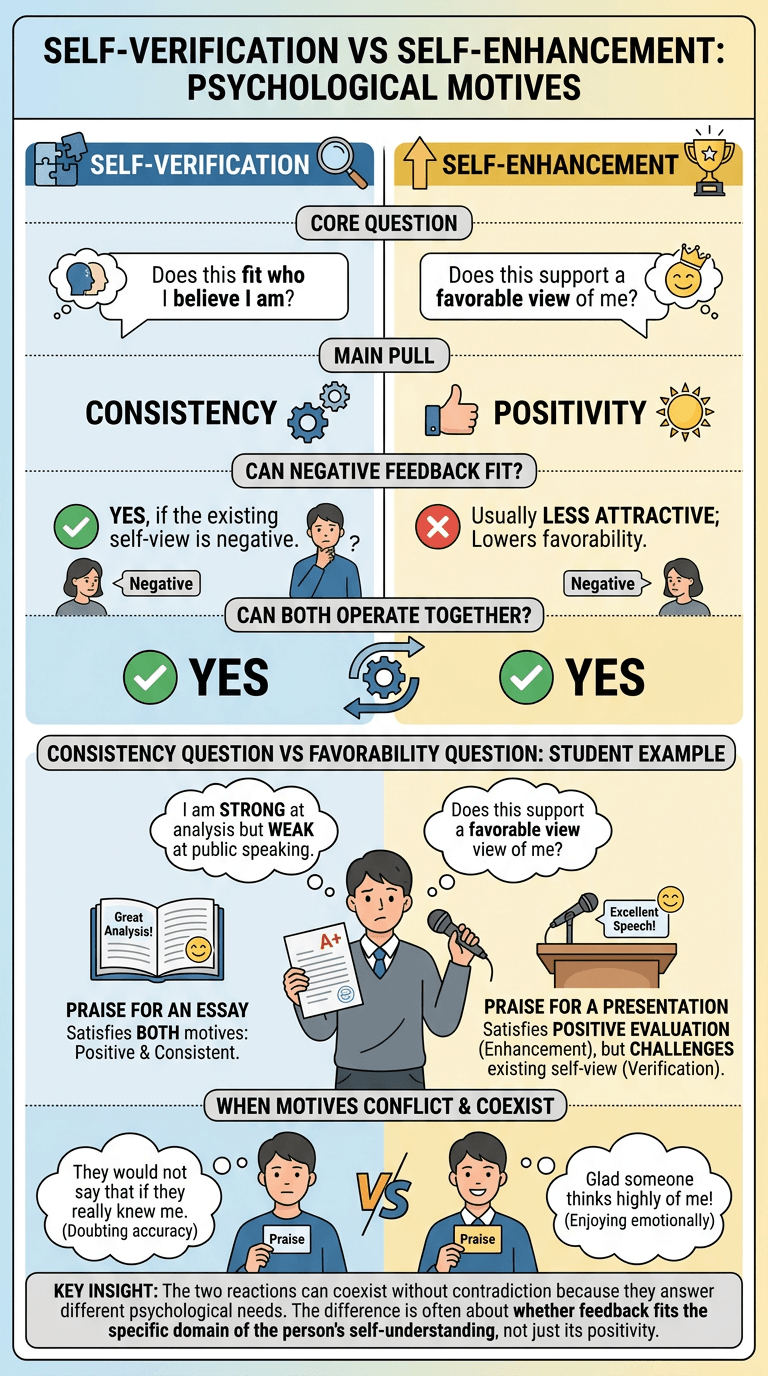
Self-verification and self-enhancement answer different questions. Self-verification asks whether feedback fits the self-view. Self-enhancement asks whether it supports a more favorable self-view. These motives often cooperate, but not always.
| Dimension | Self-verification | Self-enhancement |
|---|---|---|
| Core question | “Does this fit who I believe I am?” | “Does this support a favorable view of me?” |
| Main pull | Consistency | Positivity |
| Can negative feedback fit? | Yes, if the existing self-view is negative | Usually less attractive because it lowers favorability |
| Can both operate together? | Yes | Yes |
Consistency question versus favorability question
Suppose a student thinks, “I am strong at analysis but weak at public speaking.” Praise for an essay may satisfy both motives because it is positive and consistent. Praise for a presentation may satisfy the desire for positive evaluation while challenging the student’s existing self-view.
That distinction helps explain why the same person can eagerly accept one compliment and distrust another. The difference may be less about how positive the feedback is and more about whether it fits the specific domain of the person’s self-understanding.
When the motives point in the same direction
For positive self-views, enhancement and verification often align. Someone who sees themselves as caring may appreciate feedback that they were thoughtful. Someone who considers themselves competent may welcome recognition of good work. The feedback both feels good and fits.
This overlap matters because it prevents an overly dramatic interpretation of the theory. Most self-verifying behavior does not involve seeking negativity. Often it simply means wanting social feedback that confirms a valued identity.
When the motives conflict
The tension becomes visible when the existing self-view is negative. A review of direct tests by Kwang and Swann found evidence for both motives rather than one universal winner. Their review of self-enhancement versus self-verification concluded that the motives can influence different kinds of responses.
In ordinary life, that can look like enjoying praise emotionally while still doubting its accuracy. You may be glad someone thinks highly of you and simultaneously think, “They would not say that if they really knew me.” The two reactions can coexist without contradiction because they answer different psychological needs.
Self-Verification vs Self-Perception
Self-perception is a broader question about how people form conclusions about themselves, including what they infer from their own behavior, feelings, memories, and feedback. Self-verification begins later in the sequence. It assumes that a self-view already exists and asks what happens when social feedback supports or challenges it.
Interpersonal confirmation of an established view versus forming interpretations about oneself
If you notice that you keep volunteering for complex tasks and conclude, “Maybe I am more capable under pressure than I thought,” you are updating your self-understanding from your own behavior. If you already believe you work well under pressure and value colleagues who recognize that quality, the consistency motive is more central.
The difference protects an important boundary: self-verification does not explain every belief a person has about themselves. It explains why established beliefs can influence which interpersonal evaluations feel fitting, credible, or worth seeking.
Self-Verification vs Confirmation Bias
The two concepts can sound similar because both involve information that fits an existing belief. They are not interchangeable. Confirmation bias is a broad information-processing tendency in which people may seek, interpret, or remember evidence in ways that support existing beliefs. Those beliefs can concern politics, products, other people, causes, predictions, or almost anything else.
A social-identity motive versus a broader information-processing tendency
Self-verification is narrower. It concerns self-views and the social feedback that confirms them. The motive is tied to maintaining a coherent sense of self and predictable interactions. Confirmation bias does not require a self-concept or an audience.
For example, choosing news that supports a belief about economic policy can reflect confirmation processes without involving self-verification. Discounting a friend’s praise because it clashes with a stable belief that you are disorganized is more directly relevant to self-verification.
Why the concepts should not be collapsed
If every instance of accepting familiar information is labeled self-verification, the theory becomes too broad to be useful. The distinctive question is whether an established self-view is guiding the desire for interpersonal confirmation. Keeping that boundary clear also prevents the concept from turning into a catch-all explanation for stubbornness.
How Self-Views Can Still Change
Self-verification theory does not say people are trapped inside one identity forever. A self-view can become more flexible when new evidence is credible, repeated, behaviorally specific, and integrated into real experience. Change often takes more than replacing one global label with another.
Repeated credible evidence
One compliment may be easy to dismiss. Ten months of consistent behavior is harder to explain away. If a person believes they are unreliable but repeatedly arrives on time, completes commitments, and receives similar feedback from several people, the old self-view has more evidence to compete with.
Credibility matters. Feedback from someone who has observed the relevant behavior may carry more weight than praise from someone who knows little about the situation. Specific examples also help because they can be checked rather than simply accepted on faith.
New roles and experiences
New settings can reveal capacities that an old identity never had a chance to test. Someone who thought of themselves as “not a leader” may coordinate a volunteer project successfully. A person who considered themselves “bad with people” may discover they are comfortable mentoring one person at a time.
The useful update does not have to be a dramatic opposite label. “I am not a leader” can become “I lead well when the role is clear.” “I am socially awkward” can become “Large groups drain me, but I connect well in smaller conversations.” More precise self-views are often easier to revise because they are tied to observable contexts.
Reflection and supportive relationships without forced positivity
Supportive people can help by offering accurate observations rather than insisting on a flattering identity. “You should stop thinking that way” may create resistance. “I have noticed you handled three difficult conversations calmly this month” gives the person something concrete to consider.
Change is more believable when it respects the person’s experience while testing whether an old conclusion still fits. The goal is not to replace every negative belief with a positive slogan. It is to build a self-view that is more specific, evidence-sensitive, and current.
What to Do Next When a Familiar Negative Self-View Feels Fixed
A harsh self-belief can become self-sealing when every event is interpreted through it. One way to loosen that loop is to separate how familiar the belief feels from how well it explains current evidence.
Separate familiarity from evidence
Use a simple three-column check:
| Question | Example | Why it helps |
|---|---|---|
| What is the familiar label? | “I am unreliable.” | Makes the global belief visible. |
| What recent evidence supports it? | “I missed one deadline last month.” | Identifies real data instead of vague feeling. |
| What recent evidence complicates it? | “I met nine other commitments and communicated early when one changed.” | Tests whether the label is too broad. |
The purpose is not to force a positive answer. If the evidence shows a real pattern, that information is useful. The point is to avoid treating familiarity as the deciding factor.
Look for specific, behavior-based feedback rather than global labels
Global labels are difficult to evaluate. “You are a good person,” “You are bad at relationships,” or “You are brilliant” can mean many things. Specific feedback is easier to test: “You followed through when you said you would,” “You interrupted me three times,” or “Your explanation made the technical part understandable.”
If praise feels unbelievable, you do not have to accept the speaker’s broad conclusion immediately. Ask what behavior they noticed. If criticism feels instantly true, use the same standard. What exactly happened? How often? In what context? What alternative explanation fits the evidence? Symmetry matters: both positive and negative feedback deserve examination.
When Persistent Negative Self-Beliefs Need More Support
Self-verification is an educational framework, not a diagnosis. A negative self-view can be influenced by many things, and it should not be assumed that someone who discounts praise has a mental health disorder. Still, there are times when the level of distress matters more than the theory.
Severe self-criticism, hopelessness, major distress, or self-harm thoughts
If negative beliefs become persistent, intensely self-critical, or tied to hopelessness and major difficulty functioning, individualized professional support may be useful. The National Institute of Mental Health guidance on when to seek help recommends paying attention to severity, duration, and interference with daily life rather than relying on one isolated feeling.
If you are thinking about harming yourself or suicide, seek immediate crisis support in your location rather than trying to solve the issue through self-reflection alone. In an urgent situation, contact local emergency services or a crisis service available where you live.
FAQ About Self-Verification Theory
Does self-verification mean people want criticism?
No. The theory does not claim that people generally enjoy criticism. It proposes that feedback consistent with an established self-view can feel more credible or fitting. A person may dislike negative feedback emotionally while still regarding it as accurate. People with positive self-views may seek positive verifying feedback, so negativity is not the defining feature.
Why might praise feel unbelievable?
Praise may feel unbelievable when it sharply conflicts with a stable self-view, especially if the praise is broad and unsupported by examples. The mind may explain it as politeness, exaggeration, or lack of knowledge. Specific observations and repeated evidence are often easier to integrate because the person can evaluate what actually happened rather than accept a new identity label all at once.
Is self-verification the same as confirmation bias?
No. Confirmation bias is a broad tendency to favor information that supports existing beliefs. Self-verification is specifically about existing self-views and interpersonal feedback that confirms them. The concepts can overlap in some situations, but self-verification adds a motive for self-consistency and predictable social interaction.
Can self-verification and self-enhancement happen at the same time?
Yes. They often align when someone already has a positive self-view. A person who sees themselves as dependable may both enjoy and believe feedback that they are reliable. The motives become easier to distinguish when someone has a negative self-view and must choose between flattering feedback and feedback that feels more consistent with how they see themselves.
Can an established self-view change?
Yes. Self-views can change through repeated credible feedback, new experiences, new roles, reflection, and behavior that provides strong counterevidence to an old label. Change may be gradual because a single contradictory event can be treated as an exception. More specific self-descriptions often make updating easier than replacing one global label with another.
Key Takeaways
- Self-verification theory explains why feedback that matches an existing self-view can feel especially credible, even when the self-view is not flattering.
- Consistency and accuracy are different. A familiar belief can be incomplete, outdated, or wrong.
- Self-verification and self-enhancement often work together, but they can conflict when a negative self-view meets positive feedback.
- Self-verification concerns interpersonal confirmation of the self, while confirmation bias is a broader information-processing tendency.
- Specific, repeated, behavior-based evidence is often more useful for updating a self-view than global praise or criticism.
- Severe hopelessness, persistent self-criticism, major impairment, or self-harm thoughts deserve appropriate professional or crisis support rather than a self-help explanation alone.
About the author: Michael Reed is the Founder & Lead Writer at Psychology Exposed. He writes research-aware explanations of human behavior, relationships, self-awareness, emotional patterns, and everyday decisions for general readers.

Michael Reed is the Founder and Lead Writer at Psychology Exposed. He writes about human behavior, relationships, emotional patterns, self-awareness, and practical psychology topics using research-informed, easy-to-understand content.
Read More About Michael Reed: https://psychologyexposed.com/michael-reed/