
A reputation is rarely built from one sentence, one photo, or one interaction. It develops as people observe behavior, remember what happened, hear information from others, and gradually form expectations about what someone is likely to do next. That process can be useful because people often need to make social decisions with incomplete information. It can also be imperfect because memories, interpretations, social networks, and secondhand reports are never perfectly accurate.
This is why reputation is different from a first impression. An impression may belong to one observer at one moment. A reputation is more distributed. It can exist across several relationships, circulate through a group, and persist after the behavior that created it has changed. Understanding that difference helps explain why reputations can be slow to form, surprisingly durable, and sometimes difficult to update.
Quick Answer
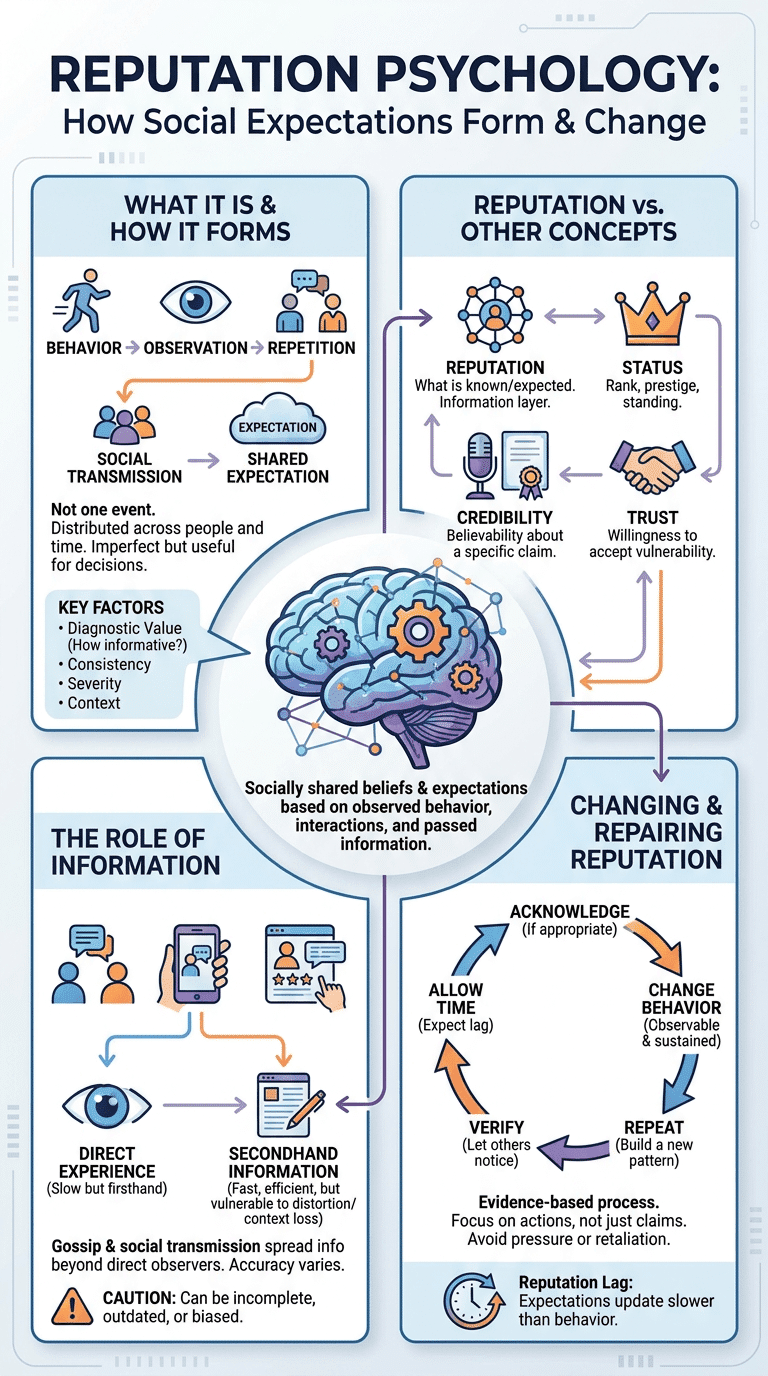
In psychology, reputation refers to socially shared beliefs or expectations about a person that develop from observed behavior, repeated interactions, and information passed between people. Reputation is not the same as status, trust, credibility, or a single impression. It can change, but updating usually depends on new evidence becoming consistent, believable, and visible enough to compete with what people already expect.
What Reputation Means in Psychology
Reputation is social information that has acquired some persistence. It tells people what others are believed to be like, how they have behaved before, or what they may be likely to do in future interactions. A broad review of reputation and cooperation describes reputation as shared information about a person’s qualities and attributes, including cooperativeness, and emphasizes that this information can influence how others choose partners and respond socially. Peer-reviewed work on reputation and cooperation also shows that reputational information moves through social networks rather than existing only inside one person’s mind.
Socially distributed beliefs and expectations
The word distributed matters. If one colleague thinks Jordan is dependable after a single project, that is primarily an individual judgment. If several coworkers have independently seen Jordan meet deadlines, discuss that pattern, and begin assigning Jordan time-sensitive work, a reputation for dependability is beginning to form.
Reputations do not require perfect consensus. One person may view someone as generous while another sees the same person as selective about whom they help. The social expectation becomes stronger when different observers receive similar information, but disagreement is possible, especially across groups that see different behavior or rely on different information sources.
Why reputation is more than one observer’s impression
An impression is a working judgment held by an observer. Reputation adds time and social transmission. It may incorporate direct experience, repeated behavior, stories from other people, and information that remains available after the original event.
This difference also explains why changing one person’s mind does not automatically change a broader reputation. A repaired interaction may matter greatly within one relationship while other people continue to rely on older information. Social expectations can therefore update at different speeds in different parts of the same network.
From Presentation to Impression to Reputation
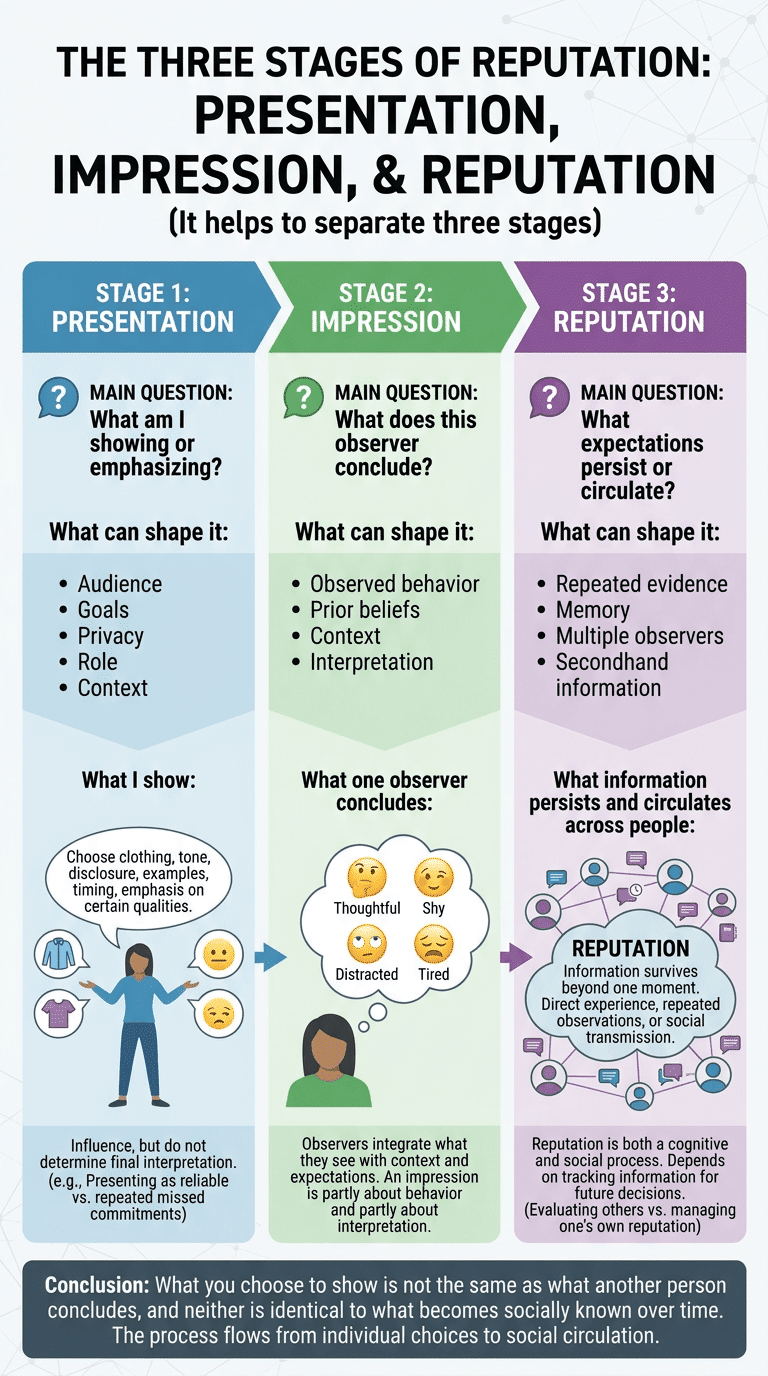
It helps to separate three stages that are often treated as if they were identical. What you choose to show is not the same as what another person concludes, and neither is identical to what becomes socially known over time.
| Stage | Main question | What can shape it |
|---|---|---|
| Presentation | What am I showing or emphasizing? | Audience, goals, privacy, role, context |
| Impression | What does this observer conclude? | Observed behavior, prior beliefs, context, interpretation |
| Reputation | What expectations persist or circulate? | Repeated evidence, memory, multiple observers, secondhand information |
What I show
People can choose clothing, tone, disclosure, examples, timing, or how strongly they emphasize certain qualities. Those choices can influence what others have available to interpret. They cannot determine the final interpretation. A person may carefully present themselves as reliable, yet repeated missed commitments may eventually carry more weight than the presentation itself. Those audience-facing choices are part of self-presentation; reputation concerns what people continue to expect after the immediate presentation has passed.
What one observer concludes
Observers integrate what they see with context and prior expectations. The same quiet behavior can be read as thoughtful, shy, distracted, uninterested, or simply tired. An impression is therefore partly about the observed behavior and partly about the observer’s interpretation of that behavior.
What information persists and circulates across people
Reputation begins to take shape when information survives beyond one moment. The information may come from direct experience, repeated observations, or social transmission. Research on the psychological foundations of reputation-based cooperation distinguishes between evaluating other people’s reputations and managing one’s own reputation, highlighting that reputation depends on people being able to track information about others and use it in future decisions. This review of reputation-based cooperation helps clarify why reputation is both a cognitive and social process.
How Reputations Form
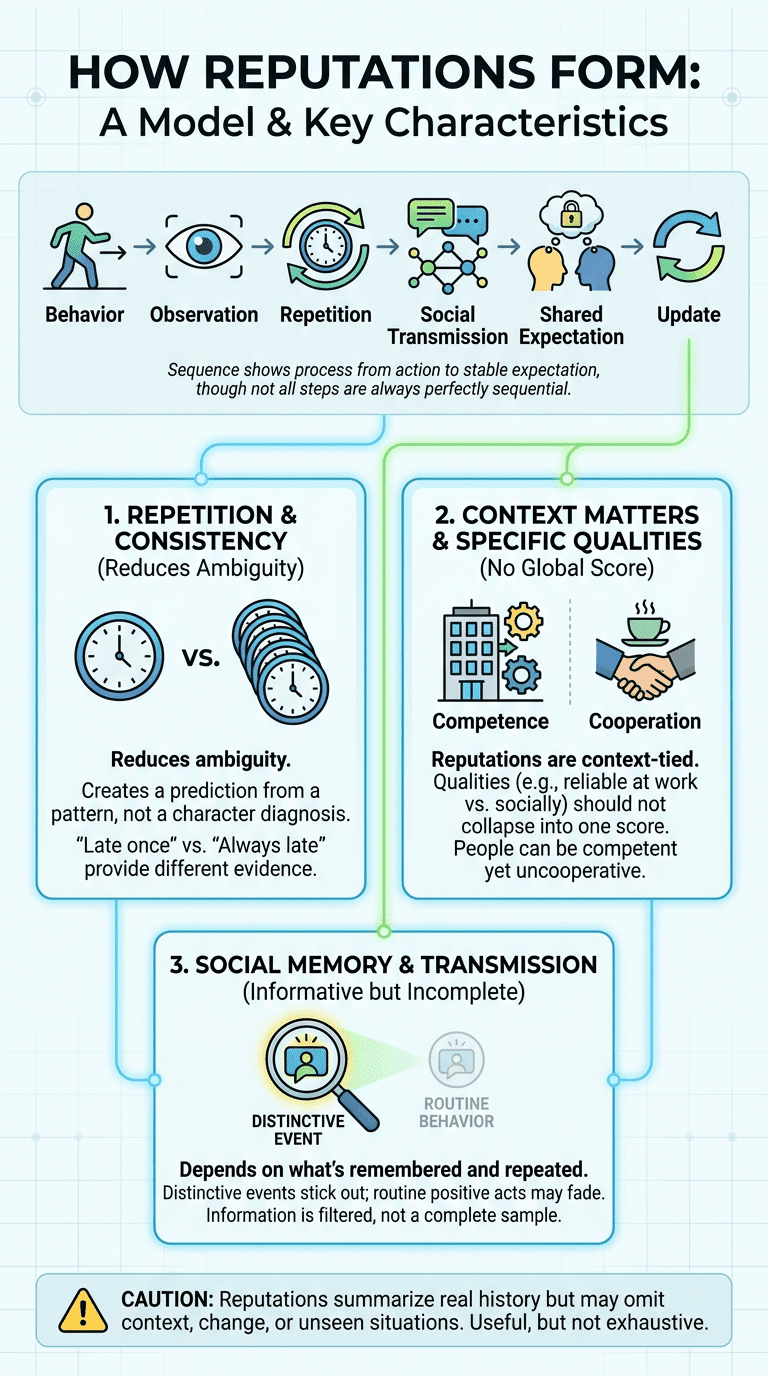
A useful model is: Behavior → Observation → Repetition → Social Transmission → Shared Expectation → Update. Not every reputation passes neatly through every step, but the sequence shows why one polished performance is different from a stable social expectation.
Repeated behavior and consistency
Repeated behavior is often powerful because it reduces ambiguity. If a friend arrives late once, there are many possible explanations. If the same friend is late for nearly every plan and rarely warns anyone, observers have more evidence for an expectation about punctuality. The reputation is not a diagnosis of character. It is a prediction built from a pattern.
Consistency also matters across situations. Someone may be extremely dependable at work but unreliable with informal plans. In that case, a broad label such as “reliable person” may be too simple. Reputations often become more accurate when they remain tied to the context in which the evidence was observed.
Reliability, cooperation, competence, and trustworthiness as possible content
People can develop reputations for many different qualities: being cooperative, technically skilled, fair, discreet, generous, unpredictable, calm under pressure, or difficult to coordinate with. These qualities should not be collapsed into one global score.
Someone may be known as highly competent but not especially cooperative. Another person may be warm and generous but inconsistent with deadlines. A reputation usually works better as a set of expectations about specific behaviors than as a verdict on someone’s entire character.
Audience memory and socially shared information
Reputation depends on what is remembered and repeated. Highly distinctive events may be easier to remember than ordinary behavior, while routine positive behavior can become less noticeable precisely because it is expected. Social groups also differ in what they consider worth mentioning, so the information that travels may not be a representative sample of everything a person does. Profiles and posts are one source of persistent social information; online self-presentation explains how those records are selected and shown to different audiences.
This creates an important caution: reputation can be informative without being complete. It may summarize real behavioral history while still omitting context, change, or situations that never became visible to the group.
The Role of Secondhand Information
Humans do not need direct experience with someone to form expectations. We routinely receive social information from friends, coworkers, family members, communities, reviews, references, and informal conversation. That efficiency is useful, but it introduces questions about accuracy, motive, and context.
High-level social transmission and gossip
Gossip, in the research sense, can refer to communication about a person who is absent. It is not automatically malicious. A community study that sampled thousands of everyday gossip events found that people frequently exchanged information relevant to cooperativeness and used that information to update evaluations of others. Research on gossip and reputation in everyday life also found that receivers considered cues that might make a report less reliable.
The important point is not that gossip is always accurate. It is that secondhand information can change expectations even when the receiver did not witness the original behavior.
Why secondhand information can spread faster than direct experience
Direct experience is slow. You can personally observe only a limited number of interactions. Social information can travel across many relationships quickly. A single event described by several people may therefore reach far more observers than the event itself.
This creates both efficiency and vulnerability. If several independent sources report similar experiences, the convergence may feel meaningful. If everyone is repeating the same original story, however, apparent agreement may be less independent than it seems. Experimental work on multiple gossip statements suggests that the number and consistency of reports can influence reputation and cooperation, while also showing why inaccurate gossip remains a concern. Open-access research on multiple gossip statements illustrates this tension between useful social information and possible distortion.
Why this is not simply a question about gossip
Secondhand information is only one route into reputation. Direct observation, repeated cooperation, public outcomes, records of performance, and long-term relationship history can all matter. Focusing only on gossip would miss the larger process through which groups build and revise expectations.
It would also encourage an unhelpful assumption that reputation is mostly about what people say. Often, the strongest reputational evidence is what people repeatedly see happen.
Why Some Events Matter More Than Others
Reputation is not a simple average where every event receives equal weight. Some behaviors are more informative about a particular trait, some are more believable, and some sharply contradict what people previously expected.
Diagnostic versus ambiguous behavior
A diagnostic behavior is one that seems especially informative about the quality being judged. Research on impression updating shows that people give more weight to behavior they see as informative or diagnostic. Experimental work on diagnostic value and impression updating found that what counts as especially informative can differ by domain, such as morality versus ability.
Context matters here. Missing one deadline during a documented emergency may tell observers less about reliability than repeatedly ignoring commitments without explanation. Conversely, solving one difficult technical problem may be unusually informative about competence when the task clearly requires skill.
Negative and positive information
People often hear the simplified claim that negative information always outweighs positive information. The research is more nuanced. Negative behavior can be especially diagnostic in some moral judgments, while positive evidence may be especially informative in some ability judgments. What changes an impression depends partly on what trait is being inferred and how unusual or revealing the behavior seems.
This is one reason reputation should not be treated as a single positive-negative meter. Evidence can update beliefs about honesty differently from beliefs about competence, generosity, discretion, or punctuality.
One striking event versus repeated ordinary evidence
A single event can matter greatly when it is severe, unmistakable, or highly diagnostic. That does not mean every mistake permanently defines someone. Smaller, ambiguous events often need repetition before they support a stable expectation.
A practical question is: What exactly does this event provide evidence for? A public speaking mistake may say little about a person’s intelligence. A missed text may say little about their overall reliability. Keeping the inference as narrow as the evidence helps prevent a reputation from expanding beyond what the behavior actually supports.
Reputation Updating
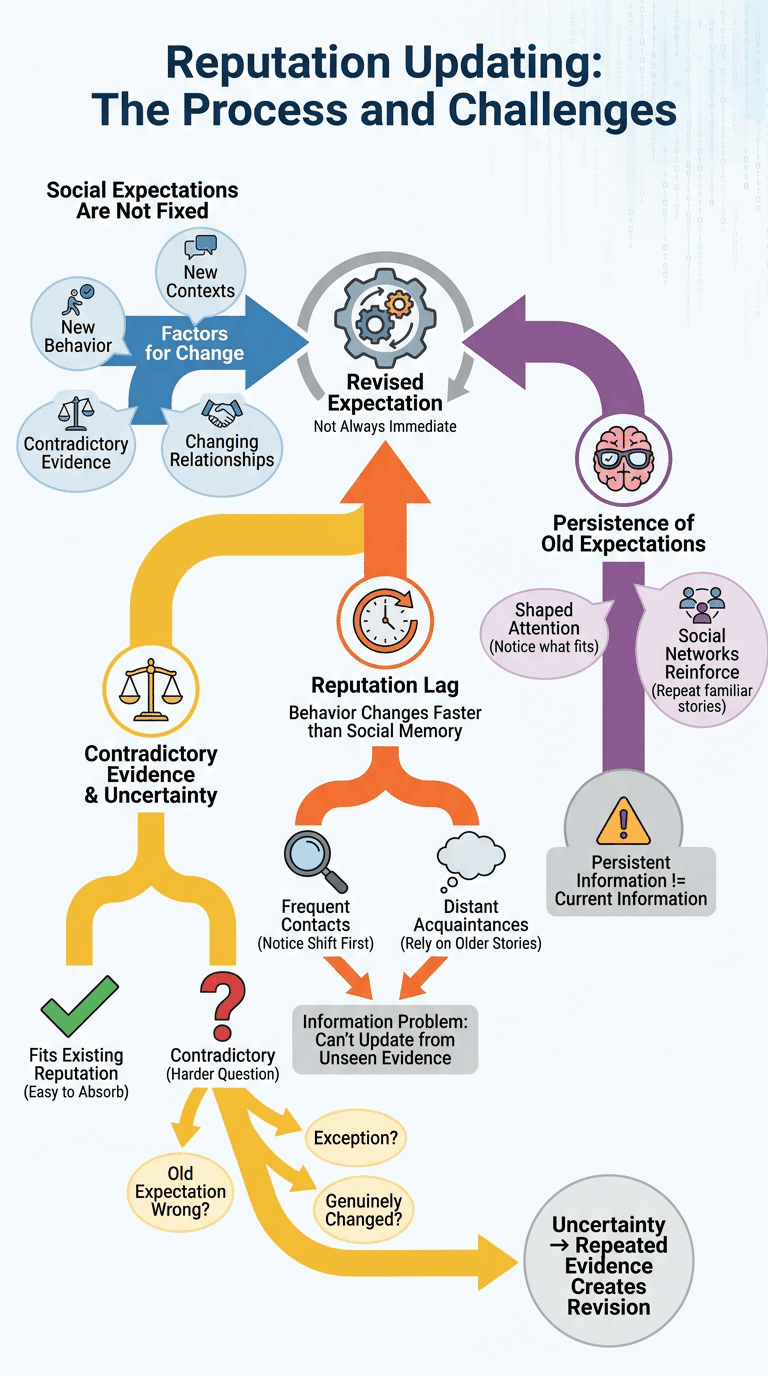
Reputations can change because social expectations are not fixed traits. New behavior, new contexts, contradictory evidence, and changing relationships can all alter what people expect. Updating, however, is not always immediate.
New evidence, contradiction, and uncertainty
When new evidence fits the existing reputation, it is easy to absorb. Contradictory evidence creates a harder question: was the old expectation wrong, is the new behavior an exception, or has the person genuinely changed?
Observers often need more than one inconsistent event to answer that question. A person known for being disorganized may complete one project flawlessly. That can weaken certainty without instantly producing a reputation for exceptional organization. The new evidence may first create uncertainty, then repeated evidence may produce a revised expectation.
Reputation lag after genuine behavior change
Behavior can change faster than social memory. Suppose someone used to cancel plans often, then becomes much more reliable. The people who interact with them frequently may notice the shift first. More distant acquaintances may continue to rely on older stories. Some people may not encounter enough new evidence to update at all.
This is reputation lag: the social expectation remains behind the person’s current behavior. It can feel unfair, but it also reflects a basic information problem. People cannot update from evidence they never see.
Why old expectations can persist even when they are incomplete
Existing reputations shape attention. If someone is known as impatient, observers may readily notice interruptions and overlook moments of patience that feel ordinary. Social networks can reinforce the same expectation when people repeat familiar stories to one another.
Persistence does not prove the reputation is accurate. It only shows that the older model still has enough social support to remain available. A useful distinction is: persistent information is not necessarily current information.
Reputation Repair as an Evidence Process
Trying to repair a reputation often goes badly when the effort focuses mainly on controlling what others say or demanding that they change their opinion. A more realistic model is evidence-based: Acknowledge → Change → Repeat → Verify → Allow Time.
Acknowledgment where appropriate
If a reputation grew from a real mistake, acknowledging the specific behavior can reduce uncertainty about whether the person understands what happened. Acknowledgment is not the same as accepting exaggerated claims or labels. It means being accurate about the part that is yours.
Research on trust repair suggests that apologies can affect perceived trustworthiness after a violation, although trust repair is not identical to repairing a broader reputation. An open-access study on apologies and repaired trust found that changes in perceived trustworthiness were part of the process. The broader lesson is modest: words can matter, but they work within a larger evidence process.
Observable behavior change
A claim such as “I’m different now” is difficult for other people to verify. Observable behavior gives them something concrete to update from. If the old expectation was that you miss deadlines, the relevant evidence is not a persuasive explanation. It is a sustained pattern of meeting commitments, flagging problems early, and making realistic promises.
The new behavior needs to match the reputation being repaired. Improving generosity will not directly update a reputation for poor confidentiality. A more precise target makes change easier for other people to notice.
Time and repeated evidence
Reputation repair often feels slow because the evidence threshold can be higher after a strong expectation has formed. One good week may be encouraging, but observers may reasonably wait to see whether the change persists under pressure or across situations.
This does not mean people must endlessly prove themselves. It means that social expectations update through accumulated information. If another person refuses to consider any new evidence, that becomes a different issue from reputation itself.
Verification by others rather than image claims alone
Independent observation can carry more weight than self-description because it reduces the gap between claim and evidence. If people repeatedly experience the changed behavior themselves, they do not have to rely on the person’s account of their own improvement.
This is also why aggressive reputation control can backfire. Pressuring people to praise you, attacking critics, manufacturing false endorsements, or retaliating against someone who reports a concern does not provide good evidence of change. It creates additional behavior for observers to interpret.
Reputation vs Status, Credibility, and Trust
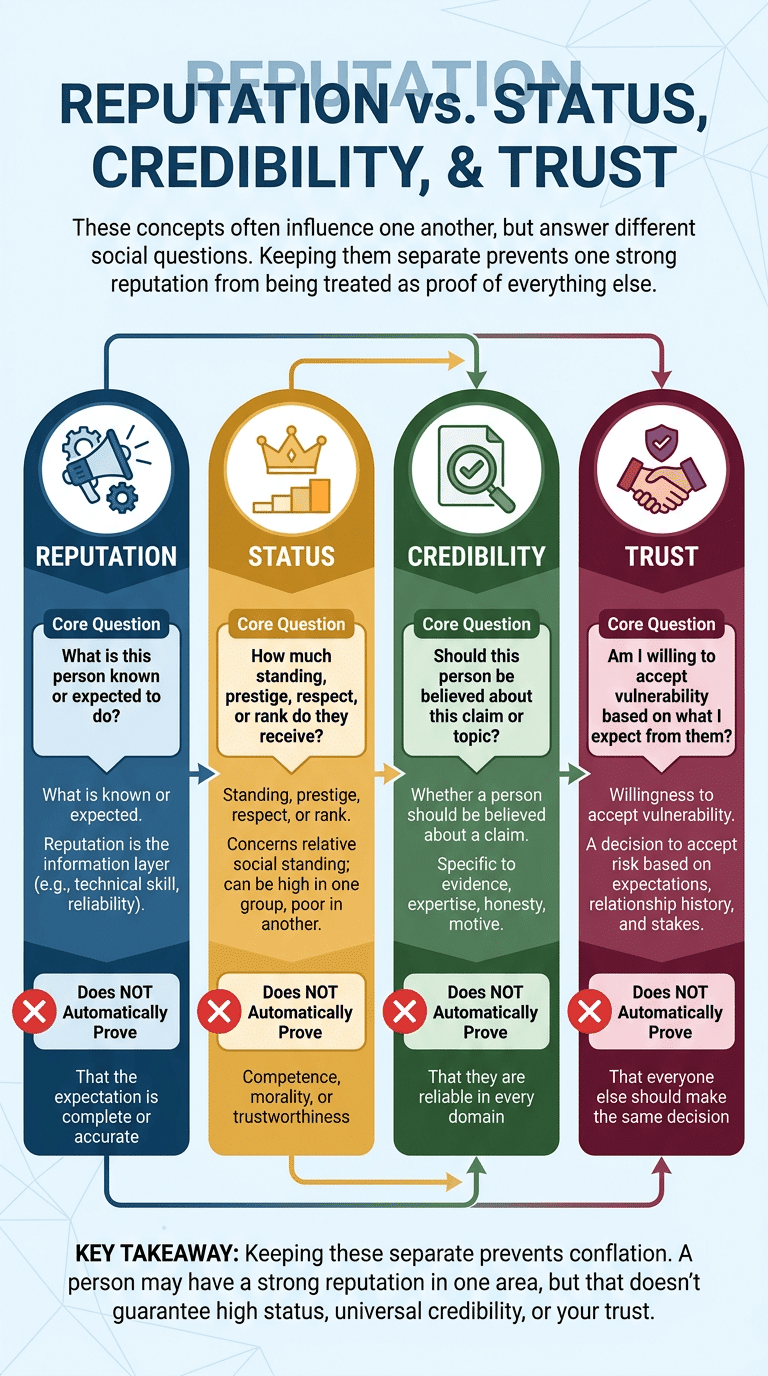
These concepts often influence one another, but they answer different social questions. Keeping them separate prevents one strong reputation from being treated as proof of everything else.
| Concept | Core question | What it does not automatically prove |
|---|---|---|
| Reputation | What is this person known or expected to do? | That the expectation is complete or accurate |
| Status | How much standing, prestige, respect, or rank do they receive? | Competence, morality, or trustworthiness |
| Credibility | Should this person be believed about this claim or topic? | That they are reliable in every domain |
| Trust | Am I willing to accept vulnerability based on what I expect from them? | That everyone else should make the same decision |
Reputation: what is known or expected
Reputation is the information layer. A person may be known for technical skill, generosity, discretion, conflict, or reliability. Those expectations can influence later decisions, but they are not the decision itself.
Status: standing, prestige, respect, or rank
Status concerns relative social standing. Reputation can contribute to status, especially when someone is known for valued abilities or contributions, but reputation and status are not interchangeable. A controversial person may have high status in one group and a poor reputation in another.
Credibility: whether a person should be believed about a claim
Credibility is more specific to evidence, expertise, honesty, motive, and the claim at hand. A chef’s excellent reputation may support credibility about cooking techniques but says little about their credibility on an unrelated medical claim.
Trust: willingness to accept vulnerability
Trust involves a decision to accept some risk based on expectations about another person. Reputation can inform that decision, but direct relationship history and the stakes also matter. Two people can know the same reputation and make different trust decisions.
Reputation vs Impression Management
Reputation and impression management sit on different sides of the social process. Impression management concerns attempts to influence how one is perceived. Reputation concerns the information and expectations that remain after people have observed, interpreted, remembered, and communicated.
Influencing how one is perceived versus information that remains over time
A speaker can choose examples that highlight expertise. That is a presentation choice. If audiences later see the speaker consistently solve difficult problems and begin describing them as knowledgeable, that is reputational development.
The two can interact, but neither guarantees the other. Skilled presentation may create a favorable first impression without producing a durable reputation. Quiet, repeated competence may eventually build a strong reputation even without deliberate self-promotion.
Why self-presentation cannot fully control reputation
Other people decide what they notice, believe, remember, and repeat. They can compare claims with behavior, receive conflicting information, or revise their view after new experiences. Reputation therefore remains partly outside personal control.
A healthier goal is accuracy where possible: make claims that can survive contact with evidence, correct false information when there is a reasonable opportunity, and allow consistent behavior to do work that image management cannot do alone.
Reputation vs Relational Aggression
Reputation is a social-information system. Relational aggression is behavior intended to harm someone through relationships, exclusion, social standing, or reputation. The fact that reputational information can be weaponized does not make all reputation exchange aggressive.
Reputation as a social-information system
Groups often need information about reliability, cooperation, safety, skill, or past behavior. Sharing accurate, proportionate information can help people make decisions. The ethical questions include accuracy, relevance, privacy, context, and whether claims can be checked.
Intentional reputation damage is a different problem
Spreading false accusations, coordinating humiliation, threatening exposure, or organizing social punishment to control someone moves beyond ordinary reputation formation. If a person is dealing with harassment, threats, stalking, retaliation, or coordinated attacks, the priority is not better impression management. It may be safer to document what is happening, seek support from appropriate people or institutions, and avoid retaliatory behavior that could escalate the situation.
What to Do Next When You Want a Reputation to Change
You cannot directly edit another person’s expectations, but you can improve the quality of the evidence available to them. A useful first step is to make the problem specific enough that behavior can address it.
Identify the specific expectation that needs new evidence
Replace a global statement such as “people think badly of me” with a narrower question. Do people expect me to be late? Do they think I overpromise? Do they doubt my confidentiality? Do they believe I avoid responsibility after mistakes?
The narrower the expectation, the easier it becomes to identify what evidence would genuinely contradict it.
Prefer consistent behavior over image-only repair
Choose actions that directly test the old expectation. If the issue is follow-through, make fewer promises and keep them. If the issue is poor communication around delays, update people before the deadline rather than after. If the issue came from one real mistake, acknowledge it once clearly and let later behavior show whether the event was an exception or part of a pattern.
Avoid trying to recruit allies to pressure everyone else into changing their view. That turns the repair effort into a social contest and can create new reputational information unrelated to the original problem.
Accept that updating is partly controlled by other people
This is the hardest part. Some people will update quickly, some slowly, and some not at all. They may have different histories with you, different sources of information, or different standards for evidence.
Your responsibility is the behavior you can control, not forcing consensus. If the reputation is based on false information, a calm correction with verifiable facts may help. If the issue involves defamation, stalking, threats, employment consequences, or another serious safety or legal concern, professional or legal guidance may be more appropriate than trying to repair the situation through social persuasion.
FAQ About Reputation Psychology
These questions address the distinctions that most often become confusing once a social expectation has already formed.
Is reputation the same as status?
No. Reputation concerns what a person is known or expected to be like based on social information. Status concerns standing, prestige, respect, or rank. A reputation can contribute to status, but someone can be well known for a trait without holding high status, and high status does not prove a positive reputation in every group.
Can one mistake permanently define a reputation?
Not necessarily. One event matters most when observers see it as highly informative, severe, believable, or consistent with other evidence. Ambiguous mistakes are less likely to support a stable reputation on their own. Even strong reputations can change when later evidence is sufficiently clear and repeated, although the pace of updating varies across people and groups.
Why does reputation sometimes lag behind real change?
Other people may not see the new behavior often enough to update. Older stories may continue circulating, distant acquaintances may receive no new information, and established expectations can influence what people notice. Behavior change happens in the person, while reputation change happens across an information network, so the timelines do not have to match.
How does secondhand information affect reputation?
Secondhand information lets people form expectations without direct experience. That can be efficient when accurate information is shared, but it also creates room for missing context, repetition of the same original story, bias, or deliberate misinformation. Receivers benefit from considering the source, the evidence behind the claim, and whether different reports are genuinely independent.
Can self-presentation repair a reputation by itself?
Usually not. Presentation can clarify intentions, provide context, or correct a misunderstanding, but durable reputation change generally requires evidence that other people can observe. When claims and behavior agree over time, updating becomes easier. When presentation promises one thing and repeated behavior shows another, behavior usually provides the more useful basis for future expectations.
Key Takeaways
- Reputation is a socially distributed expectation built from direct experience, repeated behavior, memory, and information passed between people.
- A presentation is what someone shows, an impression is what an observer concludes, and a reputation is what persists or circulates across interactions and people.
- Not every event receives equal weight. Believability, diagnostic value, context, severity, and repetition influence how strongly new information changes expectations.
- Reputation can lag behind genuine behavior change because different observers receive new evidence at different speeds.
- Repair is strongest when acknowledgment is followed by relevant, observable behavior over time, not by pressure, retaliation, or image control.
- Reputation may inform status, credibility, and trust, but it is not identical to any of them and should not be treated as objective proof of character.
Educational note: Reputation research can help explain how social expectations form, but it cannot determine whether a particular claim about a person is true. Serious situations involving threats, stalking, coordinated harassment, retaliation, or legal consequences may require specialized support rather than ordinary reputation-repair strategies.

Michael Reed is the Founder and Lead Writer at Psychology Exposed. He writes about human behavior, relationships, emotional patterns, self-awareness, and practical psychology topics using research-informed, easy-to-understand content.
Read More About Michael Reed: https://psychologyexposed.com/michael-reed/