
You mispronounce one word in a meeting and spend the next hour assuming everyone remembers it. You wear something that suddenly feels wrong for the setting and become convinced that several people are studying it. You stumble during a presentation, drop something in a quiet room, or make a slightly awkward joke, and the moment feels enormous because you experienced every detail from the inside.
The spotlight effect describes a common mismatch between how visible we feel and how much attention other people actually give us. It does not mean nobody notices you. Sometimes people do notice, and some events are genuinely memorable. The useful insight is narrower: because your own appearance, thoughts, mistakes, and bodily sensations are unusually available to you, you may estimate other people’s attention from a starting point that is too centered on your own experience.
Understanding that gap can make everyday self-consciousness easier to evaluate. It can also help distinguish a visibility estimate from a judgment concern, a social-perception question, or a broader anxiety problem that deserves individualized support.
Quick Answer
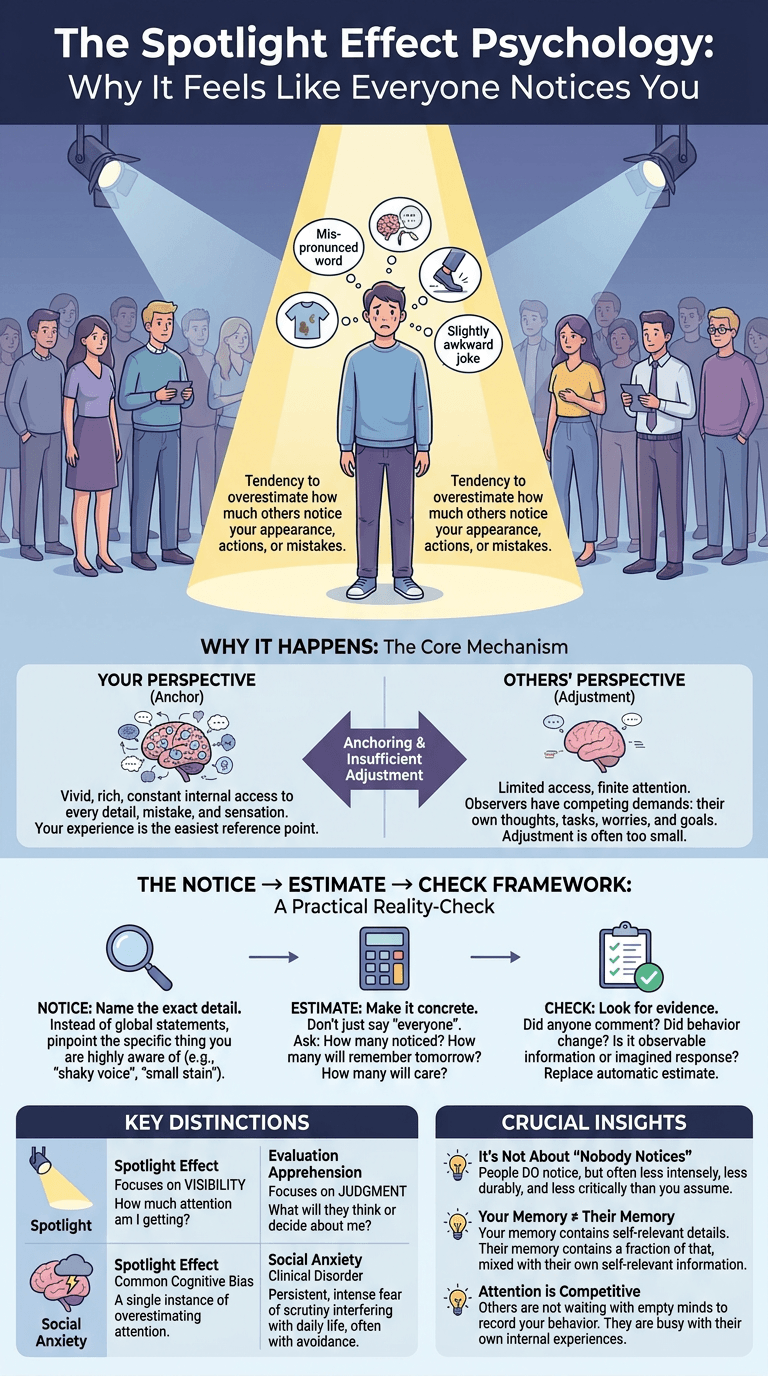
The spotlight effect is the tendency to overestimate how much other people notice your appearance, actions, mistakes, or performance. Your own experience feels vivid, so it can become the starting point for estimating what others saw. The correction is not “nobody noticed.” A better question is whether people noticed, remembered, and cared as much as you assume.
What the Spotlight Effect Means
The foundational research by Thomas Gilovich, Victoria Medvec, and Kenneth Savitsky found that people often overestimate how noticeable their actions and appearance are to other people. In one well-known set of studies, participants wearing a potentially embarrassing T-shirt predicted that more observers would remember the shirt than actually did. The researchers also found similar overestimation for how prominent people thought their own comments were during group discussion.
The concept is useful because it focuses on a specific estimate: how much attention are other people giving to me or to this feature of me? It is not a claim that other people are indifferent. It is not a diagnosis. It is not a rule that every social fear is exaggerated.
Overestimating other people’s attention to the self
Imagine walking into a room after spilling a small amount of coffee on your sleeve. The stain may dominate your awareness because you know exactly where it is, when it happened, and how much you dislike it. Someone across the room, however, is thinking about where to sit. Another person is checking the time. Someone else is worried about what they will say when it is their turn to speak.
Your internal experience and their external attention are not measured on the same scale. The stain can be highly salient to you while being only briefly noticed, or not noticed at all, by others. The spotlight effect concerns the tendency to underestimate that difference. Self-presentation asks what you choose to show an audience; the spotlight effect asks how much attention you believe that audience gave you.
Why the effect does not mean observers never notice anything
The most misleading use of the concept is reassurance that sounds like, “No one is paying attention to you.” That can be false. A bright outfit may attract attention. A loud mistake in a quiet room may be noticed. A major performance error can matter to an evaluator. A public post can reach thousands of people.
The better claim is probabilistic: people may systematically overestimate the amount, duration, or importance of attention directed toward them. That leaves room for real visibility. It also prevents the concept from being used to dismiss legitimate feedback or obvious social consequences.
Why Your Own Experience Feels So Visible
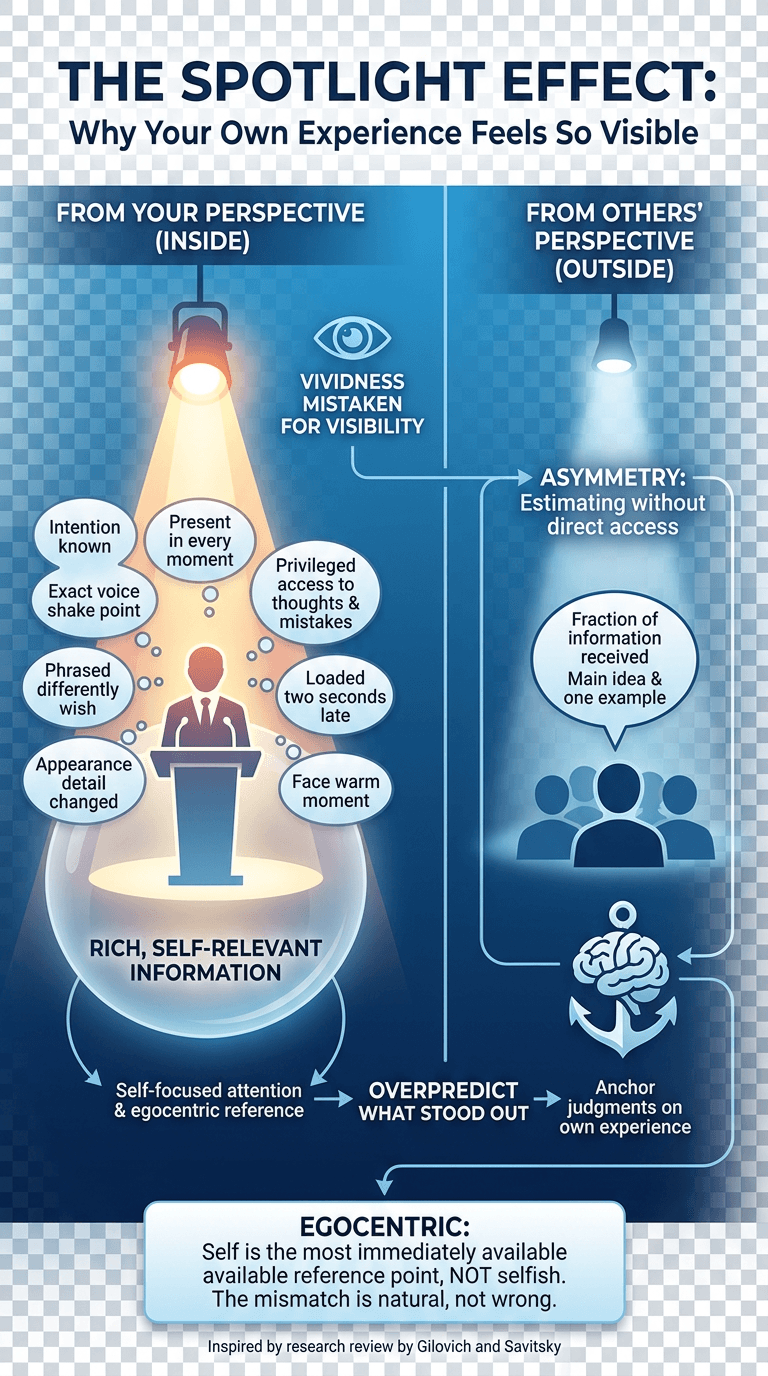
From your perspective, you are present in every moment you experience. You know the intention behind what you said, the exact point where your voice shook, the sentence you wish you had phrased differently, and the small detail of your appearance that changed that morning. Other people receive only a fraction of that information.
This asymmetry matters because people have to estimate what others see without having direct access to those other minds. The estimate often begins with what is easiest to access: their own experience.
Privileged access to your own thoughts, appearance, and mistakes
You know about details that observers may never have registered. After a presentation, for example, you may remember the slide that loaded two seconds late, the word you almost forgot, and the moment you felt your face become warm. An audience member may remember only the main idea and one example.
This does not mean your memories are wrong. It means they contain more self-relevant information than the audience had. When you use that richer information to estimate what was visible from the outside, it is easy to overpredict what stood out.
Self-focused attention and egocentric perspective
A research review by Gilovich and Savitsky described the spotlight effect as part of a broader pattern in which people anchor judgments of how they are seen on their own experience. “Egocentric” here does not mean selfish or arrogant. It means that the self is the most immediately available reference point.
When attention turns inward, the mismatch can feel even stronger. If you are monitoring your posture, voice, clothing, or mistakes, those details take up more mental space. Their vividness can then be mistaken for social visibility. A detail that occupies 40 percent of your attention does not necessarily occupy 40 percent of anyone else’s.
Anchoring on Your Own Awareness
A practical way to understand the mechanism is anchoring and adjustment. You begin from a highly informed internal viewpoint, then try to adjust for the fact that other people know less, see less, and have their own concerns. The adjustment may be too small.
Starting from what feels obvious to you
Suppose you answer a question in class and realize halfway through that you used the wrong term. To you, the error may feel impossible to miss because you know the correct term and can identify the exact second the mistake happened. When estimating what classmates noticed, you may start with that intense awareness.
But classmates did not begin with your internal anchor. One may have been writing notes. Another may have been thinking about whether they would be called next. A third may have understood your meaning and moved on before encoding the wording error at all.
Adjusting too little for how little other people know
The original spotlight-effect experiments supported this anchoring-and-adjustment account. People seemed to correct for the observer’s different perspective, but not enough. Later work also found that people can overestimate how much observers notice fluctuations in their performance or appearance. Research on the spotlight effect across changing actions and appearance suggests that observers are often more occupied with their own behavior than actors intuitively expect.
This helps explain why a small change can feel conspicuous. You see yesterday’s version and today’s version side by side in memory. A casual observer may see only today’s version, with no comparison available.
Everyday Situations Where the Spotlight Effect Appears
The effect becomes easier to recognize when it is tied to ordinary moments rather than treated as an abstract bias. The situations below share one feature: the person has unusually rich access to the detail they are worried about.
Clothing and appearance
You arrive at an event and realize you are dressed more casually than several other people. You may instantly scan the room for signs that people noticed. Because the mismatch feels important to you, each glance can look like evidence.
What it may mean: some people may notice the clothing difference, but noticing is not the same as prolonged attention or negative evaluation. The next useful step is to look for behavior that actually indicates sustained attention rather than treating ordinary eye contact as proof.
Small social errors and awkward moments
You call someone by the wrong name and correct yourself immediately. The error may replay in your mind because you feel embarrassed. You then assume the group also stored the moment as a meaningful social mistake.
What it may mean: people often encode the overall interaction more than a brief corrected slip. Research on social mishaps found that people sometimes expect others to judge their failures more harshly than observers actually do. A sensible next step is to distinguish the objective consequence from the amount of post-event attention you are giving it.
Public speaking and minor performance mistakes
During a talk, you lose your place for three seconds. Internally, the pause may feel very long because you are searching for the next point while also imagining what the audience thinks. Afterward, you may remember the pause more clearly than anything else you said.
What it may mean: an audience can notice a pause without defining the whole performance by it. Check whether feedback mentions the error, whether the main message still landed, and whether the mistake changed the outcome in a measurable way. If the question is whether an audience changed your actual performance, social facilitation is a closer fit than estimating how noticeable a pause felt.
Replaying events after they are over
The spotlight effect can continue after the room is empty. Rehearsing a moment repeatedly makes it easier for you to retrieve, which can create a false sense that it must also remain vivid for everyone else.
What it may mean: repetition in your mind is evidence of your attention, not evidence of someone else’s memory. The next step is to ask what information you actually have about how other people responded after the event.
The NOTICE → ESTIMATE → CHECK Framework
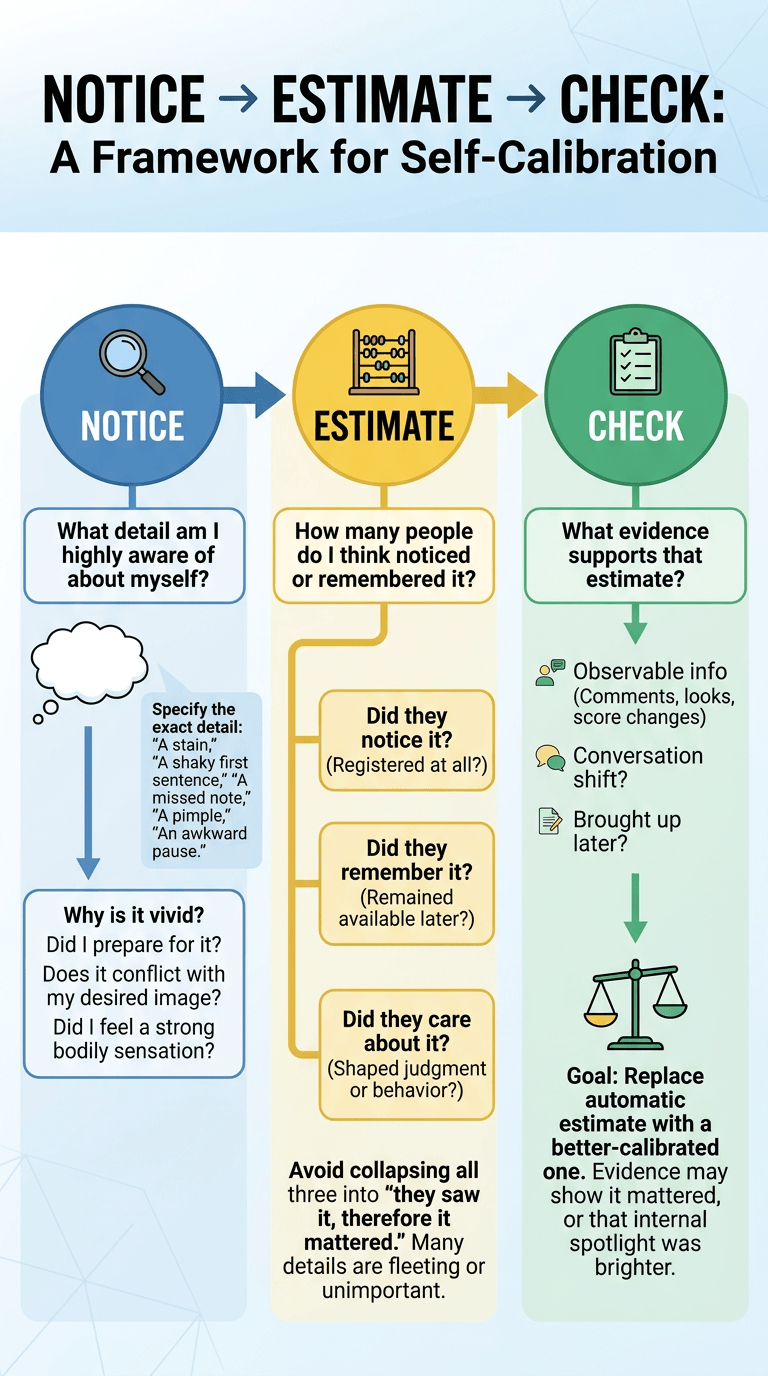
A useful self-check should not force a positive answer. It should improve the estimate. The three-step framework below is designed to separate your internal salience from evidence about other people’s attention.
NOTICE: What am I highly aware of about myself?
Name the exact detail instead of using a global statement such as “Everyone could tell I was a mess.” The detail might be a stain, a shaky first sentence, a missed note, a pimple, an awkward pause, or a moment when you walked into the wrong room.
Then ask why that detail is especially vivid to you. Did you prepare for the moment? Does it conflict with how you wanted to look? Did you feel a strong bodily sensation? Did you notice it before anyone else had a reason to?
ESTIMATE: How many people do I think noticed or remembered it?
Make the estimate concrete. “Everyone noticed” is difficult to test. “I think eight of the ten people noticed the mistake and will remember it tomorrow” is much clearer.
It can also help to split the estimate into three levels:
| Question | What it asks | Why the distinction matters |
|---|---|---|
| Did they notice it? | Was the detail registered at all? | A brief glance or awareness may be enough. |
| Did they remember it? | Did it remain available later? | Many noticed details disappear quickly. |
| Did they care about it? | Did it meaningfully shape judgment or behavior? | Attention does not automatically equal importance. |
A person may notice your stumble, forget it by lunch, and never attach a negative judgment to it. Collapsing those three steps into “they saw it, therefore it mattered” exaggerates the social impact.
CHECK: What evidence supports that estimate?
Look for observable information. Did someone comment? Did several people look back at the detail? Did the evaluator lower a score? Did the conversation change? Did anyone bring it up later? Or are you filling the silence with an imagined audience response?
The goal is not to argue yourself into certainty that nothing happened. It is to replace an automatic estimate with a better-calibrated one. Sometimes the evidence will show that the event mattered. Sometimes it will show that your internal spotlight was brighter than the external one.
What I Notice vs What Others May Notice
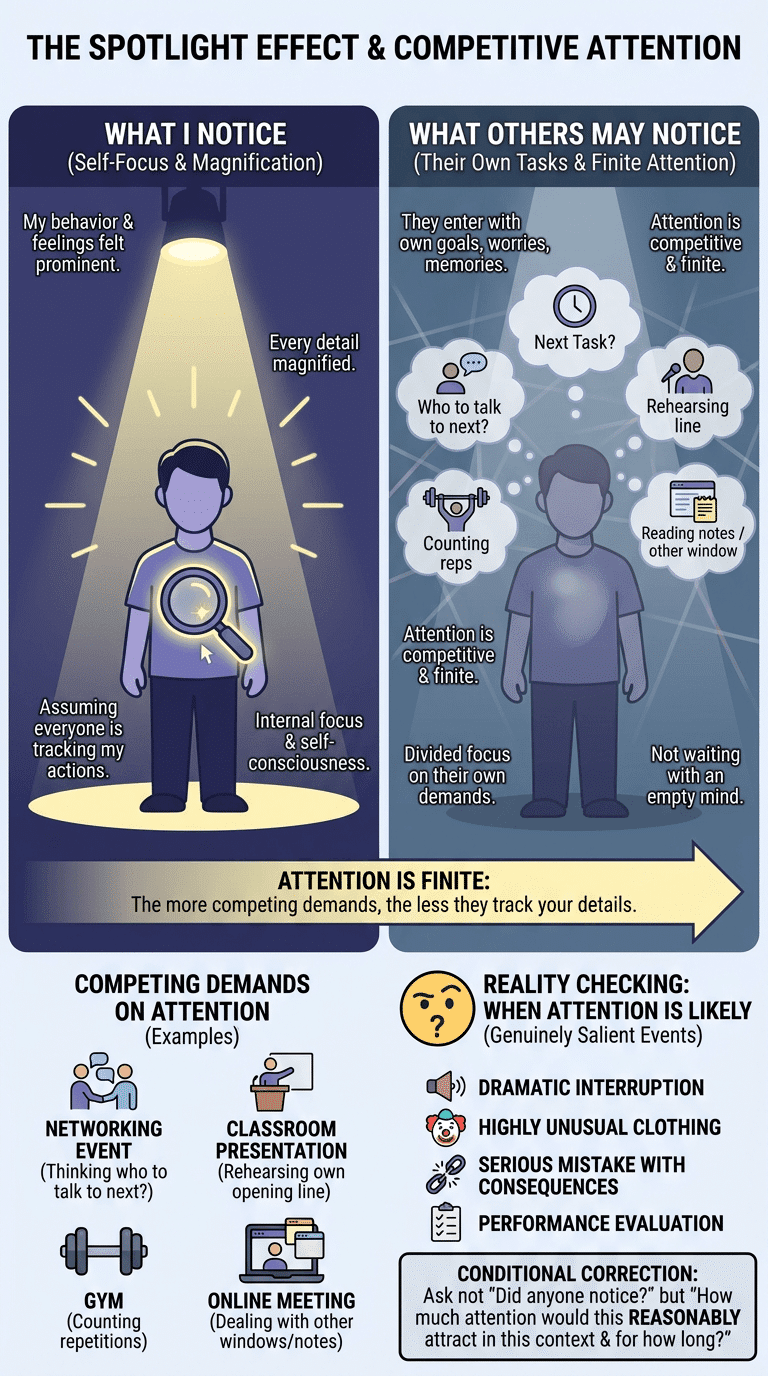
The spotlight effect becomes easier to correct when you remember that attention is competitive. Other people do not enter a situation with an empty mind waiting to record your behavior. They bring their own tasks, worries, goals, memories, and self-consciousness.
Competing demands on other people’s attention
At a networking event, one person may be thinking about whom to talk to next. At a classroom presentation, another student may be rehearsing their own opening line. In a gym, someone nearby may be counting repetitions. In an online meeting, participants may be reading notes or dealing with another window on their screen.
This is not proof that you are invisible. It is a reminder that attention is finite. The more competing demands observers have, the less reasonable it is to assume they tracked every detail that felt prominent to you.
When the event is genuinely salient or memorable
Reality checking also requires recognizing situations where attention is likely. A dramatic interruption, highly unusual clothing, a serious mistake with consequences, or a performance where the audience is explicitly instructed to evaluate you may be genuinely salient.
The right correction is therefore conditional. Ask not “Did anyone notice?” but “How much attention would this event reasonably attract in this context, for this audience, and for how long?” That keeps the concept connected to evidence rather than reassurance.
Spotlight Effect vs Evaluation Apprehension
These concepts often appear together because both involve imagining an audience. They separate at the question being asked.
| Concept | Main question | Typical concern |
|---|---|---|
| Spotlight effect | How much are people noticing me? | Visibility and attention |
| Evaluation apprehension | What will people think or decide about me? | Judgment and consequences |
Visibility estimate versus concern about judgment
You can experience a spotlight effect without expecting harsh judgment. You may simply believe everyone noticed your new haircut. You can also experience evaluation apprehension without strong spotlight thinking. An examiner may be the only person watching, yet their judgment matters greatly.
This distinction is useful because the practical question changes. A visibility estimate calls for evidence about attention. A judgment concern calls for clarity about criteria, stakes, and what the evaluator is actually assessing.
How both can occur at the same time
Suppose you stumble over a sentence during a job presentation. You may think, “Everyone noticed that,” which is a visibility estimate. You may then think, “They will decide I am unprepared,” which is a judgment prediction. The first can amplify the second, but they are still separate inferences.
Separating them creates two places to reality-check. How many people likely noticed the stumble? And among those who noticed, what evidence suggests they interpreted it as a sign of poor preparation?
Spotlight Effect vs Social Anxiety
The spotlight effect is a common social-cognitive bias. Social Anxiety Disorder is a clinical condition with a much broader pattern. Confusing the two can either pathologize ordinary self-consciousness or minimize distress that is genuinely impairing.
A common cognitive-social bias versus a clinical disorder
The National Institute of Mental Health describes Social Anxiety Disorder in terms of intense fear of scrutiny or judgment that persists and interferes with daily life. A single episode of feeling watched after an awkward moment does not establish that condition.
At the same time, a person with significant social anxiety may also experience spotlight-like estimates. The presence of one bias does not explain the whole clinical picture, and correcting one estimate may not address persistent avoidance, intense fear, or impairment.
Why one effect does not explain every fear of scrutiny
Sometimes a person is accurately aware that they are being watched. A performer is watched. A student giving an oral exam is evaluated. A person being photographed is visible. The problem, if there is one, may lie in predicted judgment, physiological fear, avoidance, prior experiences, or other processes rather than in overestimating attention.
This is why the spotlight effect should be used as one lens, not as a universal explanation for discomfort in public.
Spotlight Effect vs Social Perception
The direction of attention separates these topics. Social perception concerns how an observer interprets another person. The spotlight effect concerns how the person being observed estimates the observer’s attention.
Actor estimating observer attention versus observer interpreting another person
Imagine you give a short answer in a group discussion. Social perception asks how another person interprets your tone, confidence, or intention. The spotlight effect asks how much you think that person noticed your answer in the first place.
Keeping the actor and observer sides separate prevents a common mistake: assuming that because you are thinking intensely about how you appeared, everyone else must also have been constructing a detailed interpretation of you.
Practical Evidence Checking After an Awkward Moment
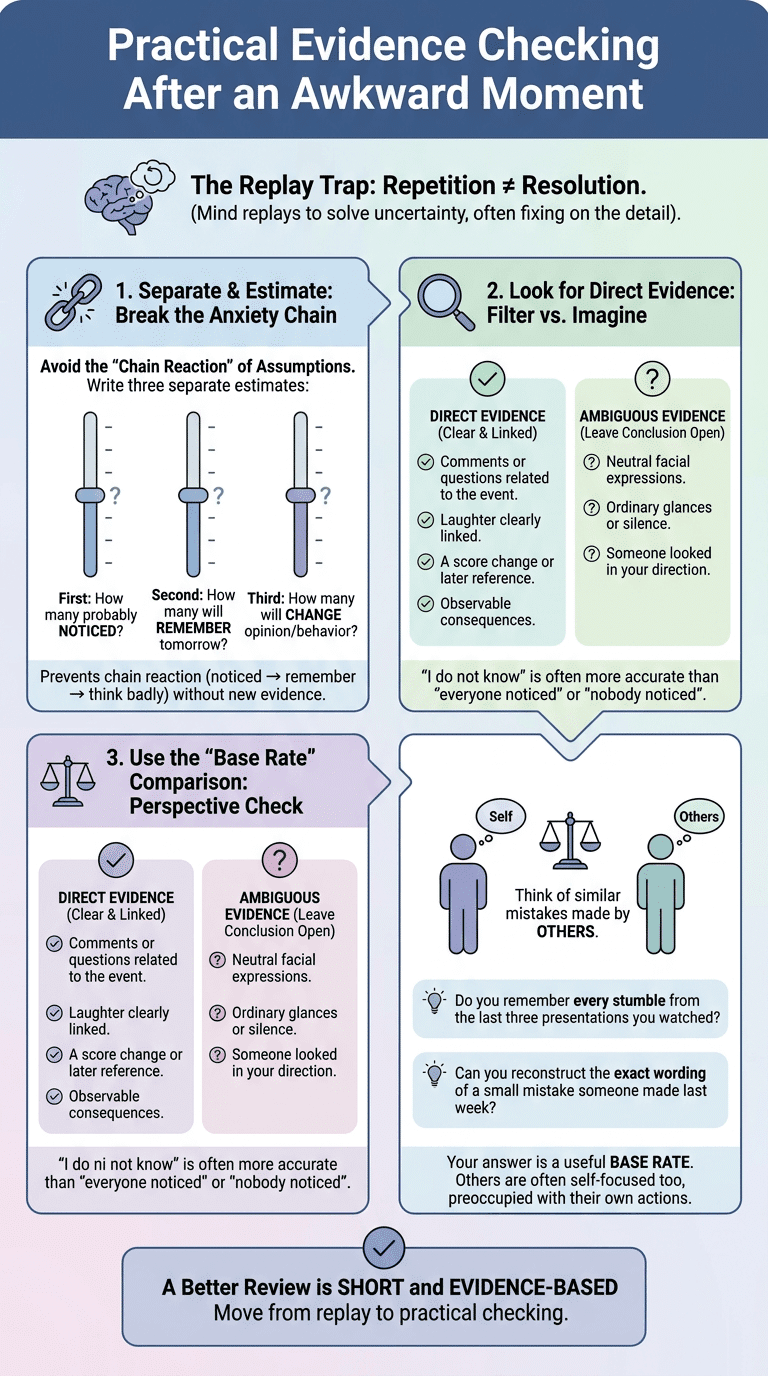
After a social mistake, the mind often tries to solve uncertainty by replaying the event. Repetition can feel productive, but it may simply keep your own attention fixed on the detail. A better review is short and evidence-based.
Separate noticing from remembering and caring
Write three separate estimates. First, how many people probably noticed? Second, how many are likely to remember tomorrow? Third, how many would reasonably change their opinion or behavior because of it?
This prevents a chain reaction in which one glance becomes “they noticed,” then “they will remember,” then “they think badly of me,” without new evidence at each step.
Look for direct evidence instead of imagined audience reactions
Direct evidence includes comments, questions, laughter clearly linked to the event, a score change, a later reference, or observable consequences. Ambiguous evidence includes neutral facial expressions, ordinary glances, silence, or the fact that someone looked in your direction.
When evidence is ambiguous, leave the conclusion partly open. “I do not know how much they noticed” is often more accurate than either “everyone noticed” or “nobody noticed.”
Ask how much attention you gave comparable mistakes made by others
Think of a similar moment involving someone else. Can you remember every stumble from the last three presentations you watched? Do you remember what each person wore? Can you reconstruct the exact wording of a small mistake someone made last week?
Your answer is not proof about the current audience, but it provides a useful base rate. Other people are often living from a first-person perspective too, which means they may be more occupied with their own actions than your self-focused estimate assumes.
When Visibility Concern Is Not Just a Spotlight-Effect Question
Self-checking has limits. If fear of being noticed becomes persistent, causes major avoidance, interferes with school or work, severely restricts relationships, or produces intense body-image distress, the issue deserves more than a quick cognitive correction.
Severe persistent fear, avoidance, impairment, or body-image distress
Consider individualized professional support when concerns about scrutiny repeatedly stop you from doing important activities, produce substantial distress, or keep expanding despite reasonable evidence. A qualified clinician can assess the broader pattern rather than assuming that every visibility concern comes from the spotlight effect.
If self-consciousness is tied to self-harm thoughts or immediate safety concerns, seek urgent local support rather than relying on self-help techniques alone.
FAQ About the Spotlight Effect
These questions address common points of confusion without turning a normal social-cognitive tendency into a diagnosis.
Does the spotlight effect mean nobody notices me?
No. Other people may notice your appearance, actions, or mistakes, especially when something is unusual, highly visible, or relevant to what they are doing. The spotlight effect refers to overestimation, not guaranteed invisibility. A more accurate question is whether the amount and importance of attention match your estimate.
Why do embarrassing mistakes feel more visible than they are?
Embarrassing mistakes are vivid because you experience the event, your emotional reaction, and your interpretation at the same time. That rich internal information can become the anchor for estimating what others saw. Observers usually have less information and competing demands on their attention.
Is the spotlight effect the same as social anxiety?
No. The spotlight effect is a bias in estimating attention. Social Anxiety Disorder involves a broader and clinically significant pattern of fear related to scrutiny or judgment, often with persistent avoidance or impairment. A person can experience the spotlight effect without having an anxiety disorder.
How is it different from evaluation apprehension?
The spotlight effect asks how much other people are noticing you. Evaluation apprehension asks what you expect those people to think, rate, or decide. You can experience both after the same event, but separating visibility from judgment makes each assumption easier to examine.
Can the spotlight effect happen online?
Yes, perceived visibility can also be distorted in digital settings. Online feedback may make attention feel unusually measurable because views, likes, comments, and follower counts are visible. Recent peer-reviewed work has explored how online attention can influence later spotlight-related estimates. The size of an online audience still does not tell you how deeply each person noticed, remembered, or cared about a specific detail.
Key Takeaways
- The spotlight effect is the tendency to overestimate how much other people notice your appearance, actions, mistakes, or performance.
- Your own experience is unusually vivid, which can become an anchor when estimating an observer’s attention.
- “They noticed,” “they remembered,” and “they cared” are three different claims and should be checked separately.
- Evaluation apprehension concerns expected judgment, while the spotlight effect concerns estimated visibility.
- The effect does not mean nobody notices you. Real salience, direct evaluation, and obvious consequences still matter.
- A useful next step after an awkward moment is NOTICE → ESTIMATE → CHECK: name the detail, make the attention estimate concrete, then compare it with observable evidence.

Michael Reed is the Founder and Lead Writer at Psychology Exposed. He writes about human behavior, relationships, emotional patterns, self-awareness, and practical psychology topics using research-informed, easy-to-understand content.
Read More About Michael Reed: https://psychologyexposed.com/michael-reed/